A test and demonstration facility operated by South Africa’s main utility Eskom will trial Primus Power’s flow batteries, after a local developer was awarded a grant for the project by the US Trade and Development Agency (USTDA).
USTDA, which establishes US commercial interests and advances economic development in developing and middle-income global economies, had held a proposal window for energy projects in Sub-Saharan Africa. Obviously while assisting those emerging nations is a priority, USTDA seeks to create export opportunities for US companies.
USTDA makes so-called “sole source” grants, where it pays for the entire capital cost of a feasibility study, pilot or demonstration programme if a local company has identified an appropriate US firm that is both able and interested in USTDA-related activities.
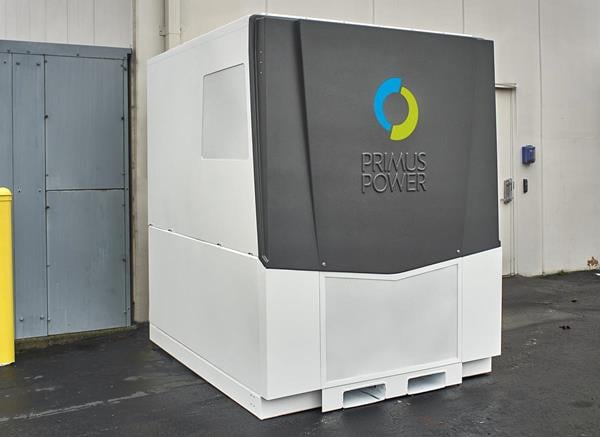
South African utility-scale solar PV developer Solafrica Energy has been awarded a grant, for an unspecified sum, to deploy energy storage systems based on Primus Power’s EnergyPod2 solution, which is centred around zinc-bromine flow batteries.
Try Premium for just $1
- Full premium access for the first month at only $1
- Converts to an annual rate after 30 days unless cancelled
- Cancel anytime during the trial period
Premium Benefits
- Expert industry analysis and interviews
- Digital access to PV Tech Power journal
- Exclusive event discounts
Or get the full Premium subscription right away
Or continue reading this article for free
Unlike the more commonly used lithium-ion batteries, flow batteries can be used for storing energy for over the four or five hours that constitute the upper limit for lithium, without compromising the economics of a project. Most flow battery systems can be scaled up in size simply by adding more liquid electrolyte, as opposed to solid hardware and extra battery cells that lithium would require.
Primus CEO: South Africa trial will demonstrate tech in ‘real world grid conditions’
Tom Stepien, Primus Power’s CEO, told Energy-Storage.News on Wednesday that the USTDA grant, “funds the demonstration of multiple EnergyPod 2 systems in the real world grid conditions in South Africa”.
“South Africa’s stationary energy storage applications including renewables integration and peak load reduction require multiple hours of discharge,” Stepien said, to which he argued that flow batteries are better suited to these types of high energy functions, as opposed to the high power functions which lithium-ion copes better with.
Solafrica’s pilot will seek to determine where on South Africa’s grid network would benefit most from the deployment of batteries, before formulating a plan for further, large-scale deployment of Primus Power batteries. Not only will increasing amounts of energy storage help integrate renewables and increase grid capacity, it will also offset diesel fuel consumption. Diesel is used for backup and to provide peaking power in many parts of the country. This summer, Eskom said it had identified a need for 2,000MW of energy storage to balance and firm up the grid across South Africa, as the utility opened its test and demonstration centre at an existing research and innovation centre in Rosherville, Johannesburg.
“South Africa’s rapid increase in renewable energy integration has introduced challenges related to intermittent power generation. Innovative and cost-effective energy storage solutions will add great value to energy users and electricity network operators alike,” Solafrica Energy project director Nasi Rwigema said.
“USTDA is pleased to support this project that will increase energy storage capacity in South Africa and ultimately expand access to affordable, reliable electricity,” Sub-Saharan Africa regional director for USTDA, Lida Fitts said.
“The project will display the value and applications of innovative US technologies in a growing and important sector in South Africa.”
Primus Power counts early-Tesla backer and executive board member Nancy Pfund of social impact investment group DBL Partners among its investors. In a recent interview, Pfund said it was significant that Microsoft is among commercial entities to be trying out Primus Power flow batteries at the software giant’s HQ. The zinc bromine flow battery maker recently also struck a manufacturing deal with Taiwan-headquartered Foxconn, assembler of Apple’s consumer electronics products including the iPhone.
USTDA meanwhile is still accepting initial proposals for companies in Sub-Saharan Africa or US companies with African partners for energy projects, with the application window closing on 25 September.