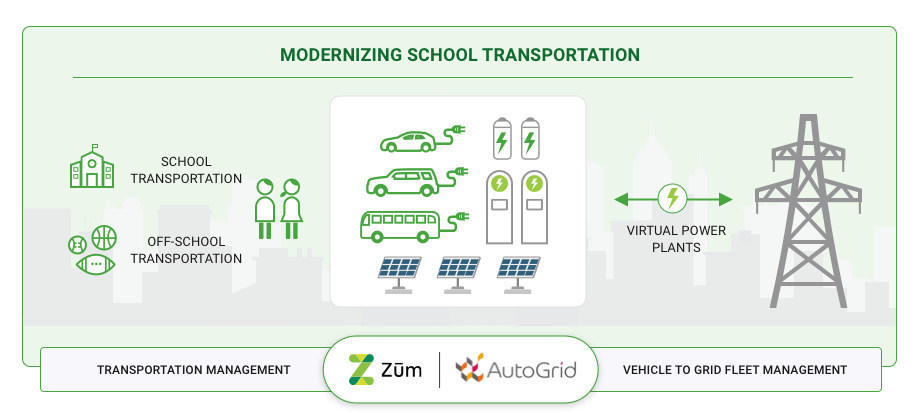
Electric school buses in the US could be turned into a virtual power plant (VPP) resource, through a new partnership between student transport supplier Zum Services and artificial intelligence-driven distributed energy software company AutoGrid.
The pair announced yesterday that over the next four years, they want to use the batteries of 10,000 new electric school buses — equivalent to more than 1GW of electricity — as an aggregated resource that can be used to help balance the supply and demand of energy on the grid.
The majority of the US’ estimated half a million school buses used today run on diesel. With the Biden-Harris presidential administration proposing to invest US$25 billion in electrifying school buses in its major infrastructure bill, Zum and AutoGrid have spotted an opportunity to create an even greater net benefit than the tonnes of carbon emissions each year that every new electric buses will save.
California-headquartered AutoGrid’s software platform enables the smart integration of various types of distributed energy resources. The company has partnered with a wide range of stakeholders in the energy industry, from solar and storage providers like Sunrun in the US to tech comglomerate Fujitsu in Japan to create various virtual power plant configurations which can perform frequency response and other grid services and energy flexibility management options like demand side response.
Try Premium for just $1
- Full premium access for the first month at only $1
- Converts to an annual rate after 30 days unless cancelled
- Cancel anytime during the trial period
Premium Benefits
- Expert industry analysis and interviews
- Digital access to PV Tech Power journal
- Exclusive event discounts
Or get the full Premium subscription right away
Or continue reading this article for free
Rahul Kar, AutoGrid’s general manager of new energy, said that school buses are “an ideal resource” for being part of a virtual power plant, since they have predictable daily schedules and are mostly only used for a few hours each day, taking students to and from schools. In other words, there will be set periods of times when availability of those battery resources can be guaranteed each day.
“Virtual power plants play a crucial role in providing stability to a renewable-powered grid and the extra revenues from these grid services enable school districts and EV fleet owners to reduce the total cost of ownership as they strive to meet their sustainability goals,” Kar said.
Zum meanwhile will supply the vehicles, building on relationships it has in the US with over 4,000 schools and school districts. The company works to help its customers optimise their fleets to be the right size and their transportation routes to be the most economical to run while maximising route coverage.
“We’re committed to making it easy for districts to evolve their fleets to 100% electric through a powerful combination of technology and innovation,” Zum’s president and chief operating officer Vivek Garg said.
“Beyond that, we are taking vehicles that have traditionally spent the majority of their lifetime stalled or parked and expanding their use in multiple ways — from leveraging them for trips beyond home-to-school routes to optimising the electric grid.”
Read Autogrid general manager for new energy, Rahul Kar’s article for PV Tech Power Vol.23, ‘Optimising DERs: Artificial intelligence and the modern grid’, which was re-published last year in June on this website.