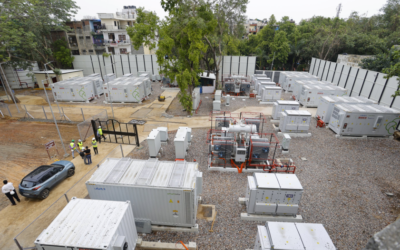
TERNA, operator of Italy’s electricity transmission system, is set to open up a pilot scheme in which up to 230MW of aggregated nominal capacity including energy storage could supply frequency and voltage services to the grid.
The grid operator opened up a consultation period for stakeholders on the roll-out of up to 230MW of Fast Reserve Unit (FRU) pilot projects. The stakeholder comment period closed on 24 January. Law firm Eversheds Sutherlands, which issues regular clean energy market briefings, said it is possible those comments may lead to a second period of consultation.
“FRU is distinct from primary reserve but works alongside it. FRU provides a continuous and automatic response proportional to the frequency error within 1 second after the event triggering the requirement for fast reserve. Power has to be maintained for 30 seconds after being triggered and decreases to zero within 5 minutes,” Eversheds Sutherlands’ note said.
Traditionally, thermal generation plants have provided all-important grid-balancing services such as reduction of regulating power needed to keep frequency and voltage “within defined security limits”, TERNA said in a note issued to explain the pilot scheme and the needs which it will serve.
Try Premium for just $1
- Full premium access for the first month at only $1
- Converts to an annual rate after 30 days unless cancelled
- Cancel anytime during the trial period
Premium Benefits
- Expert industry analysis and interviews
- Digital access to PV Tech Power journal
- Exclusive event discounts
Or get the full Premium subscription right away
Or continue reading this article for free
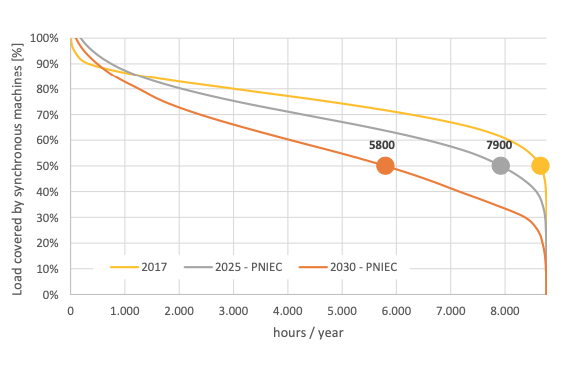
The growth in variable renewable energy sources on the grid means that the need for these services increases, while reducing the number of mostly fossil fuel-powered generators that have provided them in the past. In addition to frequency and voltage control through regulating power, TERNA said, the reduction of these thermal power plant rotating masses – also known as synchronous machines – means that there is a corresponding decrease in inertia on the grid (handily explained by this past Guest Blog post from energy storage tech provider Fluence’s market director Dr Marek Kubik on this site).
The evening ramp, when solar generation goes offline and evening peak demand increases, is also targeted by the introduction of grid service units, while grid congestion can also be relieved by technologies including energy storage, along with demand response.
To stay in line with EU 2030 climate and clean energy targets, TERNA said, Italy’s National Energy and Climate Plan (NECP) foresees an increase of renewable energy capacity on the grid to 40GW by 2030, with renewable sources expected to “cover roughly 55% of electricity demand by then”, with solar and wind comprising around 34% of total consumption.
“To ensure frequency stability it is therefore necessary to introduce a grid service characterised by a full activation time below the one of primary reserve. This ‘Fast Reserve’ service will not replace the primary reserve but complement it, thus contributing to grid security by improving the dynamics of the system response to disturbances,” TERNA said in the note (which can be found here), adding that the decommissioning of coal, which is about to start in Italy, means the Fast Reserve service will “already be beneficial in the next few years”.
Eversheds Sutherlands noted that the permitting timetable is expected to be concluded by the second quarter of 2020, while expected pricing for these services will be €78k (US$86.98k) per MW and €108k per MW, with “limited scope for private stakeholders to take part in [the] auction”.
TERNA has already opened up numerous market-based opportunities for energy storage through monthly auctions, including aggregated distributed storage units such as residential to play a role in balancing the grid through other mechanisms.