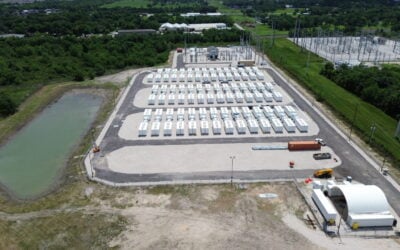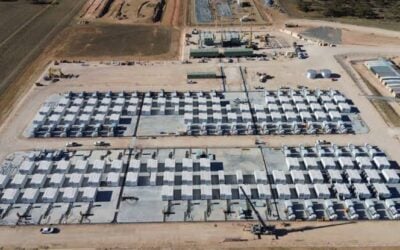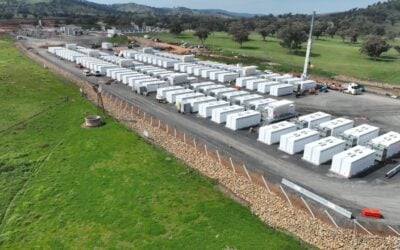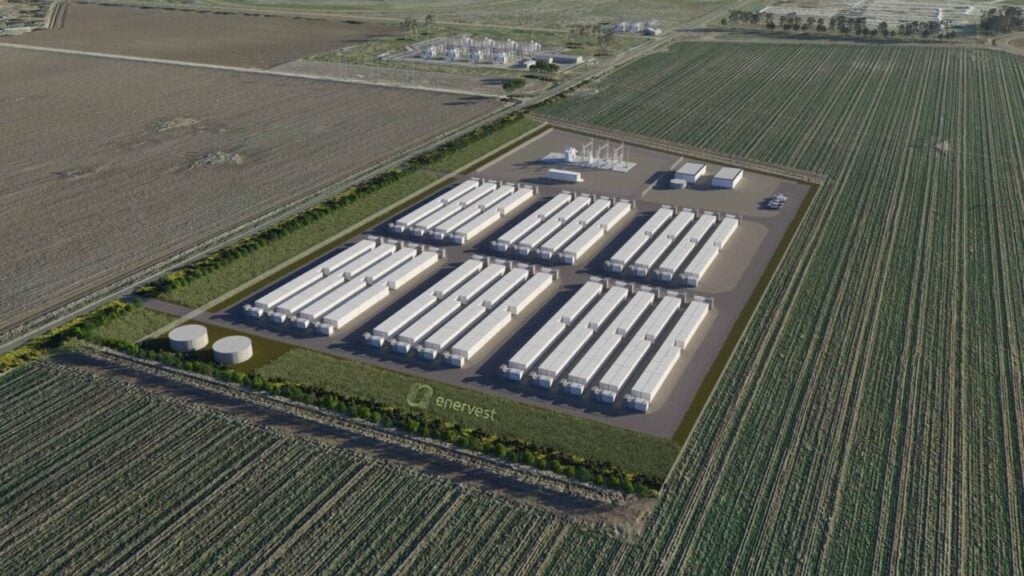
Australian energy storage developer Enervest has acquired the Northern Border Battery, a 300MW battery storage development project, from an unnamed Sydney-based developer.
The battery energy storage system (BESS) project, located on the New South Wales-Queensland border and connecting into the Dumaresq substation, will be one of the first assets retained under Enervest’s own-and-operate model.
Indeed, the acquisition marks a shift for the company, which has primarily focused on developing third-party-owned projects across its existing portfolio of utility-scale and sub-5MW projects in the National Electricity Market (NEM).
The duration nor the price of the battery storage system has not been disclosed at the time of writing.
Try Premium for just $1
- Full premium access for the first month at only $1
- Converts to an annual rate after 30 days unless cancelled
- Cancel anytime during the trial period
Premium Benefits
- Expert industry analysis and interviews
- Digital access to PV Tech Power journal
- Exclusive event discounts
Or get the full Premium subscription right away
Or continue reading this article for free
Early works have commenced, with site access and public intersection upgrades completed. Enervest confirmed the project is advancing through the connection application process with Transgrid and the Australian Energy Market Operator (AEMO), with construction expected to begin in early 2028.
Enervest CEO Ross Warby said the acquisition “represents a very significant milestone in Enervest’s long-term own-and-operate strategy and underscores our focus on attractive, high-quality, investible projects that deliver lasting benefits.”
He added that the company would work closely with Indigenous communities, local councils, and community groups to ensure the project delivers social, economic and cultural outcomes for the region.
The Northern Border Battery forms part of a broader wave of utility-scale storage deployment across New South Wales, driven in part by the scheduled closure of the Eraring Power Station in April 2029, Enervest noted.
At 2,880MW, Eraring is Australia’s largest coal-fired power station, and its retirement will remove a substantial baseload generation source from the New South Wales grid.
It is worth noting that Origin Energy, the owner of the Eraring Power Station, is currently transitioning the site into a utility-scale battery storage system.
The company began generating revenue in January 2026 from the first stage of its Eraring battery storage project, a 460MW/1,770MWh system with approximately 3.8 hours of discharge capability. A second stage is expected online in early 2027, bringing total capacity to 700MW/3,160MWh.
Enervest cited projections that more than 27GW of grid-scale storage will be required by 2030 to maintain system reliability, flexibility, and security during the energy transition.
Australia commissioned 4.9GWh of grid-scale battery energy storage in 2025 alone, matching the combined output from 2017 to 2024, according to the Clean Energy Council.
Enervest’s previous battery storage dealings
Enervest made headlines in the previous year for selling numerous utility-scale battery energy storage projects to various companies.
Earlier this year, Enervest sold the proposed 1.2GW/4.8GWh Hanworth Battery Energy Storage System near Bannaby, west of Bowral in New South Wales, to Octopus Australia.
Octopus acquired the project, citing that it is Australia’s “largest planned battery storage system”.
Prior to this, in August 2025, Enervest made headlines by selling the 125MW/1,000MWh Stoney Creek BESS to energy storage developer and system integrator Energy Vault.
The company announced the acquisition of the 8-hour duration BESS after receiving approval from the country’s Foreign Investment Review Board (FIRB). Initial plans to acquire the BESS first emerged in March 2025.
As previously reported by Energy-Storage.news, the Stoney Creek BESS was awarded a 14-year Long-Term Energy Service Agreement (LTESA) under Roadmap Tender Round 5 for long-duration energy storage (LDES).
Before the acquisition, Energy Vault penned a deal with Enervest to supply its X-Vault integration platform and its UL9540 and AS3000 certified B-VAULT product for the Stoney Creek BESS. The organisation also said it would utilise its Vault-OS Energy Management System to control, manage and optimise the BESS operations.
Interested in Australia? Read Energy-Storage.news’ Energy Storage Summit Australia coverage and related content.