A bill aimed at creating a pilot programme to incentivise energy storage deployment in New Jersey has advanced through the US state’s legislature after senators voted in its favour.
The state Senate’s Energy and Environment Committee voted narrowly, 3-2, in favour of taking forward a bill sponsored by the committee’s chair Bob Smith and vice-chair Linda Greenstein.
The bill, S-225, would establish incentives for energy storage systems which could support New Jersey’s transition from centralised fossil fuel generation to a more distributed and localised system which could integrate more renewable energy while enhancing the stability of the grid.
The bill therefore is at a relatively intermediate or even early stage of passing through the state legislature, with both Houses having to vote on the bill and pass it with or without amendments before it goes to the desk of the state governor to be signed into law.
Try Premium for just $1
- Full premium access for the first month at only $1
- Converts to an annual rate after 30 days unless cancelled
- Cancel anytime during the trial period
Premium Benefits
- Expert industry analysis and interviews
- Digital access to PV Tech Power journal
- Exclusive event discounts
Or get the full Premium subscription right away
Or continue reading this article for free
However, it can certainly be seen as progress from the stalled position New Jersey finds itself in when it comes to energy storage deployment.
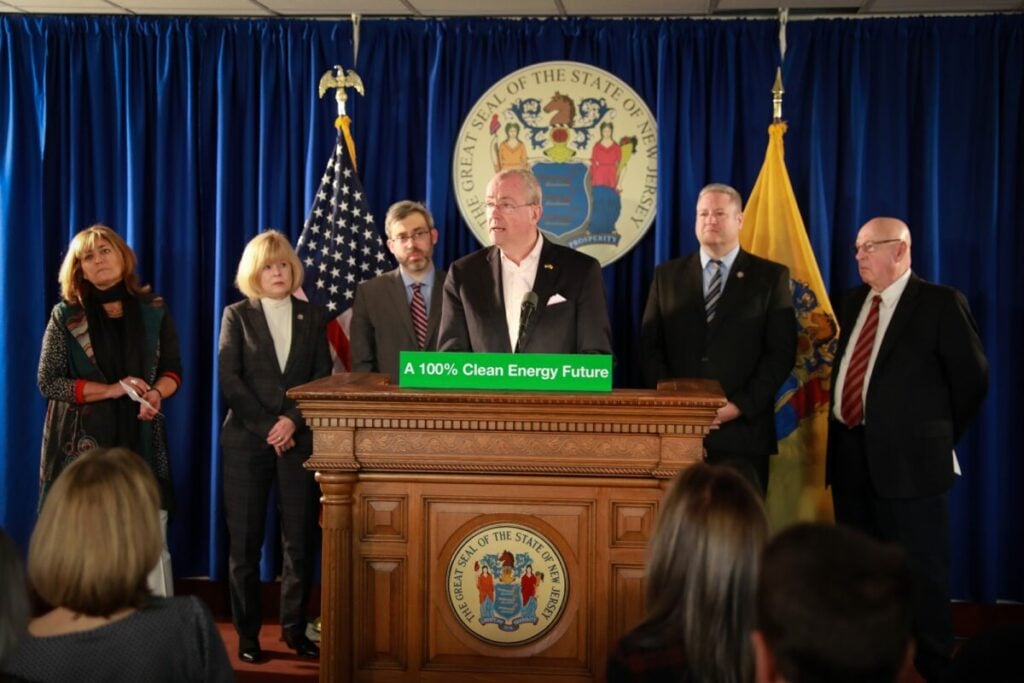
Back in 2018, it became one of the first states in the US to adopt any sort of energy storage target policy or goal, introduced as Governor Phil Murphy signed the New Jersey Clean Energy Act. It not only committed the state to 100% clean energy by 2050 but also put in place storage procurement goals of 600MW by 2021 and 2GW by 2030.
2021 came and went, and as of late 2022, when a drafted straw proposal for an incentive programme was floated by New Jersey Board of Public Utilities staff, the Garden State still had only 497MW of grid-connected large-scale storage, 420MW of which was contributed by a single pumped hydro energy storage (PHES) facility.
The slow progress was explained in a 2020 interview with then-policy director at the Energy Storage Association (ESA), Jason Burwen, who discussed the difference between the states that have set energy storage targets as policies with follow-through mechanisms in place to make them happen, and what could be called aspirational goals without those mechanisms.
Burwen, now with battery energy storage system (BESS) developer Gridstor, was speaking at a time when New Jersey was one of seven US states with any sort of storage target or goal in place and needless to say, Jersey was among those in the latter category, of those lacking follow-through mechanisms.
There are now at least 10 states with such goals, and even some states without explicit policy support, notably, Texas, are seeing far more storage deployed than utilities or developers in New Jersey are. Recognising it was falling behind, the Board of Public Utilities opened a Request for Information (RFI) on its proposals in August last year.
Senator Bob Smith said as the bill passed the committee vote that energy storage systems “are an absolutely essential component of our transition to clean energy, and we should do everything we can to support their deployment”.
“This bill will help incentivise their implementation and expansion, and in doing so help us accomplish our wider clean energy goals,” vice-chair Linda Greenstein said.
‘Benefits cannot be understated’
S-225 would direct the Board of Public Utilities (BPU) to create a pilot programme offering both upfront incentives for storage systems and performance-based incentives. Upfront incentives as proposed would be provided in dollars per kilowatt-hour (kWh) and not exceed 40% of the all-in cost of the project.
Performance incentives meanwhile would be paid based on the value the storage resources provide across various metrics and to different stakeholders. This would include supporting the transmission and distribution (T&D) network and mitigating peak demand, increasing resiliency by adding backup and enabling the further deployment of distributed energy resources (DERs).
These would apply to both behind-the-meter (BTM), customer-sited storage and front-of-the-meter (FTM) utility storage and to standalone storage facilities as well as those paired with renewables.
Storage systems would connect to the grid and wholesale markets of PJM Interconnection.
The BPU would have to direct at least US$60 million a year in funding towards the programme for the duration of the pilot, and within a year of its establishment, the regulators would have to send information to the legislature and governor about the incentives and the programme’s cost, as well as an evaluation of its effectiveness in supporting energy storage deployments.
The bill describes encouraging the adoption of energy storage as “fitting, proper and in the public interest,” and supporting it with incentives until barriers to free market deployment have come down.
The pre-filed text of S-225 can be viewed here at the state legislature’s website (online PDF).
“The benefits of energy storage systems cannot be understated,” Smith said.
“They enable wider application of clean, renewable energy, they can be used to protect from power disruptions at hospitals or personal homes, and they can reduce energy costs by charging during low-demand, low-cost hours and discharging when demand on the wider electrical grid is higher.”
Greenstein noted that storage systems “have a litany of benefits, and represent a promising way to reduce energy costs as we transition away from fossil fuels.”
Energy-Storage.news’ publisher Solar Media will host the 6th Energy Storage Summit USA, 19-20 March 2024 in Austin, Texas. Featuring a packed programme of panels, presentations and fireside chats from industry leaders focusing on accelerating the market for energy storage across the country. For more information, go to the website.