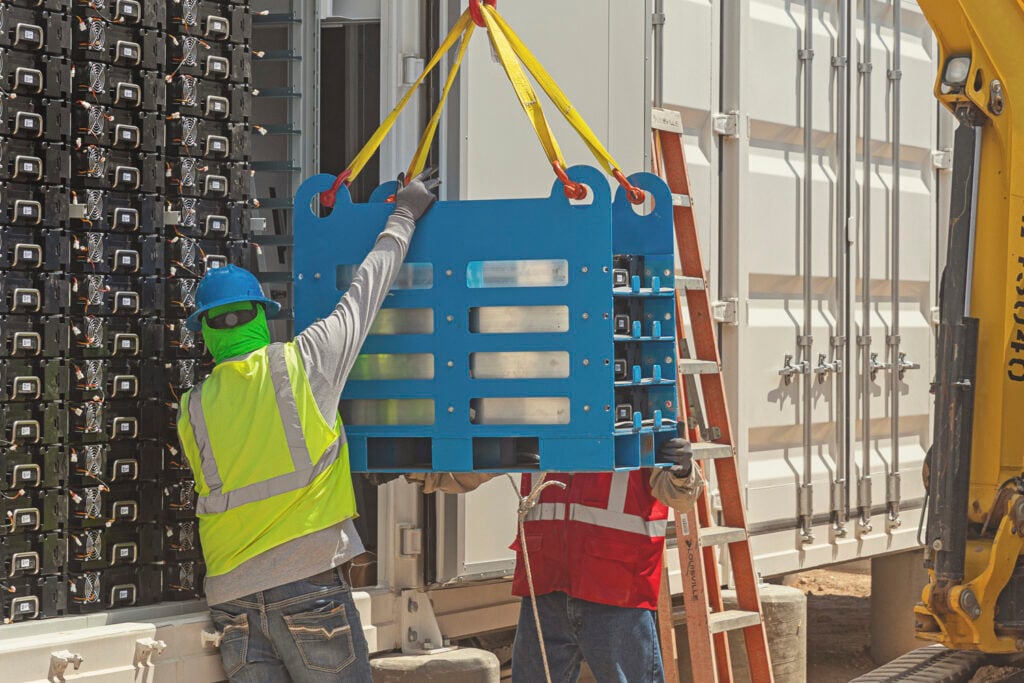
The number of people in the US working in battery storage continued to grow in 2021, adding nearly 3,000 jobs from the previous year.
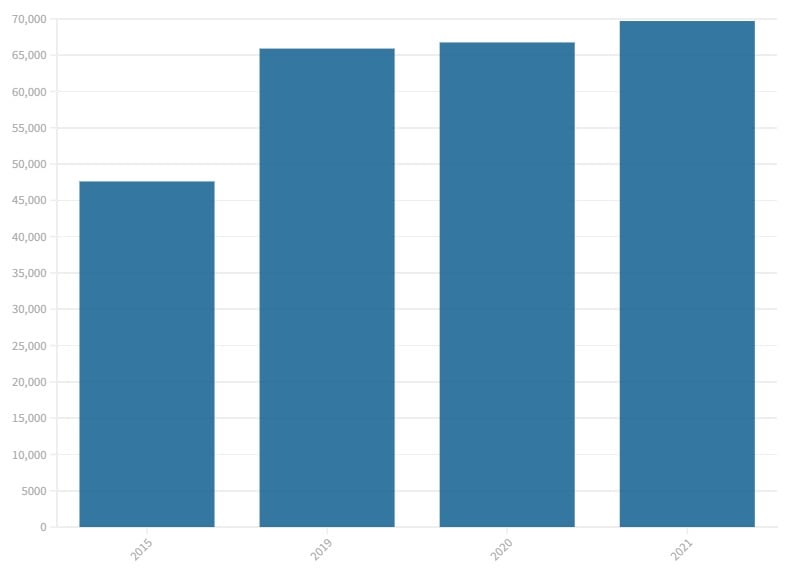
According to the latest edition of the US Department of Energy’s (DOE) annual US Energy and Employment Report (USEER), 69,698 workers were employed in battery storage in 2021.
This equated to an increase of 4.4% over 2020, when the number stood at 66,749, and continued increase from 2019’s 65,904 battery storage workers.
Although battery storage wasn’t counted as a separate breakout category in 2016, the first year the USEER report was published (covering statistics from 2015), the 2020 edition which compiled the previous five editions’ takeaways noted that from 2016 to 2019 a total of 18,300 battery storage jobs were added – equal to growth of 38%.
Try Premium for just $1
- Full premium access for the first month at only $1
- Converts to an annual rate after 30 days unless cancelled
- Cancel anytime during the trial period
Premium Benefits
- Expert industry analysis and interviews
- Digital access to PV Tech Power journal
- Exclusive event discounts
Or get the full Premium subscription right away
Or continue reading this article for free
More than half of employees in the sector (53%) as of 2021 were in construction, 18% in manufacturing, 17% in various professional services roles, 11% in wholesale trade, distribution and transport and a remaining 2% categorised as providers of “other services”.
The DOE surveyed about 33,000 private energy businesses and combined that with public labour data to create its snapshot of estimates across five major energy sectors: electric power generation, fuels, energy efficiency, motor vehicles and transmission, distribution and storage.
Energy storage is counted as a subset of transmission, distribution and storage. The number of battery storage jobs was almost nine times higher than the next highest storage category, pumped hydro energy storage (PHES), which employed 7,901 people in 2021.
In fact, battery storage accounted for 80% of all 86,584 storage jobs, with other categories including petroleum, natural gas and other fuels.
Meanwhile, in power generation categories, solar employed 333,887 people, a rise of 5.4% (17,212) from the year before, while wind power employed 120,164 people. Battery storage has almost caught up with coal’s 70,831 employee numbers and employs more workers than advanced natural gas (69,113), nuclear (55,562) and other power generation technology including natural gas and traditional hydroelectric as well.
However, despite an overall growth in energy employment, as our solar PV colleagues over at PV Tech noted in their coverage of the report last week, it isn’t all good news.
Energy sector job numbers still haven’t returned to pre-pandemic levels after some 840,000 jobs in total were lost by the end of 2020. Secretary of Energy Jennifer Granholm did note that despite a challenging period, the energy sector was still a standout among US industries for job growth in 2021.
Perhaps unsurprisingly, Texas and California made the most new energy sector hires in 2021, with around 31,000 and 29,000 new jobs respectively.
It was also noted that women remain underrepresented in the energy sector, making up a quarter of all jobs versus a national average of nearly half, while Black or African American workers were 8% of the energy workforce versus 12% national average across all industries.
The full 2022 USEER report can be found here.