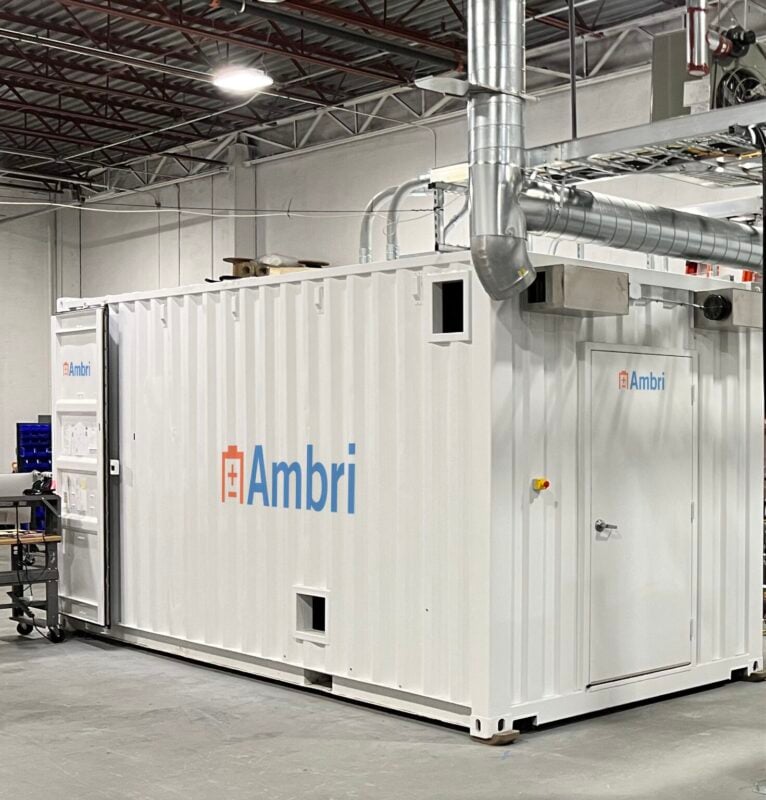
Ambri, the MIT-spinoff commercialising a liquid metal battery for stationary storage applications, looks set for a fresh start.
The Massachusetts-headquartered company said earlier this week (31 July) that the sale of its assets has been closed, bought by a consortium of Ambri’s existing lenders, which has also contributed additional capital.
Ambri had entered Chapter 11 bankruptcy protection with the US Bankruptcy Court for the District of Delaware in early May. It said at the time that an agreement for lenders to buy up assets was already in place.
The company, founded by MIT professor Donald Sadoway in 2010, makes high-temperature batteries based around liquid calcium anodes and molten salt electrolyte, while the cathode materials contain solid antimony particles.
Try Premium for just $1
- Full premium access for the first month at only $1
- Converts to an annual rate after 30 days unless cancelled
- Cancel anytime during the trial period
Premium Benefits
- Expert industry analysis and interviews
- Digital access to PV Tech Power journal
- Exclusive event discounts
Or get the full Premium subscription right away
Or continue reading this article for free
Ambri has claimed that its raw materials are abundant and low-cost, while the technology is suitable for providing long-duration energy storage (LDES).
It has been able to attract some big name backers to date, including Microsoft founder Bill Gates’ Gates Frontier venture capital (VC) fund, and India’s Reliance Industries. A pilot deployment at a Microsoft data centre was commissioned in 2022, and in the same year, a pilot project with Reliance was announced.
Other key developments for the company included plans for a pilot project with utility Xcel Energy in Colorado, US, of which details were provided around a year ago and on which construction was expected to begin this year.
Ambri’s systems received UL1973 certification in 2022 and the company signed a deal in Q3 2021 for 13GWh of key materials supply with an investor in a successfully closed US$144 million funding round.
The company said this week that a competitive sale process was conducted in accordance with Section 363 of the Bankruptcy Code, after its board decided that the sale would be the best avenue to recapitalise the company and secure its future.
Sadoway’s co-founder and co-inventor of the proprietary liquid metal battery, Dr David Bradwell, will assume the position of CEO, having been CTO since Ambri was launched, while Prof Sadoway remains Chief Scientific Advisor.
“The team at Ambri has continued to make impressive progress towards a commercial long-duration battery system, including developing our third-generation cell product. We look forward to offering our unique, safe, and low-cost commercial product to our customers at scale, to meet the strong customer demand for our battery systems, and for a cleaner energy future,” new CEO Bradwell said.
“As we embark on this fresh start with a stronger balance sheet and new capital, we are focused on positioning Ambri to play a leading role in the long duration energy storage market for the benefit of our stakeholders.”