Ambri, a US technology startup with a novel liquid metal battery that it claims can be suitable for long-duration energy storage applications, has netted a US$144 million investment and signed a deal with a key materials supplier.
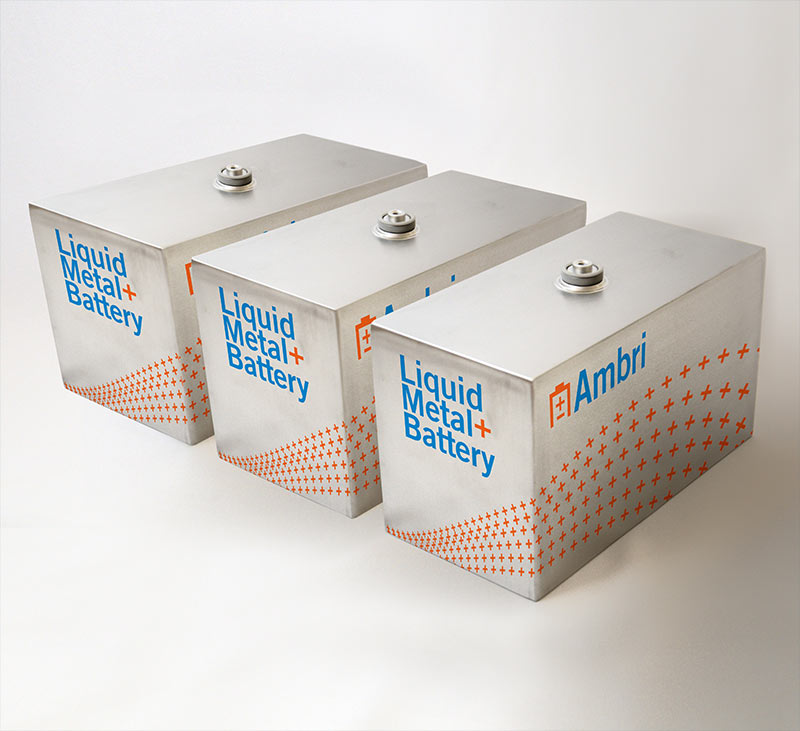
The company was born out of the labs of Professor Donald Sadoway at MIT and founded in 2010. It has packaged battery cells that use liquid calcium alloy anodes with a molten salt electrolyte and cathode make of solid antimony particles into stainless steel housing. These are then placed into ready-to-install DC containerised systems.
Ambri claims its production process has fewer steps and its products will be lower cost than lithium-ion. While the batteries operate at a high temperature of 500°C, they are not subject to thermal runaway, decomposition of electrolyte or off-gassing and can be suitable for applications that require high energy capacity, frequent cycling and have a long life with high efficiency.
The fresh funding, announced by Ambri yesterday (9 August) is aimed at commercialising and advancing the technology as well as going towards building a manufacturing facility in the US and abroad. Ambri’s largest shareholder, Bill Gates, took part, along with others including Reliance Industries subsidiary Reliance New Energy Solar, investment management firm Paulson & Co and Japan Energy Fund.
Try Premium for just $1
- Full premium access for the first month at only $1
- Converts to an annual rate after 30 days unless cancelled
- Cancel anytime during the trial period
Premium Benefits
- Expert industry analysis and interviews
- Digital access to PV Tech Power journal
- Exclusive event discounts
Or get the full Premium subscription right away
Or continue reading this article for free
Reliance New Energy Solar has become a strategic partner to the company to develop and manufacture Ambri batteries in India. Ambri is also Reliance’s joint venture (JV) partner in Dhirubhai Ambani Green Energy Giga Complex, a new massive US$10 billion green energy technology manufacturing hub in India. Meanwhile Perpetua Resources, a mining company and the subsidiary of another strategic investor, Paulson & Co, has signed a deal to supply Ambri with antimony for its cathodes.
Antimony to come from Perpetua’s mine in Idaho
Perpetua said in a separate press release, also issued yesterday, that it has agreed a deal to supply enough antimony to power a minimum commitment of 13GWh of Ambri energy storage systems. The metal will be supplied from the mining group’s Stibnite Gold Project in central Idaho which Perpetua claimed is the only responsible and domestically mined source of the critical mineral within the US.
“We’ve been looking for an opportunity to help finance important technologies for large scale utility grade battery storage systems. Ambri’s novel battery technology is ready to deliver a low-cost, durable and safe battery for longer duration applications that will enable a stable grid that incorporates an increasing amount of intermittent renewable generation,” John Paulson of Paulson & Co said, adding that Perpetua is an “ideal supply chain partner” to the tech company.
“This novel, low-cost technology will help integrate more wind and solar power into grids around the globe, especially in areas that are more remote, have been more reliant on fossil fuels, or experience extreme temperatures,” Mark Comora, president of another investor, Fortistar, said.
“This will help level the playing field when it comes to decarbonisation efforts that are critical to tackling climate change, and we are proud to invest in a company that is delivering meaningful benefits with real financial value.”
Ambri claims its systems can scale from 10MWh to over 2GWh and could be used anywhere around the world, providing energy storage for durations of between four and 24 hours. It is currently seeking to secure large-scale projects with customers for commercial operation dates beginning in 2023. Late last year, Ambri was revealed to be working on a potential Nevada data centre project where its battery energy storage systems (BESS) would be used to help integrate up to 500MW of renewable energy generation to provide round-the-clock power.
The company is among a growing number of technology providers seeking to find workable, cost-effective long-duration energy storage technologies that can meet the need for several hours of storage. Lithium-ion batteries currently considered the battery chemistry group of choice for advanced energy storage for up to about four-hour duration. But other technologies, from thermal and mechanical storage to novel electrochemical batteries, are emerging as the need to integrate the output of variable renewable energy grows. One prominent example of the latter category is the iron-air battery in the process of commercialisation by another US start-up, Form Energy, which claimed its device can provide up to 150 hours of storage.