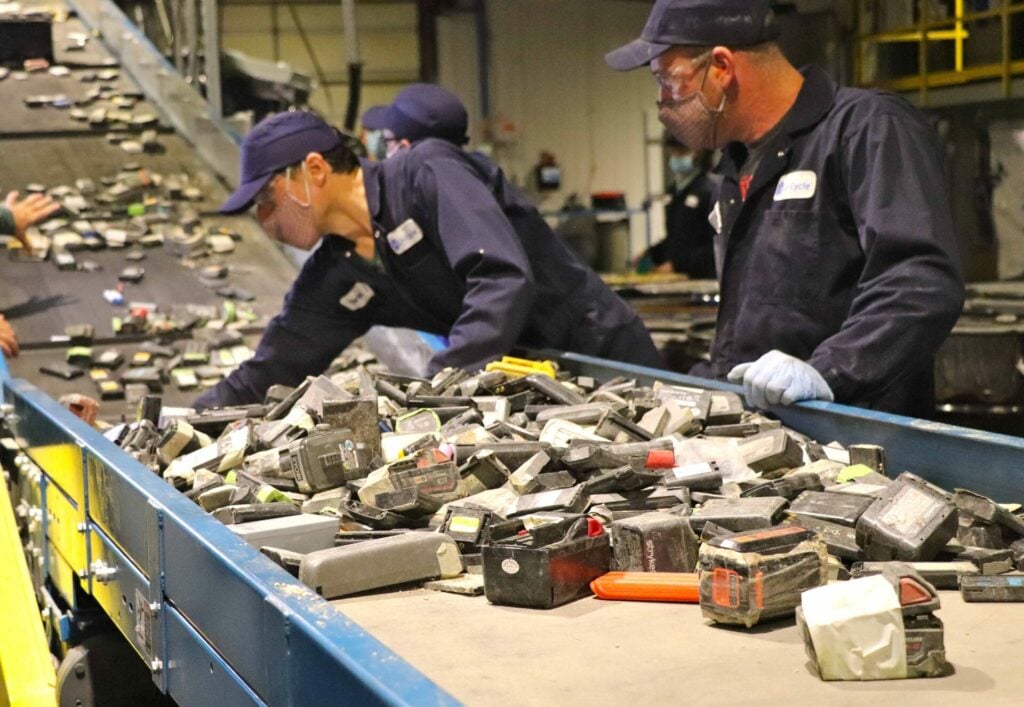
LG Chem and LG Energy Solution have agreed to make a US$50 million investment into lithium-ion battery resource recovery and recycling company Li-Cycle.
Each of the pair will invest US$25 million into the Canada-headquartered recycling specialist, with LG Chem involved in the upstream of battery manufacturing via active materials and LG Energy Solution a maker of lithium-ion batteries and complete systems for sectors including mobility, IT and stationary battery energy storage systems (BESS).
Additionally, the two South Korean companies will buy 20,000 tonnes of nickel contained in nickel sulphate from Li-Cycle’s processing. The purchases will be made over 10 years from 2023 indirectly through Traxys North America, Li-Cycle’s off-take partner from its recycling ‘Hub’ facility near Rochester, New York.
LG Energy Solution and Li-Cycle have also agreed to cooperate on recycling lithium battery scrap for nickel and other materials contained in lithium-ion batteries.
Try Premium for just $1
- Full premium access for the first month at only $1
- Converts to an annual rate after 30 days unless cancelled
- Cancel anytime during the trial period
Premium Benefits
- Expert industry analysis and interviews
- Digital access to PV Tech Power journal
- Exclusive event discounts
Or get the full Premium subscription right away
Or continue reading this article for free
“Sustainable recycling for lithium-ion batteries is critical to the electrification revolution. Li-Cycle is making economically and environmentally sustainable lithium-ion battery recycling a commercial reality through its innovate technologies,” LG Chem battery materials development lead Byungchul Choi said.
While the deal with Li-Cycle largely focuses on nickel for EV battery production, the topic of sustainability is growing more and more prevalent in stationary battery storage discussions too.
LG Energy Solution signed a six-year deal in October to purchase hundreds of tonnes of sustainably-sourced lithium concentrate from Sigma Lithium, a startup aiming to power its production 100% from clean energy and recirculate all of the water used in its processes.
Meanwhile, although recent analysis from Wood Mackenzie Power & Renewables forecast that lithium-ion battery recycling will not take off before 2030, with the research firm predicting recycling capacity will overshoot the amount of available feedstock for some time, Li-Cycle said this week it will scale up its recycling capabilities significantly.
The company has begun construction on its commercial ‘Hub’ facility in New York, which will turn ‘black mass’ intermediate product created from end-of-life batteries and battery manufacturing scrap — created at Li-Cycle’s various ‘Spoke’ facilities — back into separated battery-grade materials.
Li-Cycle said it can fund the Hub’s expected cost of about US$485 million from its balance sheet. Furthermore, due to growing demand, the Hub’s planned 25,000 tonne processing capacity for black mass will be raised to 35,000 tonnes, the company said yesterday.
Li-Cycle listed on the New York Stock Exchange (NYSE) in August, received a US$100 million investment commitment from a venture capital (VC) arm of Koch Industries shortly after that and is building facilities that can capture opportunities in the East Coast, West Coast and southern US regions.
Due to the high cost of extracting lithium from the ground, recycling, which has been dubbed “urban mining” can be a high value process and recycling could be commercially viable and the materials produced competitive with raw materials, Energy-Storage.news has heard from several sources in recent months.
Li-Cycle and others have claimed their recycling processes can reclaim about 90% of the metals in different types of lithium-ion batteries, including lithium, nickel, cobalt and manganese. European battery manufacturing startup Northvolt recently made its first cells with full recycled materials.