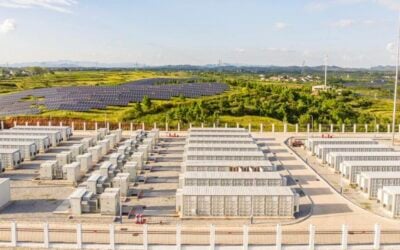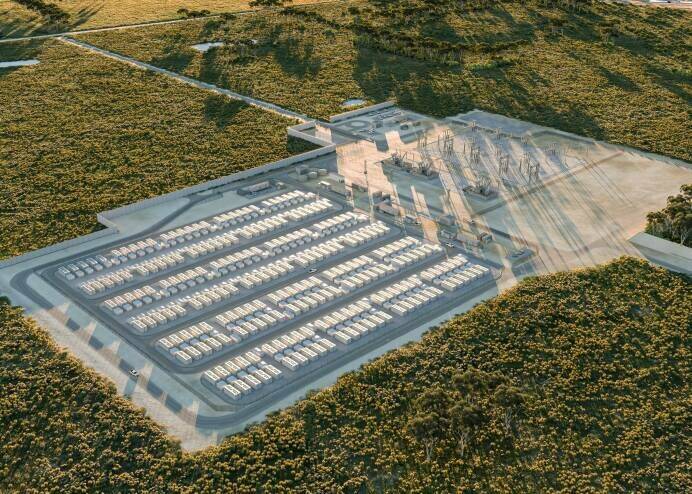
Construction has started at the 600MW/1,600MWh Melbourne Renewable Energy Hub (MREH), one of the largest energy storage projects in Victoria, Australia.
Construction started on the project with the installation of the first of 444 Tesla Megapack battery components. MREH is owned and being developed by Singapore-headquartered renewable energy investor and developer Equis, in partnership with the State Electricity Commission (SEC), an entity owned by Victoria.
The site is anticipated to be operational in 2025 and will comprise three separate battery energy storage systems (BESS), consisting of Tesla’s Megapack solution.
Tesla’s Megapack is an integrated solution which includes lithium-ion batteries, power conversion system (PCS), thermal management and controls. With increased demand globally for the technology, Tesla’s Megapack factory in Lathrop, California, is scheduled to ramp up to 40GWh annual production capacity by the end of 2024, as previously reported by Energy-Storage.news.
Try Premium for just $1
- Full premium access for the first month at only $1
- Converts to an annual rate after 30 days unless cancelled
- Cancel anytime during the trial period
Premium Benefits
- Expert industry analysis and interviews
- Digital access to PV Tech Power journal
- Exclusive event discounts
Or get the full Premium subscription right away
Or continue reading this article for free
Equis received Commonwealth government approval for MREH in October 2023, although its output and capacity were given at 1.2GW/2.4GWh in approvals granted by Minister for the Environment and Water, Tanya Plibersek.
In November 2023, the SEC invested in the hub to help progress its development with eyes to unlock 4.5GW of renewable energy projects. MREH is expected to cost in the region of AU$1 billion (US$660 million).
Victoria’s Premier Jacinta Allan and Minister for the State Electricity Commission Lily D’Ambrosio visited the site on Wednesday (4 September) to mark the Melbourne project’s entry into construction.
D’Ambrosio emphasised that the project will help achieve approximately 23% of Victoria’s 2030 energy storage capacity target. Energy storage will also play a vital role in facilitating new renewable energy generation projects, by harnessing variable technologies such as wind and solar PV. This aligns with the state’s goal of running on 95% renewable energy by 2035.
Premier Allan added: “We’re building for our future – and the SEC is unlocking more renewable and affordable energy for Victorians with one of the biggest batteries in the world.”
MREH to connect to three Renewable Energy Zones
Another key aspect of the MREH development is that it will be directly connected to three Renewable Energy Zones (REZ), allowing more energy to connect to the grid, with these having been labelled as the equivalent of modern-day power stations.
Six are currently being explored across the state including Murray River, Central North, Ovens Murray, Gippsland, South West and Western Victoria. These are aiming to unlock around 10GW of new capacity.
In what was a first for the Australian market, New South Wales saw its Central-West Orana REZ become the first to transition into the delivery phase, as reported by our sister site PV Tech, with the project having obtained Commonwealth planning approval.
Securing planning approval for the 4.5GW project brings the development closer to construction. The Energy Corporation of New South Wales has stated that it will now begin awarding the final contract to the preferred network operator for designing, building, operating, and maintaining the transmission line network for the Central-West Orana REZ.