
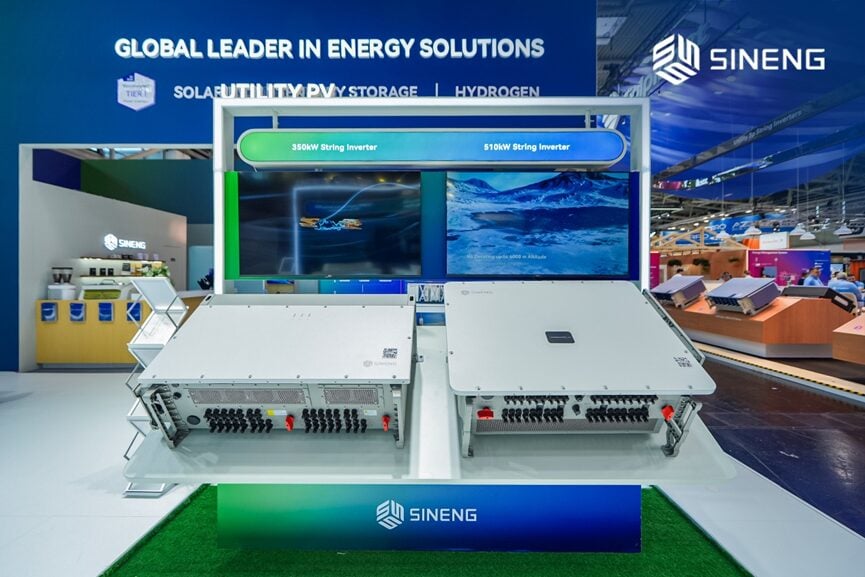
Sineng Electric has exhibited at the 2026 edition of Intersolar Europe, showcasing its latest product portfolio, highlighting advanced grid-forming capability, AI-powered intelligence and integrated solutions designed to support the evolving needs of the global energy transition.
In response to the accelerating integration of renewable energy and the growing complexity of modern power systems, the company introduced its new-generation 510 kW high-power string inverter with grid-forming technology.
Designed to support sub-arrays above 7 MW, with up to 1650 V DC input and 1000 V AC output, the solution reduces BOS costs while improving overall project economics.
Equipped with advanced grid-forming functionality, the inverter demonstrates strong adaptability in weak-grid conditions (SCR ≥ 0.93). It features wide-band oscillation suppression, black-start capability, adjustable inertia response from 0–20 s and reactive power response within 10 ms, significantly enhancing grid resilience and stability.
Complementing this, Sineng also presented its 11.16 MW transformer station for the 510 kW inverter, the 8.96 MW transformer station for the 350 kW inverter, and an 8.8 MW MV turnkey station.
The company also displayed its next-generation grid-forming energy storage solutions, designed to enhance grid stability, flexibility and renewable energy integration at scale.
The 1725 kW central PCS, configurable up to 13.8 MW, supports 2-hour to 8-hour energy storage systems and features grid-forming capability, enabling seamless on-grid/off-grid switching, fault ride-through, inertia support, primary frequency regulation and station-level black start.
The 430 kW string PCS can be integrated into MV turnkey stations with transformer, RMU and LV AC/DC panels, delivering capacities from 3.2 MW to 12.5 MW. Leveraging liquid-cooling technology, the solution reduces overall temperature rise by 5 K. This thermal management not only extends the product’s operational lifespan to 25 years but also improves charging and discharging efficiency, directly enhancing return on investment. It also supports 1.5× overload for 10 seconds and maintains stable operation under weak-grid conditions (SCR ≥ 1.02), with full black-start capability.
As hydrogen continues to emerge as a critical pathway toward carbon neutrality, Sineng presented its flexible hydrogen production power supply solutions compatible with ALK, PEM, and AEM electrolyzer ranging from 250 Nm³/h to 3000 Nm³/h.
Among the highlights was the company’s 5.7 MW hydrogen production power supply system. Featuring a standardized 40-foot container design and ultra-wide 0–820 V voltage range, the solution offers a compact footprint while effectively accommodating fluctuations in renewable energy integration.
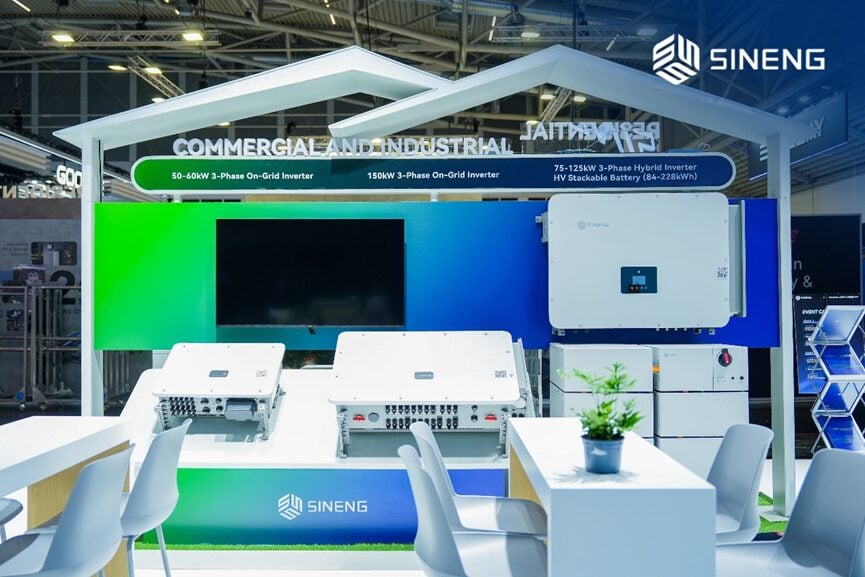
Sineng’s SN75–125HT hybrid inverter delivers high-performance, intelligent energy management for C&I applications.
It supports 10 ms seamless switching between on-grid and off-grid modes, ensuring uninterrupted power supply for critical loads. It provides 200 kW peak power for 200 ms, 150% overload capability for 10 seconds and supports VSG/VF microgrid operation with diesel generator compatibility.
Also exhibited were 84–228 kWh HV stackable batteries and 50–150 kW three-phase on-grid inverters.
For residential applications, the company offers its All-in-One energy storage solution designed to simplify installation and enhance energy independence.
Built with 340 Ah auto-grade battery cells, the system features plug-and-play installation, automatic three-phase adaptation, a compact 230 mm ultra-thin design and 1.5× DC overload capability to maximize solar utilization. It also supports flexible capacity expansion through mixed use of new and existing batteries.
The residential portfolio includes 3–33 kW hybrid inverters and high-voltage stackable batteries.
CEO Peter Yang commented: “Our solutions are designed to address the increasing complexity of modern power systems and the challenges of high renewable penetration. At Intersolar Europe 2026, we have showcased advanced grid-forming and AI-driven technologies that enhance system stability, strengthen weak-grid performance and enable reliable large-scale renewable integration. This reflects our ongoing commitment to engineering excellence and system-level performance.”
