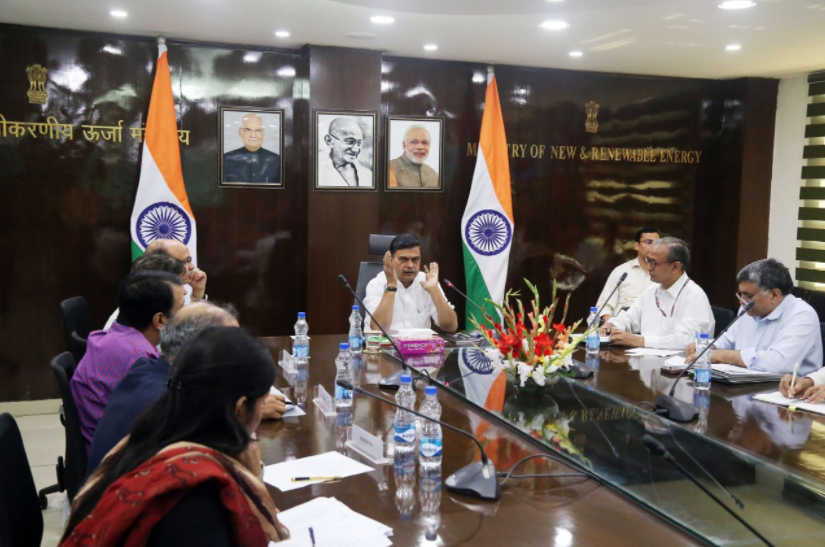
Indian power minister R.K. Singh has chaired a meeting with battery-based energy storage manufacturers calling on them to set up manufacturing units in India.
Singh’s urgency not only stemmed from the government’s push on electric vehicles (EVs) and its expected surge in the coming years, but also because future tenders will cover hybrid solar and wind projects to be coupled with energy storage. Indeed, both Andhra Pradesh and Kerala are already working on such hybrid projects.
Singh said the government would soon release a policy with a focus on ‘Make in India’.
He added: “Tenders for procuring e-vehicles have already been issued and we have started procuring the vehicles. This is going to increase.”
Try Premium for just $1
- Full premium access for the first month at only $1
- Converts to an annual rate after 30 days unless cancelled
- Cancel anytime during the trial period
Premium Benefits
- Expert industry analysis and interviews
- Digital access to PV Tech Power journal
- Exclusive event discounts
Or get the full Premium subscription right away
Or continue reading this article for free
He also assured the battery manufacturers present that the government would take all possible measures to incentivise battery manufacturing in India. Meanwhile, in terms of the raw materials necessary for battery manufacturing, he said the government had already started discussions with resource rich countries such as Bolivia.
However, the industry representatives raised concerns over the high GST tax rates on batteries and asked for preference to be given to Indian made batteries in government procurement in order to promote domestic manufacturing.
The industry also said it was necessary to create Indian standards for batteries and to set up field testing facilities for both stationary and mobile sectors. India has previously detailed quality standards for solar products that also covered storage. The industry also said that a favourable economic environment was key to progressing battery cell manufacturing, while it was also important to create an enabling environment for battery recycling in India.
Energy-Storage.News has previously reported that the latest Indian national Budget saw a hike in customs duties for lithium-ion batteries from 10% to 20%, which is unhelpful to India’s overall energy storage industry unless there is enough domestic manufacturing to meet demand.
Singh has asked the Department of Space and ISRO to share relevant technologies with the Industry to help progress the storage sector.
Dr Rahul Walawalkar, president and MD of Customized Energy Solutions and an executive director of the India Energy Storage Alliance (IESA) has said previously that 2017 was the year when Indian industries started investing in setting up manufacturing capabilities for developing li-ion battery packs in India with IESA members such as Exicom, Delta and ACME leading the way.
In a recent interview with Energy-Storage.News, he also said: “By mid-2018, India will have over 1GWh of li-ion battery pack manufacturing capacity. We also anticipate that in 2018 at least two li-ion cell manufacturing plants with capacity of 1GWh or more will start construction in India with anticipated completion for early 2020, bringing India on the global map of ‘Gigafactories’.”