Switzerland-based institutional investment group SUSI Partners has entered a development deal for two large-scale solar-plus-storage hybrid power plants in Chile.
The group, focused on investments in sustainable infrastructure, announced this morning (15 November) that its SUSI Partners Energy Transition Fund (SETF) will develop the plants, in the metropolitan area of Chile’s capital city Santiago, with locally-headquartered developer BIWO.
It follows SUSI Partners’ recent announcement that its Italian renewable energy platform will turn its attention to opportunities in Italy’s battery storage market, while the institutional investment manager already has investments in battery storage in other markets including the UK and US.
The hybrid solar PV and battery plants in Chile will have a combined PV generation capacity of 232MWp while the pair will feature “up to” 900MWh of battery energy storage system (BESS) resources across the two sites.
Try Premium for just $1
- Full premium access for the first month at only $1
- Converts to an annual rate after 30 days unless cancelled
- Cancel anytime during the trial period
Premium Benefits
- Expert industry analysis and interviews
- Digital access to PV Tech Power journal
- Exclusive event discounts
Or get the full Premium subscription right away
Or continue reading this article for free
Construction is due to begin in 2025, and the development agreement continues a working relationship between SUSI Partners and BIWO that has seen the Swiss fund manager and the developer secure financing for a portfolio of distributed solar assets. That deal marked SUSI’s entry into the Latin American market.
BIWO’s leadership team has put 4,000MW of wind, solar and storage assets into operation globally, about a quarter of which is in Chile. The company’s website claims it has just over 800MW of projects currently in development, listed as 594MW of solar PV, 117MW of wind projects and 100MW of battery storage.
As with the projects included in that prior deal between the pair, the newly announced power plants are located close to electricity demand centres and offer better conditions for brokering off-take deals, as well as being at reduced risk of curtailment.
That risk of curtailment is certainly real in Chile – a national renewable energy association, ACERA, found earlier this year that 735GWh of renewables were curtailed from injecting power to the grid during the first five months of 2023.
It has been among factors creating a rapidly emerging market for energy storage in the country, with solar PV developers in particular seeking to add BESS to their assets. As reported by Energy-Storage.news, more than 2GWh of such projects were proposed or announced in September alone.
Other factors driving the market include changes in regulations which allow energy storage assets to participate in capacity market and energy trading opportunities, as discussed in this Energy-Storage.news Premium interview with developer Flexen.
Our publisher Solar Media hosted the second annual Energy Storage Summit Latin America in Santiago a few weeks ago, and while the event focused on the whole region, it was clear Chile is the market people think about most often when it comes to energy storage in Latin America today.
Chile presents opportunities for increased storage duration
Chile’s energy market has extreme price spreads and volatility, which again make it ripe for energy storage to capitalise upon.
Those drivers also mean that storage system durations are rapidly increasing: an inauguration was held last month for a 50MW/250MWh (5-hour) BESS at a solar PV plant in the country by developer Innergex, one of two large-scale 5-hour duration systems the company is deploying; while a new report from trade group Long Duration Energy Storage Council (LDES Council) highlighted that Chile has committed US$2 billion in funding for energy storage tenders, including long-duration tech, meaning it ranks higher than the likes of Spain, the UK and US in terms of its financial support for LDES.
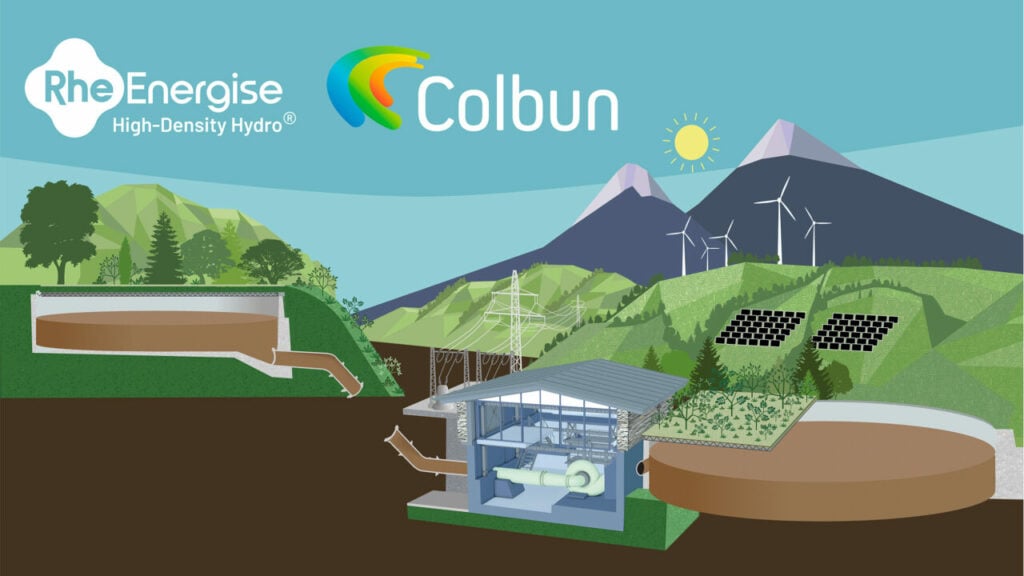
Indeed, Chilean utility and transmission operator Colbún was revealed this week to be considering a new form of pumped hydro energy storage (PHES) technology developed by a UK company, RheEnergise, for a potential 10MW/100MWh project.
RheEnergise calls its tech ‘High-Density Hydro’. The main difference, or advancement, from regular pumped hydro is that the company’s systems utilise a more viscous fluid than water, meaning that it could require much less space and geoengineering to provide similar benefits. It also requires much less water, meaning that it could be a good fit for water scarce regions.

“Innovation is key for the energy transition. Technological advances in solar and wind power makes them the leading sources of green energy in many parts of the world,” Colbún innovation manager Diego García said.
“Now, we need new storage solutions to cope with the intermittency of renewable energy, and the technology that RheEnergise is developing could have a key role in this regard.”
A 12-month feasibility study now begins, with RheEnergise hoping it will lead to a first project getting underway by the end of this decade.
Colbún is also in the midst of building out large-scale lithium-ion battery storage facilities of its own, in co-location with solar PV, completing work on a first 8MW/32MWh project of an 800MW portfolio in December last year.
Shortly before that was announced, an article in our quarterly journal PV Tech Power (Vol.32), ‘What the future holds for solar PV in Chile,’ published in September 2022, analysed the Chilean PV market through interviews with leading figures including Colbún’s chief executive, José Ignacio Escobar.