
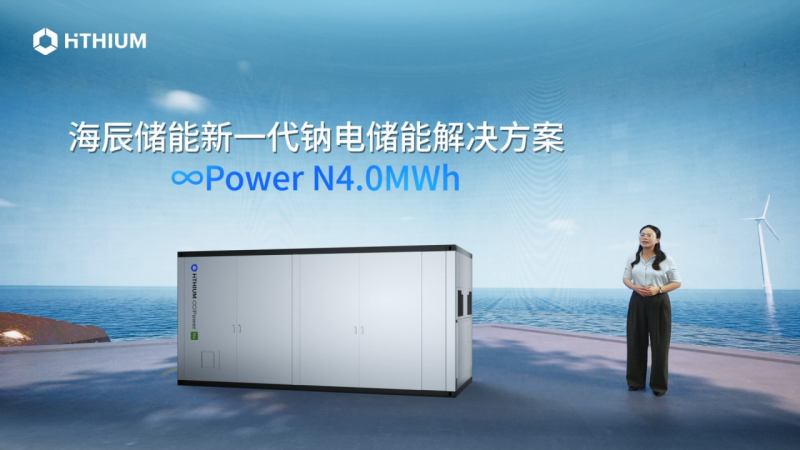
Hithium’s recent sodium-ion battery and BESS product launch is the latest in a long line of announcements showing an inflection point for the battery chemistry. But how do its new products compare to other sodium-ion systems out there, and to its own LFP offering?
What is the Hithium ∞Cell N785Ah? Key specs and claims
Hithium has already developed sodium-ion (Na-ion) BESS cells in the past. These were 162Ah cells, whereas these new cells are large-format 785Ah cells, marking a big step up in capacity. While there is talk about building more robust Na-ion supply and manufacturing chains, the ∞Cell N785Ah is compatible with Hithium’s 1,000Ah lithium-ion (Li-ion) manufacturing platform, so it has the potential to be scaled quickly.
The Hithium N785Ah cell has been designed with a cycle life of 20,000 cycles, a calendar life of 30 years, and 2- and 8-hour discharge durations. No specifications have yet been given on the energy density of the cell, but the 162Ah predecessor has a ≥95Wh/kg gravimetric energy density and a 173Wh/L volumetric energy density, so it’s likely to be above this and more likely to be in line with more recent Na-ion cells with energy densities exceeding 160Wh/kg. The operating temperature has also not yet been published, but the 162Ah has an operating temperature range of -40-60°C, so it’s assumed to be very similar, if not the same.
The 785Ah cell is a sodium iron phosphate pyrophosphate (NFPP) cell. This has become a popular design choice for commercial Na-ion cells because they tend to have a longer cycle life and lower thermal runaway risk. However, it does come at the expense of energy density, as some other Na-ion cell chemistries have a higher energy density, but this is not as critical for a lot of BESS applications compared to EVs, where energy density is absolutely key. NFPP is a stable cell chemistry with a robust structural cathode stability and high thermal stability, and is seen as a well-balanced sodium battery chemistry.
Try Premium for just $1
- Full premium access for the first month at only $1
- Converts to an annual rate after 30 days unless cancelled
- Cancel anytime during the trial period
Premium Benefits
- Expert industry analysis and interviews
- Digital access to PV Tech Power journal
- Exclusive event discounts
Or get the full Premium subscription right away
Or continue reading this article for free
The electrolyte in the cell has been designed using micro-bonding and targeted repair mechanisms, and the desolvation barrier was lowered by using low-viscosity, wide-liquid-range, and weakly coordinated solvents. The cell also has a dense solid electrolyte interphase (SEI) layer that suppresses electrolyte decomposition and overconsumption of the electrolyte. Hithium has stated that an ultra-thick electrode coating can offset the lower energy density compared to Li-ion while making it longer lasting.
The cells are used in the ∞Power N4.0MWh BESS, which claims to have a battery management system (BMS) that can estimate state of charge (SoC) to within 2.5% accuracy. The BESS is also compatible with 800V—1500V power conversion systems (PCS). Hithium has also stated that it is targeting a levelized cost of storage (LCOS) of $0.015/kWh.
A round-trip efficiency (RTE) has not been released, but Hithium has stated that the BESS uses a new hybrid air-liquid cooling thermal management approach that provides a ’24-hour comprehensive efficiency’ of at least 88%. Thermal management is also improved by weather data dictating the type of cooling, leading to a 30% lower auxiliary power consumption 50% lower standby auxiliary power consumption.
Hithium vs CATL, HiNa and Envision: how Na-ion cells compare in 2026
Hithium is not the only company to release Na-ion cells for BESS. A lot of the other cells, however, do have a lower capacity, so there is the potential for the latest Hithium cell to be one of the leading cells for utility-scale Na-ion storage.
One of the main companies which has released different Na-ion cell products is CATL. CATL currently has the most commercially advanced Na-ion cells with a 60GWh supply deal struck earlier this year with Hyperstrong, and BESS containers with 30+MWh configurations. The CATL Naxtra line has a much lower cell capacity at 300+Ah than Hithium’s latest cell, a lower cycle life of 15,000 cycles (to 80% capacity), a similar (assumed) operating temperature of -40-70°C, and an energy density of 175Wh/kg. It should be noted, though, that the Naxtra line is less focused on BESS and more on heavy-duty vehicles, but was CATL’s first major commercial breakthrough into the Na-ion market and comes with an 8-year service life.
The more recent CATL Tener sodium-ion line on the other hand, which has been designed for BESS applications, uses another 300+Ah cell and is designed for 1-8 hour durations and comes with a 30-year warranty. The energy density of the Tener line is lower than the Naxtra at 160Wh/kg. The CATL Tener Na-ion cells have a 25-30-year service life (to 70% state of health), cycle life of 15,000 cycles at 25°C and over 10,000 Cycles at 45°C, energy conversion efficiency of 97%, and an operating temperature range of -40-70°C. This one has been designed for the extreme cold and retains over 92% of its original capacity at -20°C.
HiNa is another Chinese company with different Na-ion battery products. HiNA has 4 different Na-ion products, with two specifically for BESS: HE 240 and NE170. The HE240 has a 240Ah capacity, >150Wh/kg energy density, and a much shorter cycle life of 8000 cycles, as well as an operating temperature range of -40-60°C. By comparison, the NE170 cell has a 170Ah capacity, >100Wh/kg energy density, -40-60°C operating temperature range, and a slightly improved cycle life of 10,000 cycles. Both cells have an anticipated service life of at least 20 years and a 94% energy efficiency.
While best known for its EV batteries, BYD also has a stake in the Na-ion BESS market, and it’s been stated by the company that BYD is aiming to achieve a LCOS of $0.03/kWh. The Na-ion-based BYD MC Cube has a 200Ah capacity, cycle life of 10,000 cycles, volumetric energy density of 430Wh/L, and an operating temperature range of -30-55°C, but the efficiency and calendar life have yet to be disclosed.
Envision Energy is a newer company in the Na-ion space, and its cells to date have a 180Ah capacity, cycle life of 20,000 cycles, and an operating temperature range of -40-70°C, but no other metrics have been given at this stage. Peak Energy, on the other hand, is developing its GS-1.1 BESS cells, which have a service life of 20 years, a guaranteed cycle life of 7,300 cycles (potentially up to 20,000 cycles), a 96% DC RTE, and a -40-55°C operating temperature range. No cell-level energy density has been given yet.
Finally, there’s Hithium’s older sodium cell, which, while a much smaller format and capacity, is a good comparison for the latest Hithium sodium-ion battery—especially as the ∞Cell N162Ah was claimed to be the first commercial Na-ion battery in the world for large-scale utility energy storage. The capacity of the cell is 162Ah, with a gravimetric energy density of ≥95Wh/kg, volumetric energy density of 173Wh/L, cycle life of 20,000 cycles, service life of 30 years, energy efficiency of 94%, and an operating temperature range of -40-60°C. The cells are designed for 1-, 4-, and 8-hour durations and retain 94.2% of their initial capacity after 4,000 cycles at 25°C. So, while the capacity metrics are much lower than the latest model, this cell set the platform for the recent large-format developments.
Here is a comparison table of all the Na-ion cells discussed:
| Company/Cell | Capacity | Cycle Life | Calendar life | Energy Density | Operating Temperature Range | Energy Efficiency |
| Hithium ∞Cell N785Ah | 785Ah | 20,000 | 30 years | Not disclosed | -40-60°C (assumed) | ’24-hour comprehensive efficiency’ of at least 88% |
| HiTHIUM ∞Cell N162Ah | 162Ah | 20,000 cycles | 30 years | ≥95Wh/kg gravimetric 173Wh/L volumetric | -40-60°C | 94% |
| CATL Naxtra | 300+Ah | 15,000 | 8 years | 175 Wh/kg gravimetric | -40-70°C | Not disclosed |
| CATL Tener (cell) | 300+Ah | 15,000 cycles at 25°C ≥10,000 Cycles at 45°C | 25-30 years | 160Wh/kg gravimetric | -40-70°C | 97% |
| BYD MC Cube | 200Ah | 10,000 | Not disclosed | 430Wh/L volumetric | -30-55°C | Not disclosed |
| HiNa HE240 | 240Ah | 8,000 | 20 years | >150Wh/kg gravimetric | -40-60°C | 94% |
| HiNa NE170 | 170Ah | 10,000 | 20 years | >100Wh/kg gravimetric | -40-60°C | 94% |
| Envision | 180Ah | 20,000 | Not disclosed | Not disclosed | -40-70°C | Not disclosed |
| Peak Energy | Not disclosed | 7,300 guaranteed cycles, potentially up to 20,000 cycles | 20 years | Not disclosed at cell level | 40-55°C operating temperature range | 96% DC RTE |
Hithium sodium-ion vs Hithium LFP: when does Na-ion make sense?
As well as the recent utility-scale Na-ion BESS, Hithium also has multiple LFP Li-ion BESS products. It’s known that the energy density of Li-ion cells is much higher than Na-ion cells, so it may not be as fair a comparison against other Na-ion cells, but because Hithium does have large-format LFP cells with high capacities, it’s good to see how the Na-ion cells stack up on all metrics, not just energy density.
On the large format LFP side, Hithium has three main product lines: 587Ah LFP, 1175Ah LFP, and 1300Ah LFP cells. All three formats have an operating temperature of -30-60°C and a calendar life of 25 years, but the rest of the performance metrics vary. Both the 587Ah LFP and 1175Ah LFP cells are currently in production, with the 1300Ah cell entering mass production in Q4 2026.
The 587Ah LFP cell has a capacity of 587Ah, a cycle life of 11,000 cycles, a gravimetric energy density of 185Wh/kg, a volumetric energy density of 413–415Wh/L, and a 94.5% energy efficiency. By comparison, the 1175Ah LFP has a capacity of 1175Ah, a comparable cycle life of 11,000 cycles, a gravimetric energy density of 180Wh/kg, and a volumetric energy density of 400Wh/L, but no energy efficiency metrics have been given at this stage. Finally, the 1300Ah LFP has a capacity of 1300Ah, a cycle life of 10,000 cycles, a gravimetric energy density of 190Wh/kg, a volumetric energy density of 406Wh/L, and a 96% RTE.
This table compares the latest Hithium ∞Cell N785Ah cell against the three large-format LFP cells from Hithium:
| Company/Cell | Capacity | Cycle Life | Calendar life | Energy Density | Operating Temperature Range | Energy Efficiency |
| Na-ion ∞Cell N785Ah | 785Ah | 20,000 | 30 years | Not disclosed | -40- 60°C (assumed) | ’24-hour comprehensive efficiency’ of at least 88% |
| 587Ah LFP | 587Ah | 11,000 | 25 years | 185Wh/kg gravimetric 413-415Wh/L volumetric | 30-60°C | 94.5% energy efficiency |
| 1175Ah LFP | 1175Ah | 11,000 | 25 years | 180Wh/kg gravimetric 400Wh/L volumetric | 30-60°C | Not disclosed |
| 1300Ah LFP | 1300Ah | 10,000 | 25 years | 190Wh/kg gravimetric 406Wh/L volumetric | 30-60°C | 96% RTE |
While it’s obvious that the overall performance metrics of Li-ion cells is much better than Na-ion, there are many advantages of Na-ion cells that these metrics don’t show that might make a large format Na-ion cell with a high capacity—such as Hithium’s N785Ah cell—a preferable option in some use cases/geographical regions.
One of the biggest advantages of the Na-ion cell is the cycle life, which is practically twice the cycle life of all the LFP cells—and LFP cells typically have a higher cycle life out of all Li-ion battery chemistries so the life cycle gains over NMC would be even higher. So, for BESS that plans to be in the field for long time periods without plans to replace the cells regularly, Na-ion could be the better option. This is particularly true for colder environments because the Na-ion cell has a wider operating temperature range than LFP cells and can operate in colder conditions. Na-ion cells are also safer for transporting and can discharge down to 0V and don’t undergo thermal runaway, so there is a safety element that needs to be considered for larger-scale installations as well.
Perhaps one of the biggest advantages of the Hithium Na-ion cell over its LFP counterparts going forward is the cost and abundance of the raw materials. It’s expected that Na-ion will become a lot cheaper than Li-ion cells, as they will not be affected by the fluctuations in lithium pricing, and sodium is the 6th most abundant material in the Earth’s crust. So, while they don’t have as high an energy density, they could offer lower long-term costs, and Hithium is in a good position because its N785Ah cells can use the 1000+Ah Li-ion platforms for mass manufacturing, meaning there are lower startup costs to get these cells to mass-market scale.
