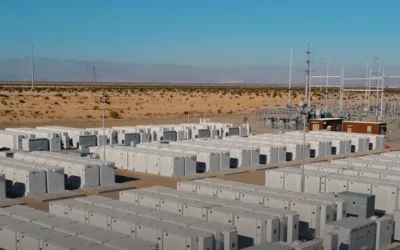
While more energy-dense BESS units mean packing more into smaller footprints, they may have additional implications for noise and fire safety, a developer source told Energy-Storage.news.
With the widespread proliferation of lithium-ion battery energy storage system (BESS) technology, suitable land for projects has become harder to come by. This has made energy density an increasingly important consideration for developers when procuring BESS for projects and various BESS providers now provide as much as 5MWh in a 20-foot shipping container-sized unit.
But, more energy-dense systems come with additional considerations. Engineering, procurement and construction (EPC) firm Burns & McDonnell recently wrote an article on the topic for PV Tech Power (Vol.37), Solar Media’s quarterly journal covering the downstream solar and storage industries.
In it, Burns & McDonnell compliance expert Ben Echeverria and engineering manager Josh Tucker wrote that designing projects to get as much energy into a smaller footprint could bring up complications around then need to build vertically as well as transporting BESS – which are already substantially heavy even when less energy-dense – to the project site.
Try Premium for just $1
- Full premium access for the first month at only $1
- Converts to an annual rate after 30 days unless cancelled
- Cancel anytime during the trial period
Premium Benefits
- Expert industry analysis and interviews
- Digital access to PV Tech Power journal
- Exclusive event discounts
Or get the full Premium subscription right away
Or continue reading this article for free
A separate source working for a project developer told Energy-Storage.news that increased energy density within BESS units also means a noisier system, particularly important in densely populated countries like in Europe, and potentially one with additional fire safety considerations.
Speaking anonymously, they said: “The downside is the energy-dense systems are definitely noisier. There is more energy in a smaller area so you are having to do more intensive cooling, so that might not be able to be deployed in some places.”
“Integrators focusing on noise solutions is really important in GB and other European markets, maybe less so in the US where there’s more space. In Europe, noise is almost always a significant consideration.”
Noise in BESS projects typically comes from the cooling system as well inverters and transformers. The levels are generally typically low although a planning paper for a solar-plus-storage project in the UK suggested that system integrator Wärtsilä’s Gridsolv Quantum BESS product, for example, could reach as high as 70-80 dB (decibels), the equivalent of a washing machine or vacuum cleaner.
The firm recently released the latest iteration of Gridsolv which claimed enhanced fire safety and energy density.
It should still be said that BESS are still far quieter than the thermal power plants and (in off-grid cases) diesel generators they are increasingly replacing.
Alongside noise, a BESS that is significantly more energy-dense than industry standards could carry with it increased fire safety considerations, as our source explained.
“Anecdotally you can draw some correlation between systems you read about catching fire and the ones that are more energy dense, though everyone complies with the same rigorous testing standards,” they said.
“It makes sense, batteries give off heat and it’s important to get rid of that heat and it’s harder to do that if you are packing it in a smaller space. Unless you’ve made it more efficient in which case it’s giving off less heat, and I’m sure those coming up with more energy-dense systems are also putting a lot of work in on cooling systems to cool those effectively.”
Read all Energy-Storage.news articles on the topic of fire safety here.
Energy-Storage.news’ publisher Solar Media will host the 9th annual Energy Storage Summit EU in London, 20-21 February 2024. This year it is moving to a larger venue, bringing together Europe’s leading investors, policymakers, developers, utilities, energy buyers and service providers all in one place. Visit the official site for more info.