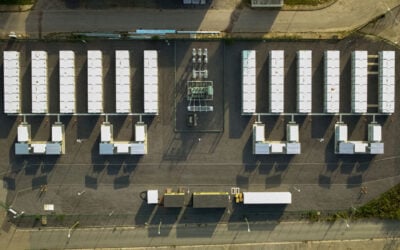
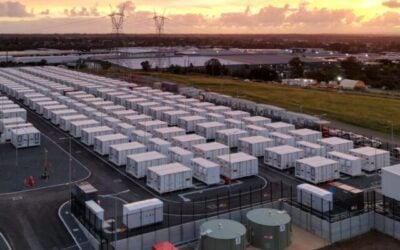
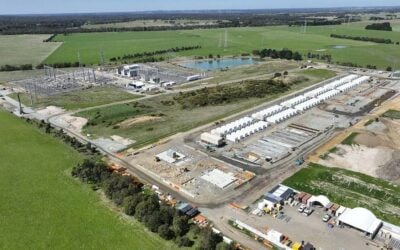
While residential energy storage is expected to be far and away the biggest segment, GTM has also predicted rapid growth at commercial scale. Image: SunPower Australia.
US analysis firm GTM Research has published the latest commentary to highlight significant potential in Australia for energy storage, driven by the success of its PV industry.
‘The Australian energy storage market: Downstream drivers and opportunities’, authored by GTM’s Brett Simon, predicts that by 2020, Australia will be installing 244MW of storage capacity on a yearly basis. In monetary terms, Simon predicts that what was an US$8 million market in 2013 will be worth US$448 million in five years’ time.
Of this total annual capacity figure, as much as 132MW is expected to be deployed behind the meter and paired with PV in homes. Residential energy storage, with households storing their solar to reduce electricity costs, either by reducing their exposure to time-of-use electricity rates or simply by self-consuming a higher proportion of PV-generated power compared to more expensive power from the grid, is likely to drive the market on.
Residential storage will “explode” from 1.9MW deployed this year to 44MW in 2016, the report claims, with the above factors accelerated by big drops in the feed-in tariff (FiT) rates, or by FiT schemes closing early. The country has different FiT schemes for different regions, with different timelines for their phase out or degression. The removal of FiT incentives, replaced by what GTM called “paltry solar export tariffs”, will mean storage makes a growing degree of economic sense for homeowners.
Try Premium for just $1
- Full premium access for the first month at only $1
- Converts to an annual rate after 30 days unless cancelled
- Cancel anytime during the trial period
Premium Benefits
- Expert industry analysis and interviews
- Digital access to PV Tech Power journal
- Exclusive event discounts
Or get the full Premium subscription right away
Or continue reading this article for free
The GTM report also said that commercial-scale storage, while not enjoying prospects for growth as strong as household, will nonetheless ramp up rapidly too. A combination of high demand charges and incentive schemes in South Australia would catalyse this market, from just 1.5MW this year to 23MW in 2016.
Australia’s storage market potential is increasingly well known both at home and abroad
GTM’s report follows closely in the wake of several other reports on the growth potential of energy storage paired with solar in Australia, mostly published by organisations based domestically. Since August, PV Tech’s sister site, PV Tech Storage, has covered reports that have emerged from Australian crowd-funded non-profit organisation Climate Council, technical services company AECOM – commissioned by Australia’s Renewable Energy Agency (ARENA) – and more recently from the Australian Energy Storage Council, an offshoot of the Australian Solar Council.
Meanwhile, recent announcements from Tesla and Enphase have confirmed that both US companies share the enthusiasm of GTM and others for the emerging household solar-plus-storage market in Australia. Tesla has confirmed Australia will be one of the initial markets for Powerwall when the EV maker’s home storage battery finally hits the shelves, with Enphase expected to follow suit.
Meanwhile, Tesla’s collaborator on battery packs, Panasonic, is already trialling multiple applications of its own branded home storage devices with utility Red Energy. According to the GTM report, the interest not only of international firms to sell into Australia, but also of Australia’s electricity retailers to diversify into solar-plus-storage, is a strong indication of its future trajectory.