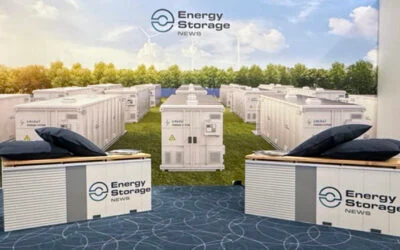
Google has partnered with and made a strategic investment in carbon dioxide-based long-duration energy storage (LDES) company Energy Dome.
The search engine and web services giant has formed a global commercial partnership with the Italy-headquartered startup, potentially using the Energy Dome CO2 Battery to enable carbon-free energy use at scale, Energy Dome announced this morning.
As regular readers of Energy-Storage.news will be aware, Energy Dome’s technology stores energy through adiabatic compression of carbon dioxide (CO2) gas, which is then liquified in the charge cycle before evaporating in the discharge cycle.
Heat created during the compression phase is stored and used in the expansion of the gas, driving it through turbines to generate electricity in a closed loop cycle.
Try Premium for just $1
- Full premium access for the first month at only $1
- Converts to an annual rate after 30 days unless cancelled
- Cancel anytime during the trial period
Premium Benefits
- Expert industry analysis and interviews
- Digital access to PV Tech Power journal
- Exclusive event discounts
Or get the full Premium subscription right away
Or continue reading this article for free
Invented by CEO and founder Claudio Spadaccini, who claims to have combined techniques, characteristics and components of existing industries, Energy Dome says the CO2 Battery is easy to build and low-cost, comes with low environmental and safety risks, and is best-suited for applications requiring 8-hour to 24-hour durations of storage.
In addition, Energy Dome claims its tech can provide grid operators with inertia services due to its use of rotating turbomachinery. Thermal power generators’ turbines have traditionally supplied this, but new sources are being sought as fossil fuel plants retire.
Energy Dome says the CO2 Battery is another option alongside grid-forming battery energy storage systems (BESS) equipped with advanced inverters, which can mimic the frequency-maintaining role and supply ‘synthetic inertia,’ or synchronous condensers, which do the same but without the multi-level benefits of energy storage.
Details of potential projects were not given, but Google’s energy demand is mainly coming from data centres and, increasingly, artificial intelligence (AI).
Energy Dome did say the partners aim to develop projects around the world, including Europe, the US, and the Asia-Pacific region. A pipeline of potential sites and projects has already been identified and is in the development and contracting stages. Financial terms of the digital technology giant’s strategic investment were also undisclosed.
First LDES partnership for Google
Google has already brokered many clean energy deals and formed partnerships for low-carbon power, including a December 2024 agreement with US solar PV and energy storage developer Intersect Power and a recent hydroelectricity deal with Brookfield, but this marks its first foray into the LDES space.
However, the company is known to have publicly expressed interest in LDES solutions, loosely defined as technologies that provide discharge durations at full rated output for anything from six to 24 hours, as Google joined the global Long Duration Energy Storage Council (LDES Council) trade association in 2022.
“Google is committed to powering our operations with clean energy, and Energy Dome’s technologically proven and scalable long-duration energy storage solution can help us unlock rapid progress,” Google director of EMEA energy Maud Texier said.
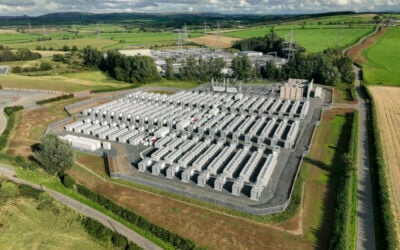
Energy Dome has to date built one 2.5MW/4MWh functioning commercial demonstration project in Sardinia, Italy, which went online in the same year Google joined LDES Council. After its successful operation over the past couple of years, the LDES company is currently building the first large-scale 10-hour duration CO2 Battery, also in Italy.
Another key feature of the CO2 Battery is that the projects can be easily replicated, and Energy Dome’s next project set to go into construction, in Wisconsin, US, will be the same output, storage capacity and form factor as the 20MW/200MWh project in Sardinia.
The startup has signed commercial offtake deals with utilities Engie for its 200MWh Sardinia project and with Alliant Energy for its Wisconsin project, announcing earlier this week that the latter has gained approval from regulators in the US state.
In January, the CO2 Battery was selected for a 20MW/160MWh deployment in India by state-owned power company NTPC, which was among the subjects Energy Dome’s Ben Potter, COO of its storage-as-a-service division, discussed in an interview earlier this year with ESN Premium.
The new partnership “isn’t just about Google,” Maud Texier said.
“By helping to scale this first-of-a-kind LDES technology, we hope to help communities everywhere gain greater access to reliable, affordable electricity and support grid resilience as we integrate more renewable energy sources.”
Energy Dome was the inaugural winner of the LDES Company of the Year award at the 2024 Energy Storage Awards, hosted by our publisher Solar Media.