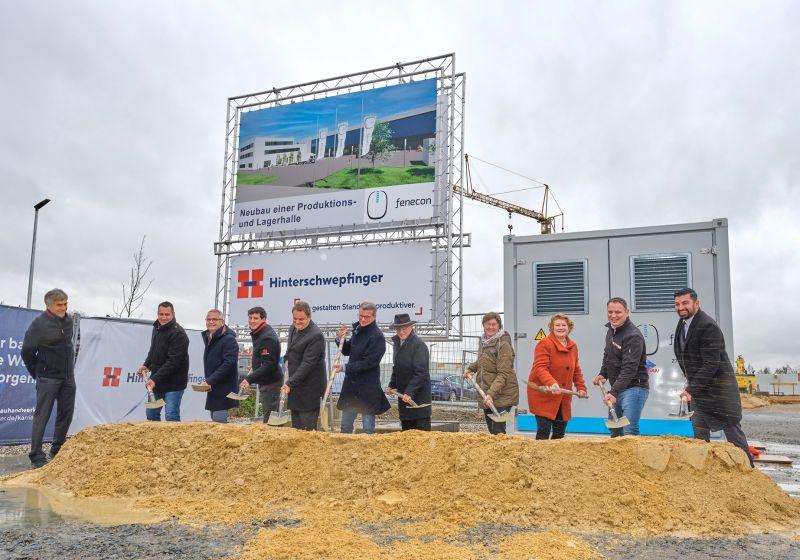
Energy storage hardware and software company Fenecon has begun construction of a new factory in Germany which will repurpose electric vehicle (EV) batteries into stationary storage systems.
The new site in the Bavarian municipality of Iggensbach will produce large-scale battery energy storage systems (BESS) using EV batteries paired with energy management systems (EMS).
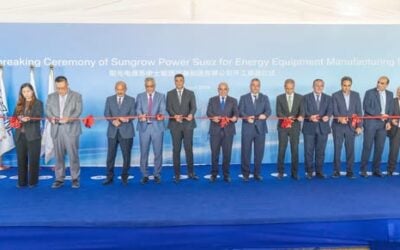
Called CarBatteryReFactory, the site’s construction in an industrial park officially began last week on 18 November with a ceremonial groundbreaking event.
Fenecon, which announced the development yesterday, said the project represents around €22 million (US$22.72 million) investment, with funding contributions of €4.5 million from the European Union (EU) Innovation Fund and €1.7 million from the local Bavarian Economic Development Corporation.
Try Premium for just $1
- Full premium access for the first month at only $1
- Converts to an annual rate after 30 days unless cancelled
- Cancel anytime during the trial period
Premium Benefits
- Expert industry analysis and interviews
- Digital access to PV Tech Power journal
- Exclusive event discounts
Or get the full Premium subscription right away
Or continue reading this article for free
Some funds were also raised by crowdfunded investment, and Fenecon noted a community information and engagement event was attended by more than 200 local people in the evening following the groundbreaking.
Known as “second life” usage, batteries previously used for transportation can be repurposed for on-grid or off-grid stationary energy storage applications.
It’s an area of growing interest in the global battery storage industry, with McKinsey forecasting that some 227GWh of used EV batteries will be available by the end of this decade.
Earlier this year, McKinsey Battery Insights solution manager Nicolo Campagnol told our quarterly journal PV Tech Power that second life won’t be a dominant technology in the energy storage space, but will be a big niche and will play an important role.
Campagnol suggested also that especially for smaller BESS integrators, second life batteries could present a handy supply chain option when availability is constrained, as it continues to be at the moment.
Fenecon, which has been in the second life business since 2017, will be able to move up from small series production at its current plant to large series production at the CarBatteryReFactory by the end of next year, the company claimed.
“The recognition from the European Union and the funding from the Bavarian Ministry of Economic Affairs make this innovative project of industrialised manufacturing for the transition from mobile batteries to stationary batteries possible in the first place,” Fenecon founder and CEO Franz-Josef Feilmeier said.
“We are proud to further advance the 100% energy transition with this extremely useful secondary use of e-car batteries and to create urgently needed electricity storage capacities in Germany.”
In an article published on this site yesterday, various companies involved with second life batteries for BESS commented on how useful the technology could be in establishing a more sustainable battery industry based around circular economy principles.
Once batteries are below 80% capacity after a few years of use in EVs, they are deemed no longer suitable for that application. However stationary energy storage applications can be much less demanding of batteries – depending on how they’re used – and those secondary EV batteries can often serve them adequately.
In yesterday’s article, it was noted that ‘third life’ batteries could also become a useful niche in the market: after use for transport, the batteries could be used for a time for grid-stabilising ancillary services. Once they’ve degraded a bit further and lost a little more capacity, they could find their third purpose as backup power resources.
Fenecon noted however that initially production at its Iggenbach plant will begin using conventional batteries designed for BESS and begin large series production from EV batteries, including new and used, from 2024.
The production capacity of the factory has not yet been disclosed but Fenecon claimed it will be Europe’s largest second life-based factory.
Fenecon sees one of its main differentiators and strengths as being its EMS technology, which it claims has been designed to be future proofed. As well as renewable energy and battery storage controls, it is also designed to be able to integrate numerous other energy resources like heating.
At this year’s Intersolar Europe / Electrical Energy Storage Europe trade show in Munich, Fenecon’s Franz-Josef Feilmeier said that for both hardware and software, it would be hugely advantageous to the industry to have an open source ecosystem.
Enabling compatibility across different energy storage systems, EV chargers, heat pumps and other technologies would lower costs and increase accessibility. Feilmeier cited the example of smart phones, which are based on shared operating system platforms open to different app developers.
Second life battery storage will be in focus in a feature article in the forthcoming Q4 2022 edition of PV Tech Power, due out in December. See here for more details on how to subscribe.
Energy-Storage.news’ publisher Solar Media will host the 8th annual Energy Storage Summit EU in London, 22-23 February 2023. This year it is moving to a larger venue, bringing together Europe’s leading investors, policymakers, developers, utilities, energy buyers and service providers all in one place. Visit the official site for more info.