Geothermal-based energy storage company EarthBridge Energy has secured land rights to deploy its technology in Texas.
The Texas General Land Office issued a geothermal lease to EarthBridge in West Texas, the company announced earlier this week (2 May).
EarthBridge said it now plans to deploy its GeoBattery energy storage technology as part of a new, hybrid energy development combining additional, on-site renewable energy resources.
CEO Derek Adams said: “This marks an important step in EarthBridge’s strategy to deploy geothermal energy storage assets across the US and adds a key project to our portfolio.”
Try Premium for just $1
- Full premium access for the first month at only $1
- Converts to an annual rate after 30 days unless cancelled
- Cancel anytime during the trial period
Premium Benefits
- Expert industry analysis and interviews
- Digital access to PV Tech Power journal
- Exclusive event discounts
Or get the full Premium subscription right away
Or continue reading this article for free
The company’s system will absorb excess electricity from wind and solar farms and store it for 10-1000+ hours, feeding it back to the grid when it is needed.
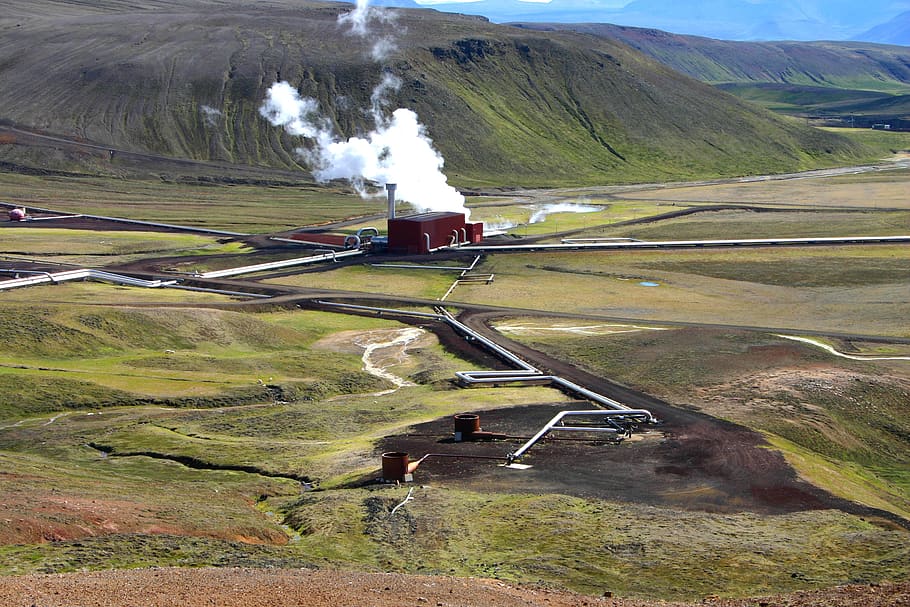
The system stores heat energy in subsurface reservoirs and converts it back to electricity using a high-efficiency turbine. The technology brings the installed cost of long-duration energy storage (LDES) below $10/kWh and enables the deployment of 100% carbon-free energy at scale, EarthBridge claimed.
To charge, the system draws water from an underground reservoir via a well, which is then simultaneously heated and cooled when at the surface by an electrical heat pump. The heated and chilled water are then stored in different zones of an underground reservoir, or different reservoirs, depicted below (taken from a company overview).
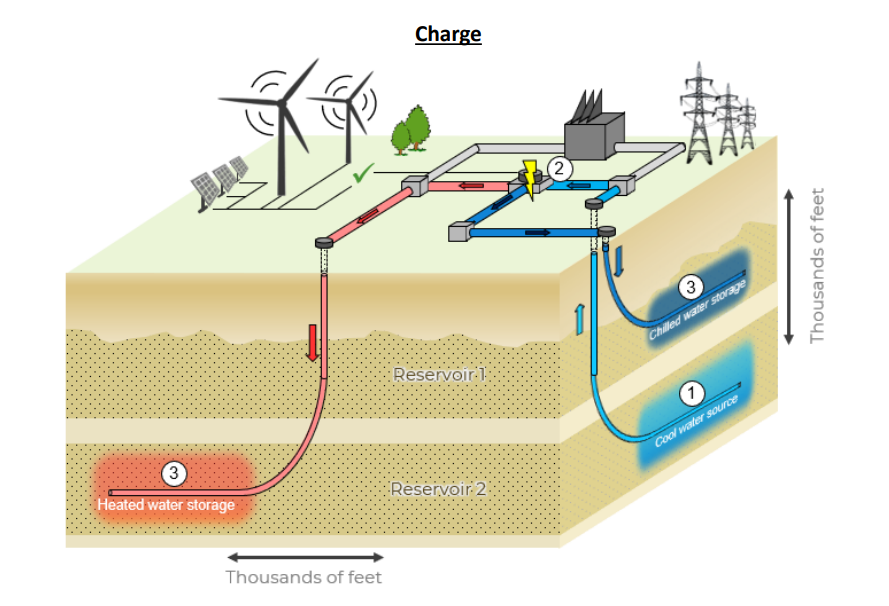
To charge, the system brings the heated and chilled water back to the surface where the heat pump system is reversed and used to drive a power turbine converting the thermal energy back to electricity. The outflow water is directed back to the source well.
The company said its Geobattery doesn’t require hot geothermal sources so can be deployed anywhere where you can drill a well for water. Major sedimentary basins are a sweet spot, it added.
The company intends to mainly monetise its technology using price arbitrage in the wholesale energy market.
It can be deployed front-of-meter like any generating facility, or behind-the-meter through a PPA with a wind or solar farm or as an asset sale with a development fee.
Last month, the company partnered with the US Department of Energy and three national labs – National Renewable Energy Laboratory (NREL), Lawrence Berkeley National Laboratory and Idaho National Laboratory – to explore the potential of underground geothermal energy storage across the US.