
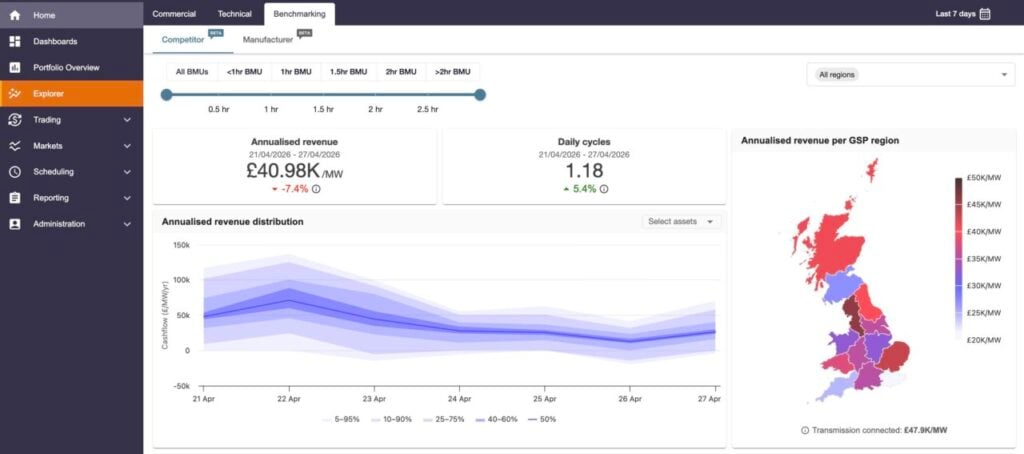
There can be great value in two assets sharing a grid connection, but the operational reality is not as simple as it may sound. The question is not how to remove the complexity, but how to manage it, writes Daniel Moore-Oats of Arenko.
This is an extract of a feature article that originally appeared in Vol.46 of PV Tech Power, Solar Media’s quarterly journal covering the solar and storage industries.
Every edition includes ‘Storage & Smart Power,’ a dedicated section contributed by the Energy-Storage.news team. Full access to upcoming issues as well as the 10-year back catalogue is included as part of a subscription to Energy-Storage.news Premium.
Co-located renewables with battery projects are great investment options with a real chance to make energy systems more efficient and resilient, addressing the core challenge of renewable energy, intermittency. On paper, the logic is simple enough – put a battery next to a solar or wind farm, share a grid connection, and use the battery to smooth output, capture excess generation, and respond to market signals.
Try Premium for just $1
- Full premium access for the first month at only $1
- Converts to an annual rate after 30 days unless cancelled
- Cancel anytime during the trial period
Premium Benefits
- Expert industry analysis and interviews
- Digital access to PV Tech Power journal
- Exclusive event discounts
Or get the full Premium subscription right away
Or continue reading this article for free
However, as soon as two assets start sharing a grid connection, their combined operations become highly complex and dynamic. The system is no longer just about generating power or storing it. It becomes a constant balancing act between what was forecast to happen, what’s physically happening on site, and what the market and grid are asking for at any given moment.
At this point, real-time data and system integration stop being ‘nice to have’ and become fundamental to whether a project truly performs. This article is based on examples in the UK, but many of its takeaways will be more widely applicable.
Forecasts are precisely that: a forecast
Most renewables assets rely heavily on day-ahead forecasts and forecasts are always wrong. Traders take a view on what a site is likely to generate tomorrow, trade into the market accordingly, and then manage any deviations as they arise.
This approach works well, or at least predictably, for standalone assets. The majority of volume is traded day-ahead, and while forecasts aren’t perfect, the deviations are contained to imbalance prices on the renewable asset. Co-location changes the equation.
When a battery energy storage system (BESS) is operating alongside a solar or wind asset, it needs to know not just what was forecast yesterday, but what’s really happening right now – and what’s likely to happen in the next few minutes or hours. If it doesn’t, you start to see inefficiencies creep in with significant value implications, particularly on the battery and its business case.
A useful analogy is Formula 1 motor racing. A team runs two cars, each with its own pace, tyre strategy, and position in the race. But they are not competing against each other; they are working towards a single team result which ultimately determines financial reward. The pre-race strategy sets the plan, much like a day-ahead forecast. But races are not won on the starting grid. They are won on the pit wall, where teams are constantly reacting to live data, adjusting strategy, and coordinating both cars in real time – especially when conditions change suddenly.
Co-located assets operate in much the same way. Solar and BESS are two distinct assets, each with different capabilities, constraints, and optimal moments to act. The day-ahead plan provides the framework, but it is the speed and quality of intraday adjustments, and ultimately real-time coordination, that determine overall performance. When conditions shift, as they inevitably do, the ability to see what both assets are doing and to respond is what separates value captured from value lost.
This visibility also matters beyond the site
But even with better intraday forecasting, the problem is not fully resolved because the real world continues to change after ‘gate closure’. The key question then becomes “how do systems respond in real time?”
Once traders and asset operators get into real-time operations, things become much more immediate. Forecasts are still there in the background, but now they’re dealing with what the asset is physically doing. This is where the real-time data and automation really kicks in because when solar or wind output jumps unexpectedly, and assets are sharing a grid connection, those changes have direct consequences.
On-site control systems are constantly monitoring this. If generation suddenly increases and risks breaching the grid connection, something has to be curtailed. Often, that means the battery automatically reduces its output.
If a battery has been curtailed because the solar asset is generating more than expected, its ability to export is reduced. If this information isn’t communicated, the system operator might still think that capacity is available and try to dispatch it. At best, this creates inefficiency for the asset operator and penalties for the owner; at worst, it means the system operators are unable to manage the grid when they need to most.
When we step back and look at everything involved, the sheer scale of coordination needed becomes clear: forecasting systems generate multiple views of expected generation; optimisation platforms determine battery behaviour and prices; on-site control systems enforce physical limits; metering systems track real-world performance. Sitting on top of all of this are the system operator’s platforms.
All these systems need to talk to each other, and they need to do it quickly and reliably.
The challenge is that they weren’t all designed together. They often belong to different organisations, use different data formats, and operate on different timescales. Getting them to work as a cohesive whole is not trivial, and without that level of integration, gaps emerge. Those gaps are where value is lost.
Turning overbuild and clipping into captured value
All of this really starts to matter when you look more closely at overbuild, clipping and how value is actually captured.
Most solar sites today aren’t sized exactly to their grid connection. Instead, they are intentionally overbuilt to maximise output during the shoulder periods – mornings and evenings – even if that means hitting the grid limit and clipping generation at peak times.
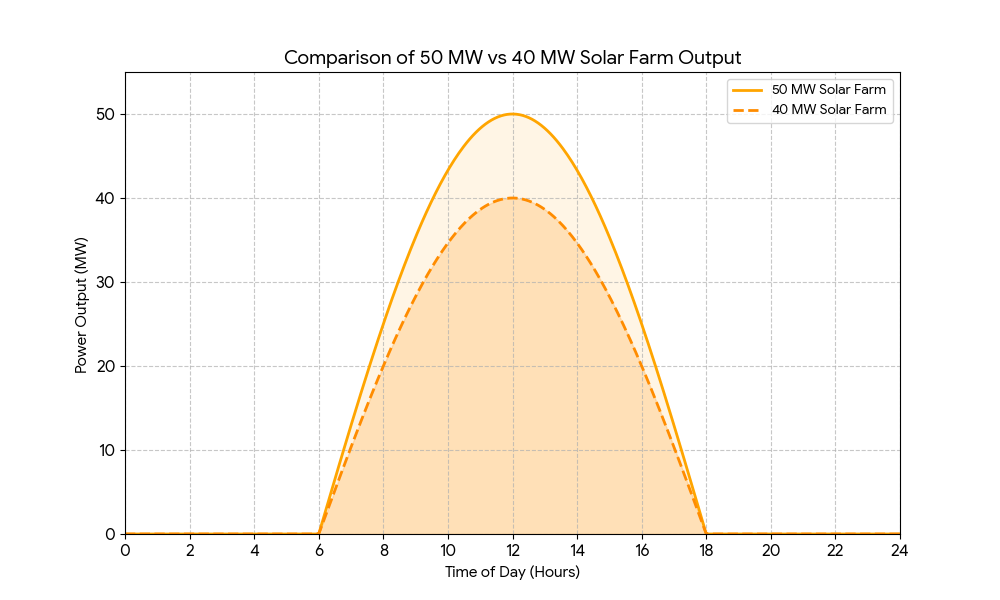
This dynamic is illustrated above, where the solar plant’s capacity exceeds the export limit, allowing more energy to be generated outside of peak irradiance hours and increasing overall utilisation of the connection.
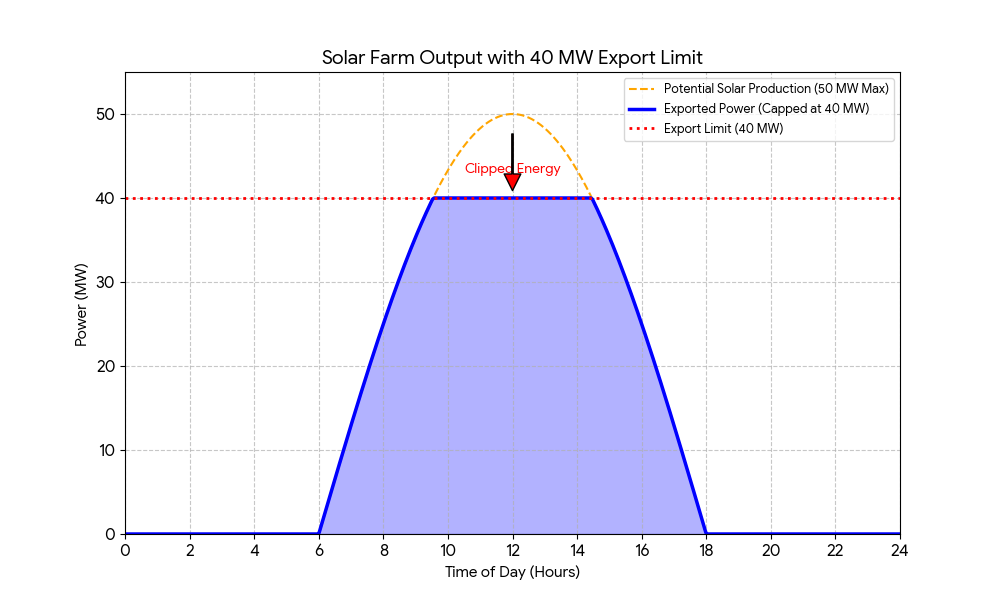
However, the benefits of overbuilding also come with an inherent inefficiency. As shown below, during the middle of the day the site reaches its grid constraint and any additional generation is clipped. On a standalone solar asset, that excess energy cannot be exported and is simply lost, despite having been physically generated. For this particular example, in the last month alone, this has happened 46 times.
Co-location fundamentally changes this dynamic. In the chart below, the battery begins to absorb that excess generation at the point where clipping occurs. Instead of being curtailed, the surplus energy is redirected into storage around periods of anticipated clipping. This is not just a theoretical shift — it depends on accurately identifying when clipping is likely to occur and aligning the site’s activity in advance, within the grid code constraints.
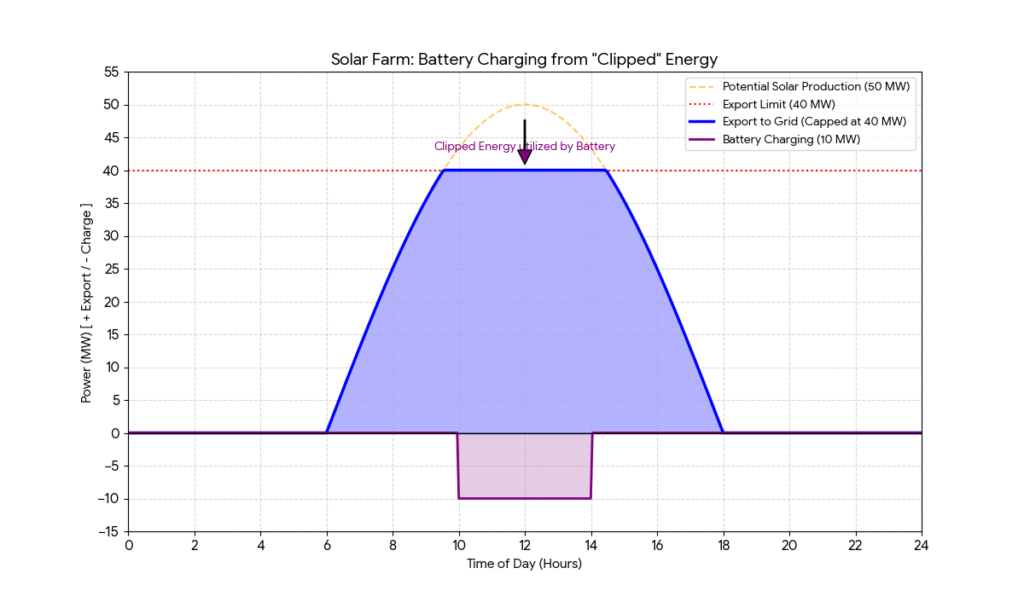
Such an intervention has a knock-on effect, as shown below. By importing energy, the battery effectively creates headroom on the grid connection. This relieves the export constraint and allows more of the solar generation to flow without being clipped. In other words, the battery is not just capturing excess energy; it is actively reshaping the site’s operating profile.
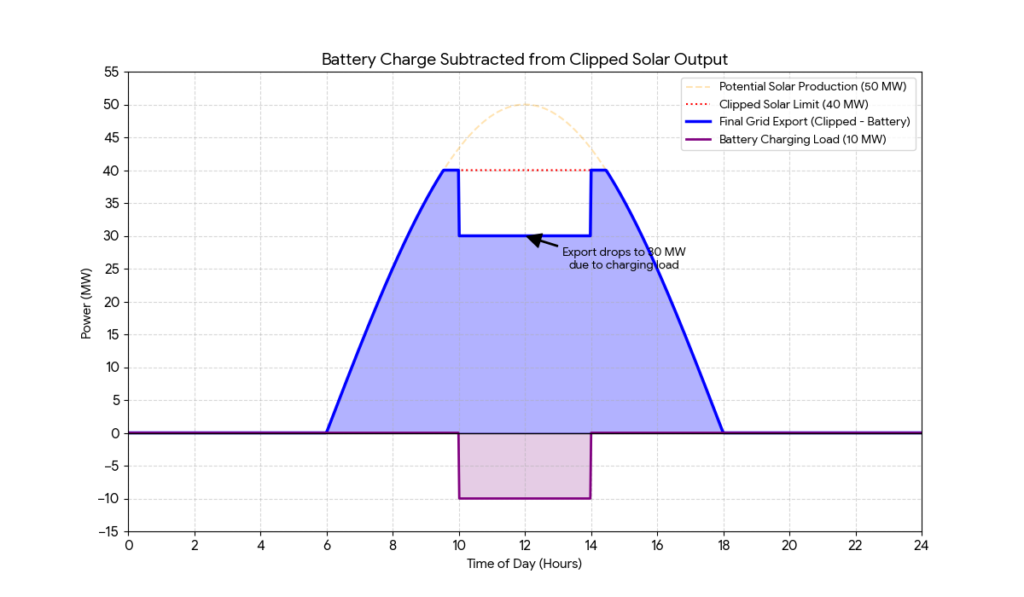
This final chart brings these dynamics together. The energy that would previously have been lost is now captured, stored and ultimately exported when there is available capacity on the grid connection. What was once structural inefficiency becomes additional value.
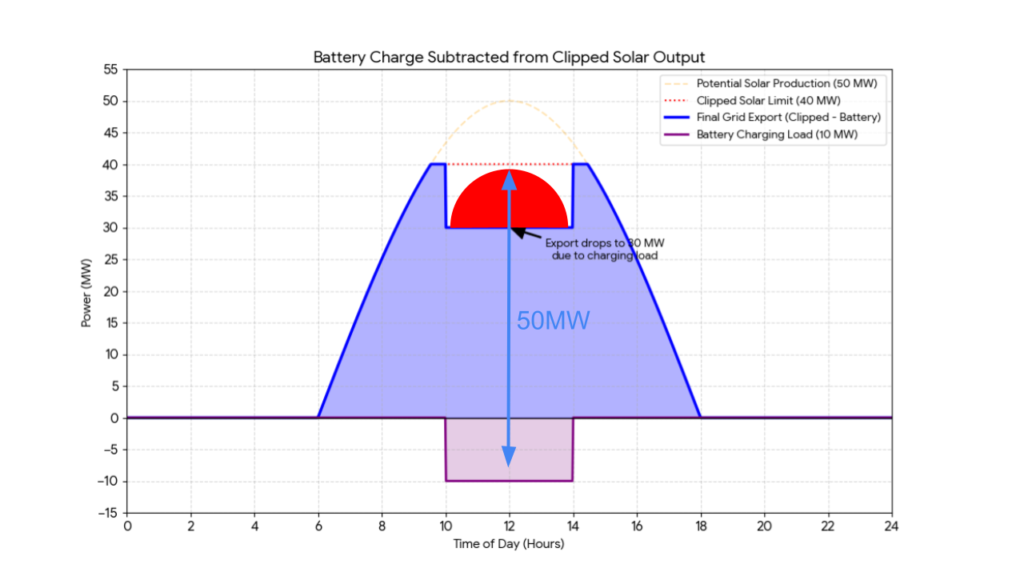
While this sequence appears straightforward when set out visually, in practice it relies on continuous, real-time coordination. The system needs to respond to actual site conditions, but within the constraints of the grid code. This makes capturing clipped energy a coordination challenge rather than a purely reactive one.
Success depends on accurate data, integrated systems, and co-optimisation to anticipate when clipping will occur, determine how much excess generation is available, and ensure storage capacity is deployed effectively so that energy can be captured and monetised later.
The figures above are not just showing operational behaviour. They also depict the flow of value. The first part of the sequence highlights where value is created but constrained, while the latter part shows how co-location allows that value to be captured and preserved.
The role of the battery, therefore, shifts. It is no longer only an optimisation tool for market participation; it becomes a mechanism for protecting revenue that is already effectively locked in
The priority, therefore, changes, too. The objective is not simply to chase arbitrage opportunities or respond to price signals, but to ensure that as much renewable generation as possible is captured and delivered. Every unit of avoided clipping directly translates into retained value.
Making complexity manageable
The reality is that co-located projects that share a grid connection are extremely complex to operate and capture the most value from. This complexity isn’t going away. If anything, it’s going to increase as more co-located and hybrid projects come online. So, the question is not how to remove it, but how to manage it. This is why technology platforms are so important. The role they play is less about simplifying the system and more about making it usable.
Arenko’s Nimbus platform coordinates the solar asset and battery in real time, sitting across all the different layers: forecasts, controls, markets and grid signals, providing a way to connect them.
These platforms are designed to ingest data from multiple sources, process it in real time, and feed it into optimisation and control decisions. The technology doesn’t remove the complexity; instead, it allows asset and system operators to work with it, rather than against it.
As the energy system becomes more decentralised and more reliant on renewables, this kind of coordination becomes increasingly important.
Instead of a small number of large, predictable assets, we’re moving towards a system comprising many smaller, more variable ones, which naturally increases the need for real-time visibility and control.
Co-located projects are the very essence of this shift in how the grid operates, but in a microcosm. These projects make better use of existing infrastructure, reduce curtailment, and provide grid flexibility. So, the question you have to ask yourself if you are investing in or operating co-location isn’t whether real-time data matters – it clearly does – but do you have the ‘digital backbone’ to deliver the deep systems integrations and automation you need to act on it? If not, how will you ensure you deliver your co-location business case?
About the Author
Daniel Moore-Oats is director of product at Arenko, a UK-based clean energy software provider that enables trading desks, utilities and asset owners to digitally connect energy assets with revenue opportunities. Moore-Oats has spent over a decade in a wide range of business technology roles and has been with Arenko since 2022, where he leads the Product Team that develops the Nimbus product suite – a secure digital backbone that allows multi-technology clean energy asset owners and operators to manage, trade and optimise their portfolios at scale.
