A double-header of big news from Germany, with construction starting on a ‘Grid Booster’ BESS from TransnetBW and Fluence and the EU putting €58 million towards a project that will combine green hydrogen and iron flow battery storage at scale.
First of several Grid Booster BESS projects in Germany
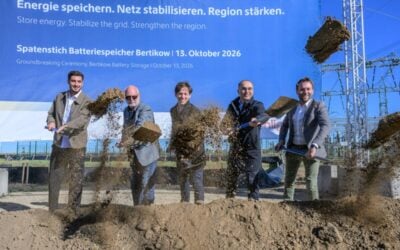
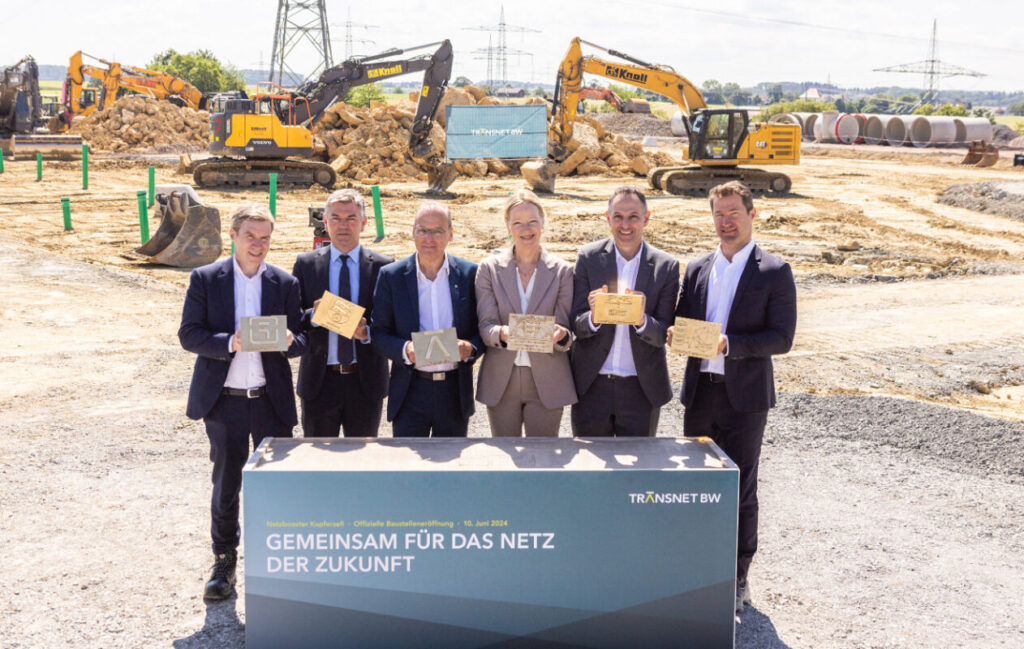
Construction has started on the 250MW/250MWh Grid Booster battery energy storage system (BESS) project in Germany from transmission system operator (TSO) TransnetBW and system integrator Fluence.
The project in Kupferzell, Baden-Württemberg will act as a transmission asset for TransnetBW to operate the grid more efficiently, particularly in light of regional imbalances in Germany’s electricity system – renewable generation is predominantly in the north while demand centres are in the south.
A big part of that is mimicking the function of the extra long-distance, high-voltage lines which serve as a backup for primary lines, allowing for more use of those lines.
Try Premium for just $1
- Full premium access for the first month at only $1
- Converts to an annual rate after 30 days unless cancelled
- Cancel anytime during the trial period
Premium Benefits
- Expert industry analysis and interviews
- Digital access to PV Tech Power journal
- Exclusive event discounts
Or get the full Premium subscription right away
Or continue reading this article for free
The project – Netzbooster in German – was approved by the regional council in April, allowing for construction to go ahead and for Fluence to start shipping BESS units.
Dr. Werner Götz, CEO and chairman of TransnetBW, said: “By using this technology in innovative ways we can increase capacity in the existing electricity grid and integrate more renewable energy. The Netzbooster is thus making an important contribution towards the energy transition.”
Grid Boosters are sometimes called storage-as-transmission or non-wires alternative (NWA) when at the smaller scale. Germany is the first country to launch such projects using BESS at scale, introducing the concept around five years, while similar projects have been deployed in Lithuania, Brazil, and some US states such as New York.
Fluence is also providing the BESS for two Grid Boosters from another of Germany’s four TSOs, TenneT, totalling 200MW while another TSO, Amprion, is deploying five totalling 250MW with the BESS provider not yet revealed.
EU puts €58 million towards LEAG’s hydrogen-plus-flow battery project
In similarly-timed news, the EU has provided a grant of €58 million (US$62 million) to coal and lignite power plant operator LEAG for a project that will combine green hydrogen and novel flow battery technology.
The funding is from the Just Transition Fund (EU JTF) and will go to LEAG’s ‘H2UB’ project. The project is aimed to building a centre for green hydrogen production paired with large-scale energy storage at its Boxberg power plant site.
In June last year, it tied up with NYSE-listed iron flow battery company ESS Inc to use the company’s proprietary technology for a 50MW/500MWh system as part of the project.
In the EU funding announcement, LEAG said the funding would go towards the hydrogen and ‘construction of a solid flow battery as a storage facility for electricity from renewable energies’ though it didn’t mention iron flow batteries or ESS Inc specifically.
In response to queries from Energy-Storage.news, LEAG said the ‘funding refers to parts of the H2UB Boxberg project’ while ESS Inc said the funding is not for its part of the project specifically but for the larger programme to combine hydrogen and energy storage at Boxberg.