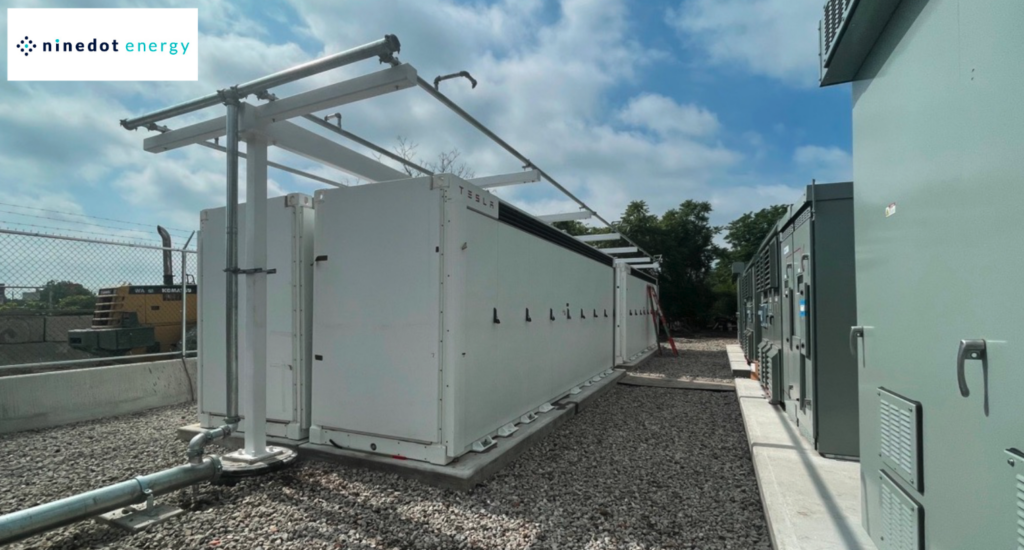
The first battery energy storage system (BESS) in New York City using Tesla Megapacks, a 12MWh system in the Bronx by NineDot, has been inaugurated.
Community-scale renewable energy project developer NineDoty Energy unveiled the 3.08MW/12.32MWh BESS unit yesterday (9 August). Alongside the four-hour battery, the project – called Gunther – includes a solar PV canopy and infrastructure ready for bi-directional electric vehicle (EV) charging points.
The project appears to have been developed for NineDot by commercial and industrial-focused (C&I) energy storage system integrator Stem Inc. In January, the two companies announced a deal for over 110MWh of front-of-meter BESS projects delivered by Stem for NineDot and a press release about Gunther’s inauguration listed Stem as one of the project partners.
David Arfin, NineDot Energy CEO and co-founder: “Building battery storage sites in a dense urban environment requires an unusual set of skills and experience all brought together in NineDot Energy, as well as support from a wide range of visionary regulators and policy-makers and a terrific group of dedicated partners who we are thanking today.”
Try Premium for just $1
- Full premium access for the first month at only $1
- Converts to an annual rate after 30 days unless cancelled
- Cancel anytime during the trial period
Premium Benefits
- Expert industry analysis and interviews
- Digital access to PV Tech Power journal
- Exclusive event discounts
Or get the full Premium subscription right away
Or continue reading this article for free
The company said it builds its battery storage projects in areas that sit at the intersection of existing infrastructure and high energy demand, in this case a ‘barely-used sliver of land in the Bronx’. It has a pipeline of 400MW of clean energy systems to 2026.
The project received US$1.2 million from the New York State Energy Research and Development Authority (NYSERDA) through the Retail Energy Storage Incentive Program. The programme provides commercial customers funding for systems up to 5MW in size, grid-connected or behind-the-meter, and provide value to a customer under an investor-owned utility rate, including delivery charges or New York State’s value of distributed energy resources (VDER) programme.
Several BESS projects using Tesla Megapacks, the EV giant’s biggest utility-scale storage product, have been announced over the past month and reported on by Energy-Storage.news.
They range from a 12MWh system being built in Somerset, UK, after local opposition thwarted original plans to build a gas generator, to much larger 198MWh and 300MWh projects in the UK and Australia, respectively. The EV giant was the third-largest BESS system integrator globally as of the end of 2021 according to research firm IHS Markit.