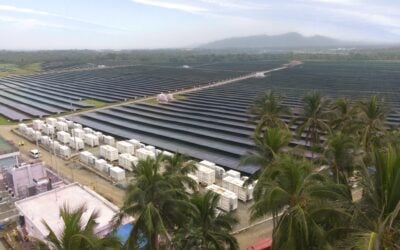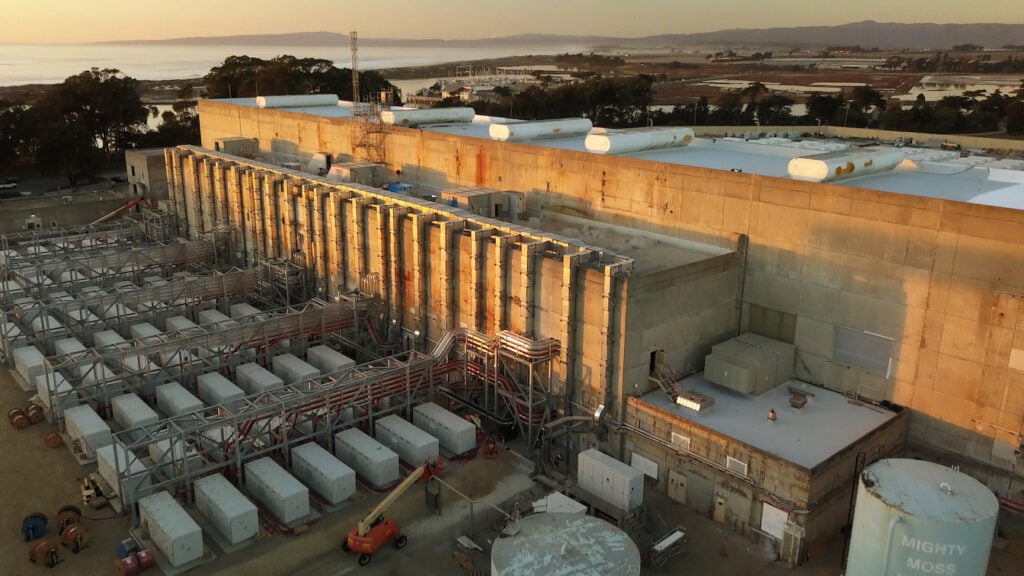
Augmentation at the Vistra Moss Landing Energy Storage Facility in California has been completed, with the world’s biggest battery energy storage system (BESS) now at 400MW / 1,600MWh.
Retail and power generation company Vistra Energy brought the 300MW / 1,200MWh Phase 1 of the BESS project online in December 2020 at a site formerly occupied by natural gas turbines at its Moss Landing Power Plant in California’s Monterey County.
Vistra and lithium-ion battery rack supplier to the project LG Energy Solution held a media day yesterday to celebrate the successful completion in July of Phase 2. Along with the two companies and their engineering, procurement and construction (EPC) partner Burns & McDonnell, the event was attended by representatives from California grid and electricity market operator CAISO, utility Pacific Gas & Electric (PG&E), federal and local authorities and business leaders.
“This facility provides a solution California desperately needs and this expansion was able to come online at the right time – as the summer heat intensifies and demand for electricity is at its highest,” Vistra CEO Curt Morgan said.
Try Premium for just $1
- Full premium access for the first month at only $1
- Converts to an annual rate after 30 days unless cancelled
- Cancel anytime during the trial period
Premium Benefits
- Expert industry analysis and interviews
- Digital access to PV Tech Power journal
- Exclusive event discounts
Or get the full Premium subscription right away
Or continue reading this article for free
“The state’s laudable immense buildout of intermittent renewable power has both lowered emissions and presented a reliability challenge. California produces an excess amount of renewable power during the day while the sun is up, but often struggles to meet demand as the sun goes down. Our Moss Landing battery system helps to fill that reliability gap, storing the excess daytime power so it doesn’t go to waste and then releasing it to the grid when it’s needed most.”
There is a 10-year agreement for Resource Adequacy in place with PG&E for the Phase 2 capacity, while Phase 1 has a 20-year agreement along similar lines. Resource Adequacy is the means by which California’s utilities must provide reliable local electricity capacity for their customers, meeting CAISO’s requirements.
California’s energy and climate crisis: Battery storage is answering the call
As Vistra CEO Curt Morgan said, California is in the midst of an acute shortage of electricity, particularly so during increasingly frequent summer heat waves, while wildfires aren’t helping either. State governor Gavin Newsom recently declared of a State of Emergency with a predicted shortfall of as much as 5,000MW expected over the next two years.
In doing so, Newsom committed to expediting renewable, energy storage and demand response projects, while also publishing a roadmap for achieving California’s aims of getting to an emissions-free electricity system by 2040. The roadmap similarly leaned heavily on promoting and expediting clean energy technologies including short and long-duration energy storage.
“The energy storage facility that Vistra is deploying in Moss Landing will help us build a more reliable, low-emission grid, providing zero-emission power to communities far and wide when they need it. As we face the increasing threat of wildfires and disruptions to our grid, this backup power can serve to bolster our grid’s stability and reliability,” Congressman Jimmy Panetta, who attended the event yesterday, said.
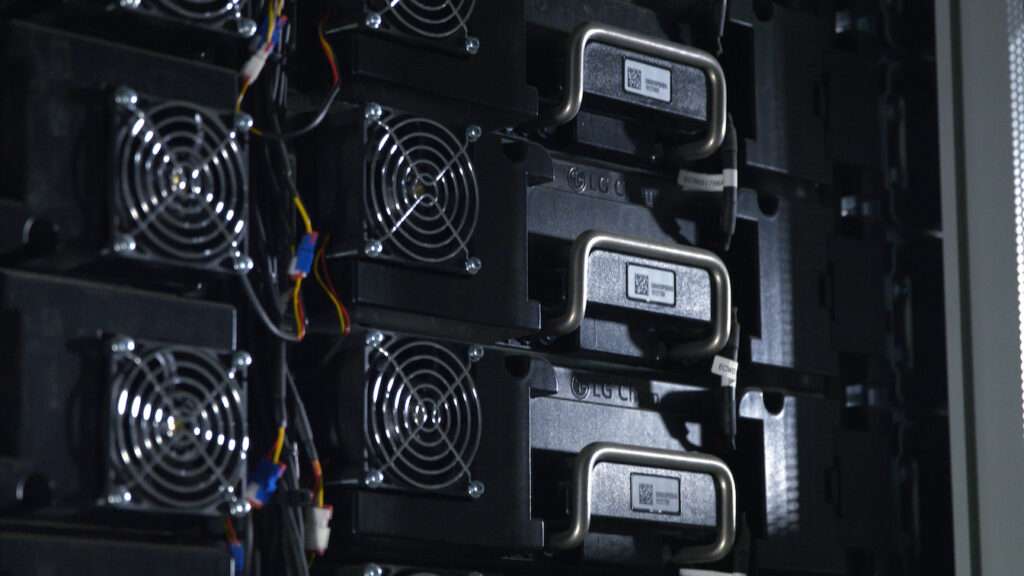
LG Energy Solution noted in a press release that it worked to remain on schedule to supply its TR1300 battery storage racks to the project despite the global shipping crisis caused by COVID-19. LG’s involvement in the project had been revealed in a June announcement.
The site could still be expanded further, to up to 1,500MW / 6,000MWh. Vistra’s Curt Morgan said it not only has the space but would be able to utilise the existing site infrastructure, “including existing transmission lines and grid interconnection”.
Somewhat confusingly, another large-scale battery storage project is sited at Moss Landing, using Tesla Megapack storage systems, developed by PG&E. While still among the world’s largest such projects, that one will be smaller than Vistra’s at 182.5MW / 730MWh. The pair were among four large-scale battery storage systems approved by the California Public Utilities Commission (CPUC) in 2018 to replace gas peaker plants the utility is retiring.
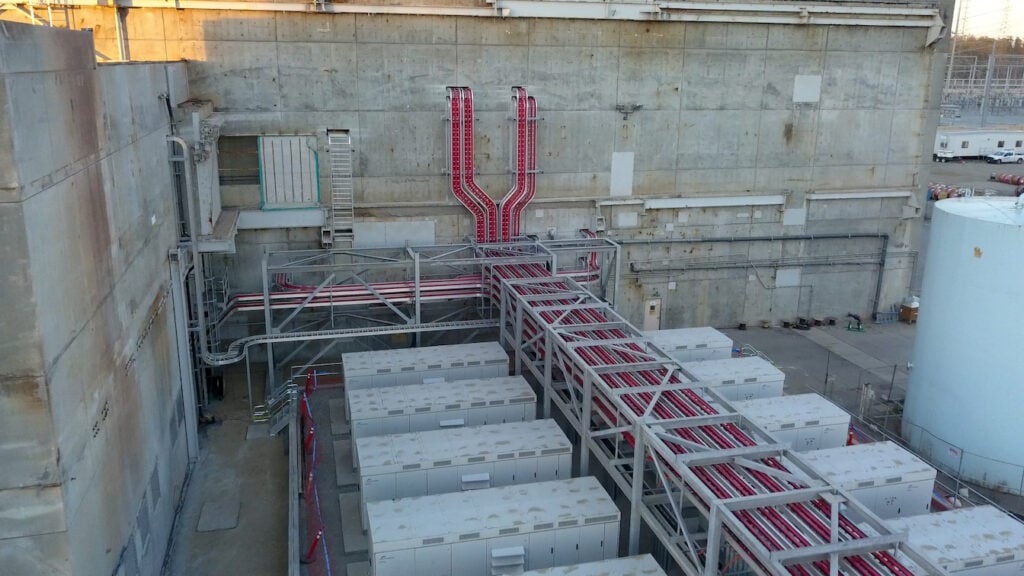
Vistra’s Moss Landing facility contributed to the US having a record-breaking year in 2020 when the country went beyond a gigawatt of advanced energy storage installations for the first time. Coming fairly close is Crimson, a 350MW / 1,400MWh BESS project also being built in two phases in California, by developer Recurrent Energy for its parent company Canadian Solar.
Other, even larger projects have been proposed, notably in Australia by a number of developers and investors, but are yet to gain approvals and the financial close necessary to proceed. Vistra Energy itself is also proposing a 600MW project in Morro Bay, California. Vistra is targeting net zero emissions by 2050 and its interim targets include 7,500MW of coal plant retirements by 2027 and the deployment of around 9GW of renewables in the US by 2030.
Of the BESS project, Monterey County Supervisor John M. Phillips said Moss Landing had long been associated in peoples’ minds with its “landmark power plant and two smokestacks”.
“In fact, Vistra’s Moss Landing Energy Storage Facility is the largest battery storage facility of its kind in the world and is providing a tremendous amount of reliable, clean energy,” he said.