European authorities have waved through a multi-billion-euro scheme to turn the continent into a global hub for green battery making, amid hints that barriers could be set for foreign imports.
This week, the European Commission gave the nod to a €3.2 billion (US$3.5 billion) plan by major EU states to create a “pan-European” battery ecosystem via a coordinated research push alongside industry operators.
The so-called IPCEI – Important Project of Common European Interest, a status conferred to research schemes seen as key in the EU – will see Belgium, Finland, France, Germany, Italy, Poland and Sweden support their respective national battery industries with the Commission’s blessing.
The €3.2 billion will bankroll projects by 17 sector players across the seven countries, from BASF to Eneris, BMW, Enel X and Fortum. At a respective €1.25 billion (US$1.38 billion) and €960 million (US$1.06 billion), German and French battery schemes will reap a sizeable slice of the funding.
Try Premium for just $1
- Full premium access for the first month at only $1
- Converts to an annual rate after 30 days unless cancelled
- Cancel anytime during the trial period
Premium Benefits
- Expert industry analysis and interviews
- Digital access to PV Tech Power journal
- Exclusive event discounts
Or get the full Premium subscription right away
Or continue reading this article for free
The multi-country project will be structured along the four core steps of the battery chain, from the more efficient sourcing of ores to the development of cells and modules, the roll-out of software- and algorithm-powered battery systems and sounder recycling and dismantling practices.
The €3.2 billion pot will focus on lithium-ion batteries, both liquid electrolytes and solid-state systems, and seek to unlock a further €5 billion in private money. If backed projects exceed their revenue expectations, they will return the extra gains to their respective member states.
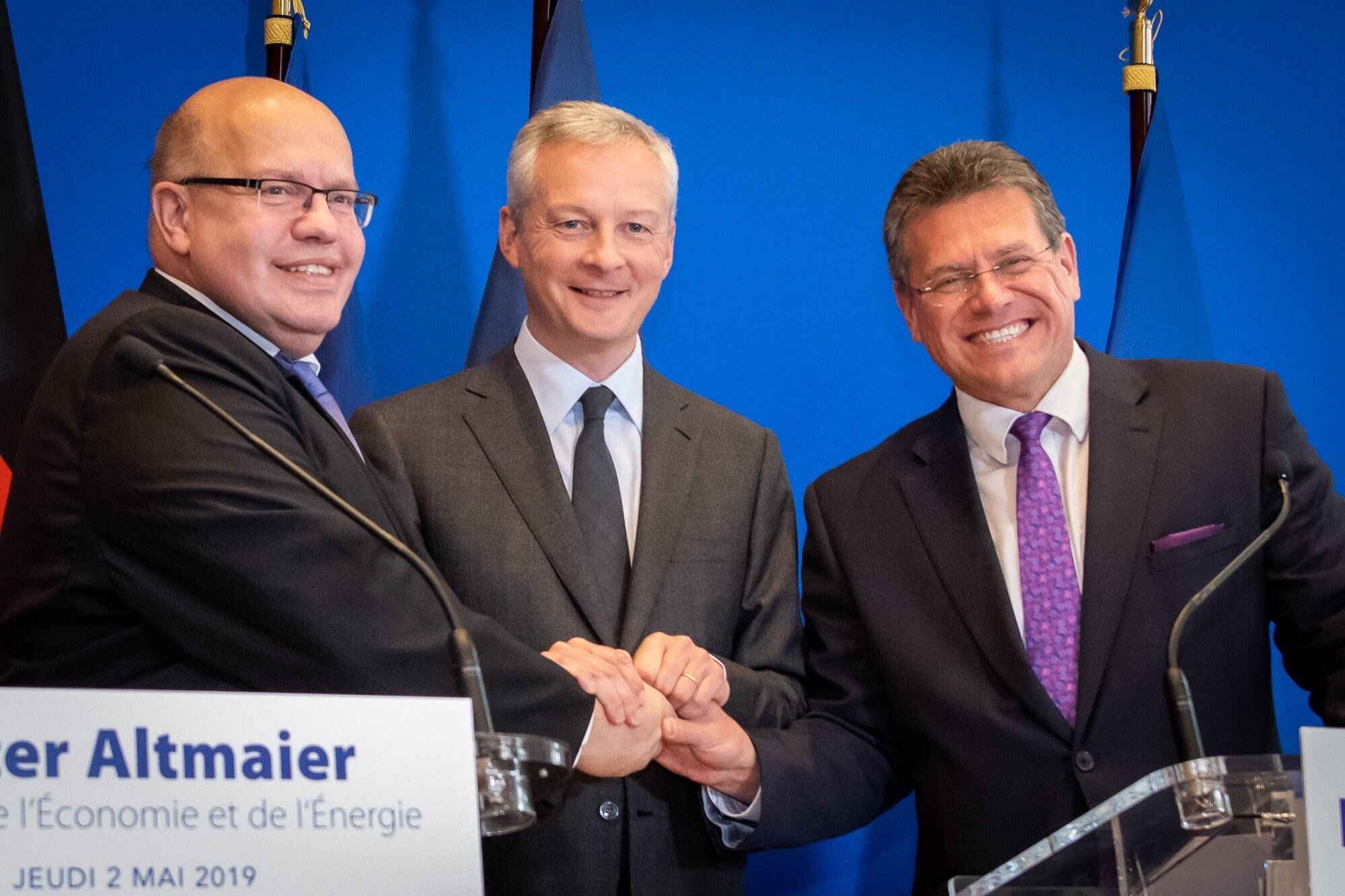
The IPCEI – to be overseen by a body integrated by all seven states – stems from months of talks between the Economy ministers of Germany (Peter Altmaier), France (Bruno Le Maire) and others. On social media this week, the Commission’s Maroš Šefčovič thanked all for their “coordination”.
In separate statements to the media, also this week, Šefčovič’s hinted that EU authorities may not stop at fostering an EU battery landscape; they could also act to set up hurdles to battery imports from outside the EU bloc.
Šefčovič, the Commission’s VP for Interinstitutional Relations, was asked whether Southeast Asia-made batteries could face EU bans if they breach green standards the EU is developing:
“I think that if they would not respect the standards, then yes,” he said, in comments reported by Euractiv.
Europe bets on batteries after PV defeat at the hands of Asia
The European Commission now rallying behind the IPCEI may have begun its term only this month but its battery manufacturing ambitions go back a longer way. Šefčovič, who was also part of the earlier cabinet, launched the European Battery Alliance in 2017 and continues to head the group.
Whether the new €3.2 billion research push and the broader Alliance that underpins it can make Europe a serious global contender remains to be seen. The continent has already waged, and largely lost, a similar pulse over solar manufacturing in the past decade.
Policymakers first acted to set up minimum import prices to shield EU module makers against cheaper Chinese rivals, but changed tack when the tariffs raised PV prices but were not the job creator they were hoped to be. Last year’s phase-out further crippled an already weak EU sector.
Attempts since to revive EU solar makers, including a vow by French president Emmanuel Macron to bring back the “champions”, have been greeted with scepticism. Approached for a recent PV Tech Power feature, BNEF analyst Jenny Chase said PV making in Europe “doesn’t make sense” anymore.
However, Chase and several other interviewees did feel battery making could prove a better wager for Europe. “Batteries are a bit more nascent and interesting. The complexity, the role of software, may create more potential to keep highly paid jobs in Europe,” she remarked.
The view emerged as various battery factory schemes made strides in Europe this year. Northvolt’s plans to create a 56GWh fleet of lithium cell factories in Europe have been followed by Tesla’s ambitions for a gigafactory near Berlin that would make “batteries, powertrains and vehicles”.
As the Commission itself insisted this week, Europe’s pitch for battery know-how comes with a specific focus on reduced environmental footprint. Its statement explicitly linked the efforts to nurture a battery sector to the EU’s broader transition towards climate neutrality.
The energy storage focus of the EU’s climate-minded policymakers has been apparent with earlier decisions this year. Last month, the European Investment Bank voted to shift its multi-billion-euro energy lending capabilities to prioritise storage batteries, grid upgrades and others.