The European Union (EU) has unveiled its plans for its own Inflation Reduction Act-style support package, the Green Deal Industrial Plan, for clean energy technologies including energy storage.
The announcement from European Commission President Ursula von der Leyen this week comes after senior policymakers raised concerns that the US’ recent US$369 billion investment plus incentives package for both upstream and downstream renewable energy sectors was taking potential investment away from Europe.
“It is no secret that certain elements of the design of the Inflation Reduction Act raised a number of concerns in terms of some of the targeted incentives for companies,” von der Leyen said.
In response, the bloc has a new “…plan to make Europe the home of clean tech and industrial innovation on the road to net zero.”
Try Premium for just $1
- Full premium access for the first month at only $1
- Converts to an annual rate after 30 days unless cancelled
- Cancel anytime during the trial period
Premium Benefits
- Expert industry analysis and interviews
- Digital access to PV Tech Power journal
- Exclusive event discounts
Or get the full Premium subscription right away
Or continue reading this article for free
The first pillar of the plan is to create a regulatory environment that allows the fast scale-up of sectors crucial to net zero, including wind, heat pumps, solar, clean hydrogen and “storage”.
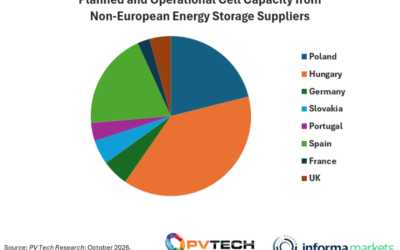
The Commission President then highlighted that Europe was overly reliant on other regions for the supply of rare earth materials vital for manufacturing of technologies like wind turbines and batteries, notably lithium, and that “…we need to improve the refining, processing and recycling of raw materials here in Europe.”
The plan is aimed at helping Europe achieve its increased renewable energy targets under its REPowerEU plans, formulated in response to Russia’s invasion of Ukraine.
The other three pillars of the Green Deal Industrial Plan are:
- boosting investment and financing of clean tech production
- developing the skills needed to make the transition happen
- facilitating open and fair trade for the benefit of all
Expanding on the fourth pillar and referring to the Inflation Reduction Act, von der Leyen said: “We should work towards ensuring that our respective incentive programmes are fair and mutually reinforcing. And we should set out how we can jointly benefit from this massive investment, for example by creating economies of scale across the Atlantic or setting common standards”.
Since the US passed its support package in August 2022, the country’s planned domestic battery manufacturing capacity for 2031 has been growing twice as fast as Europe’s, although the latter’s head start means it still currently has a higher figure.
Meanwhile in the downstream of the industry, the US act has introduced an investment tax credit (ITC) for standalone energy storage projects, as well as extending the ITC and production tax credit (PTC) incentives for solar and wind that have been responsible for accelerating industry growth and deployments of both technologies.
The EU announcement has been well-received by the European solar PV industry, as covered by Energy-Storage.news‘ sister site PV Tech.
Energy-Storage.news’ publisher Solar Media will host the eighth annual Energy Storage Summit EU in London, 22-23 February 2023. This year it is moving to a larger venue, bringing together Europe’s leading investors, policymakers, developers, utilities, energy buyers and service providers all in one place. Visit the official site for more info.