The government of Estonia will financially back a 500MW pumped hydro energy storage project to meet the country’s need for long-duration energy storage, as the Baltics prepare to disconnect from Russia’s grid this weekend.
At the end of January, the coalition government of Estonia announced plans to hold auctions for onshore and offshore wind with a total annual generation capacity of 2TWh, each, set to launch in April. The decision means that it also needs to support the deployment of long-duration energy storage (LDES), according to Minister of Economic Affairs and Research Kristina Kallas.
“If we buy offshore wind on such a large scale and build these capacities, then in addition to that we also have to guarantee that we have the capacity for large-scale storage. Building offshore wind without storage means a very high risk that it will be exported,” Kallas said.
The government will therefore provide a revenue guarantee to the Paldiski 500MW pumped hydro energy storage (PHES) project, being developed by special purpose vehicle Energiasalv Pakri OÜ. The government signed an MOU in April last year to back the project, but the wind procurement has accelerated the need for it.
Try Premium for just $1
- Full premium access for the first month at only $1
- Converts to an annual rate after 30 days unless cancelled
- Cancel anytime during the trial period
Premium Benefits
- Expert industry analysis and interviews
- Digital access to PV Tech Power journal
- Exclusive event discounts
Or get the full Premium subscription right away
Or continue reading this article for free
The Paldiski project is an EU Project of Common Interest, meaning it is seen to have benefits to the energy system beyond Estonia’s borders.
Construction is expected to start in 2025 with the first phase, 500MW/6GWh, expected to be operational by 2032. The plant’s modular design means it can be expanded to 15GWh in a second phase, increasing the discharge duration from eight hours to 30 hours. It has a relatively unique design using newly built underground reservoirs from technology provider Zero Terrain.
Peep Siitan, the CEO of Energiasalv, told state-owned outlet ERR in November that the company expects a revenue guarantee for the project, but the exact amount and nature of it will be revealed in April. However, he said it could involve a revenue ‘floor’ amounting to €35 million (US$36.2 million) a year.
Climate Minister Yoko Alender said the state’s analysis should assess the project’s impact on the electricity market and the excavation of materials, and that some state aid issues would also need to be resolved.
Projects part of Baltics switching over to European grid
The Baltic nations – Estonia, Lithuania and Latvia – are all set to switch from the Russian electricity grid over to the Central European one this weekend. They will disconnect from Russia on 8 February, and then Lithuania’s lines will be connected to Poland’s system and the Continental European grid the next day.
While all of Europe’s accelerated move to clean energy is partially related to reducing reliance on Russian gas, the Baltics’ synchronisation with the European grid created a situation unique to that region (though the process pre-dates Russia’s invasion of Ukraine).
For energy storage, it created a huge new need for flexibility and grid-supporting resources, especially during the ‘isolation’ period in between the disconnecting from Russia and connecting to Europe. To deal with this, new transmission lines have been built, synchronous compensators have been installed in all three countries to add system inertia and electrical systems, IT infrastructure and management systems for existing DC connections have been upgraded.
In Lithuania, system integrator Fluence deployed four 50MW BESS projects for TSO Litgrid which will help it manage the ‘isolation period’, discussed in detail by a Litgrid executive at the Energy Storage Summit Central Eastern Europe 2023 in Warsaw, Poland (Premium access).
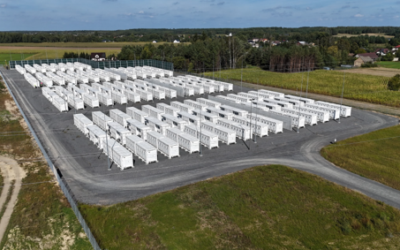
Energiasalv’s project is not the only pumped hydro project being explored in Estonia, with state-owned Eesti Energia also developing its own 225MW project. Eesti Energia is also building large-scale BESS, which it discussed with Energy-Storage.news in a Q&A interview last year (Premium access). The private sector is also building BESS in Estonia, including a 200MW/400MWh from Baltic Storage Platform.
In Latvia, large-scale BESS are also being deployed by both the TSO and private sector companies.