
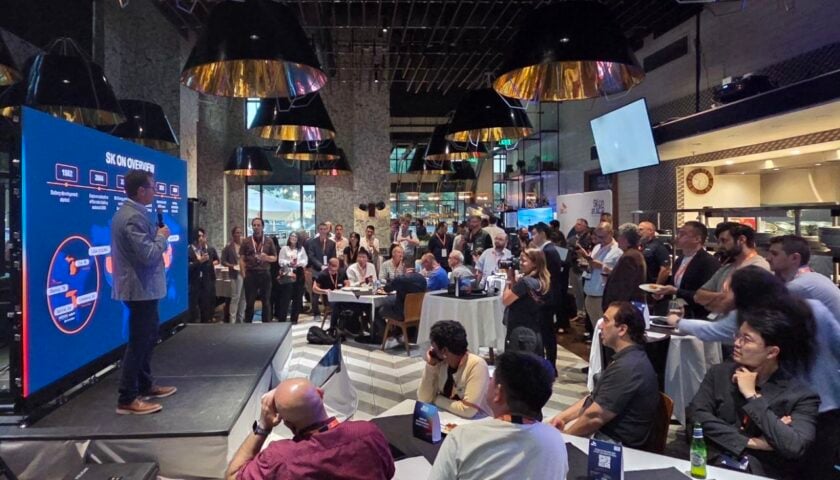
SK On’s North America president tells ESN Premium about the battery company’s vertically integrated push for market share across the US.
“It’s easy to have the battery technology, but to scale it for what you need, to support the demand that’s out there, it’s hard to do. We’ve done it, and we’ve proven that,” says Rob Schnell, SK On’s North America president.
Speaking to ESN Premium in an exclusive interview, Schnell discusses the South Korean tech company’s latest battery energy storage system (BESS) product launch and its strategy for taking market share in the growing US market.
In addition to a range of new features and the flexible configuration of its second-generation GridOn BESS solution, Schnell says SK On’s “establishing manufacturing footprint” makes the company “well-positioned” to capture market share even as competition heats up.
Try Premium for just $1
- Full premium access for the first month at only $1
- Converts to an annual rate after 30 days unless cancelled
- Cancel anytime during the trial period
Premium Benefits
- Expert industry analysis and interviews
- Digital access to PV Tech Power journal
- Exclusive event discounts
Or get the full Premium subscription right away
Or continue reading this article for free
“Our plan is to use our manufacturing footprint in the US. We believe that’s one of our strong advantages. Obviously, we’re a big player in this market, and we have one of the strongest footprints in the US, and we’ve proven we can scale a battery plant and produce at the right quality, the right reliability, on time, for our customers.”
Meanwhile, the Gen2 GridOn BESS, which debuted at the American Clean Power Association (ACP) CleanPower 2026 conference in Texas a couple of weeks ago, will join the first-generation product on the US market next year. The 20-foot standard ISO container solution features 4.5MWh – 5.7MWh usable energy storage capacity and is available in 1-hour, 2-hour and 4-hour configurations.
“GridOn is our new platform for our energy storage business, which uses cells built in our plants here in the US, using the same core technology as we’ve grown up with in our EV business, and now we’re converting that to energy storage,” Schnell says of the lithium iron phosphate (LFP) BESS.
‘Unique’ safety features and flexible configuration
The second-generation product increases energy density by 20% due to “incremental improvements in product evolution,” and comes with two safety features that SK On claims are “unique.”
One is an electrochemical impedance spectroscopy (EIS) early-detection solution for system malfunctions. Linked to the battery management system (BMS), it is designed to detect abnormalities up to 30 minutes earlier than existing systems, using microcurrents to “scan” the batteries and their thermal behaviour.
“It’s a very advanced warning system that will be first on the market. If this system detects the potential for an issue, you can shut down that part of the unit,” Schell says.
The other is a coolant submersion system that activates to maintain the stability of battery packs.
“In case there is some type of thermal event, it rapidly deploys cooling in a specific and unique way into the affected modules, which we believe is also unique in the industry.”
Along with these safety features, Sk On believes that the platform’s flexibility will also win customers over. GridOn’s discharge rate can go from lower rates up to 1C, making it not only a standout versus US competitor products, but also positions SK On to tackle the data centre segment: “which, of course, is the most talked-about part of the industry right now,” Schnell says.
“This GridOn platform can be used in a wide range, whether it’s a renewable application, an industrial application, or a data centre application, with its ability to have varied discharge rates up to the 1C level.” The previous iteration, of which SK On is contracted to deliver 7.2GWh of systems to US developer Flatiron Energy for projects beginning this year, is built as DC blocks, but Gen2 will incorporate the AC elements as well, integrating in-house and third-party supplied components to cover the full AC/DC solution.
While the focus for now is on the US, Schnell says GridOn will “absolutely” be offered as a global product, in markets expected to include Asia and Europe.
The US LFP cell manufacturing wave
So, that’s the technology and the strategy, but what does that competitive arena SK On is stepping into look like?
As of August last year, Solar Media Market Research analysis found that, based on company announcements, total US battery cell manufacturing for BESS applications would exceed 50GWh annual production capacity by the end of 2026.
BESS assembly capacity—everything but the cell, effectively—already surpassed that figure by the time of the analysis, according to an Energy-Storage.news blog from Solar Media Market Research’s Charlotte Gisbourne.
LFP cell production is still a new development for the US market, Gisbourne wrote, but players including SK On’s fellow South Korean manufacturer LG Energy Solution (LG ES) and Envision-owned AESC had already begun mass production.
Tesla and Canadian Solar had also made US manufacturing announcements in the weeks leading to Gisbourne’s blog being published and, fast-forwarding to Q1 and Q2 of this year, various reports highlighted continued growth. ACP said in a report last month that US domestic cell production is projected to reach nearly 180GWh/year in 2028, likely enough to cover market demand.
Into the mix come new market entrants such as Ford Energy, US automaker Ford’s recently launched energy storage subsidiary. It seems unlikely the trend will stop there.
Like LG ES and Samsung SDI, SK On is leveraging existing lines for electric vehicle (EV) batteries, converting them to produce LFP cells instead, as electric mobility demand slows in the US amid policy support rollbacks.
“Even forecasting the amount of demand that’s going to be out there is a little bit of a guess,” Schnell tells ESN Premium.
“If you look out to 2030, just a year ago, people were saying that the demand was probably a little over 100GW, 110GW, maybe something like that. Now we’re talking about 150GW, something like that.”
“There are several players that also have the capability in the US and are growing in this market. We believe there’s a lot of demand in the market, and we believe there’s a lot of space for us to compete and be successful,” Schnell says.
SK On currently has three manufacturing sites in the US: SK Battery America (22GWh) in Commerce, Georgia, which began production in 2022; the Hyundai SK Battery Manufacturing America (35GWh) joint venture (JV) plant in Bartow County, also in Georgia; and SK On Tennessee (45GWh), in Stanton, Tennessee, where production is planned to start in 2028.
Schnell says SK On Tennessee is “fully constructed” with the majority of equipment already installed and its planned startup could be accelerated to align with market demand. Perhaps ironically, it began as an EV battery JV, Blue Oval SK, with Ford, before the JV was dissolved, leading to SK On assuming full control of the factory complex.
“We’re rapidly growing the size of our energy storage team in the US. We have a capable team, and we’re in the process of doubling the size of that team over the next six months to be able to support all our customers,” Schnell says.
“Our approach is really to be able to cover the range of needs. GridOn really fits this platform approach, a flexible approach [targeting] renewable, industrial and data centres. Our intention is to cover the full market.”
This article has been amended from its original form to more accurately reflect technical terminology around the 1C charge rate which was mistakenly added by a sub-editor, specifications and to clarify that SK On did not buy out Ford from its Blue Oval SK JV, but the JV was dissolved ahead of the battery manufacturer taking full control of the Tennessee production plant.
