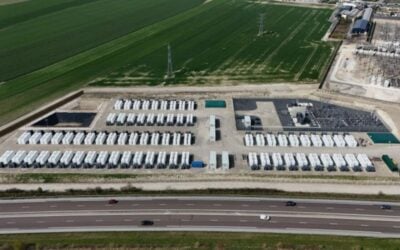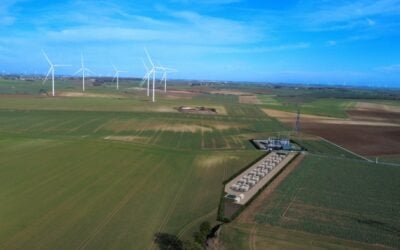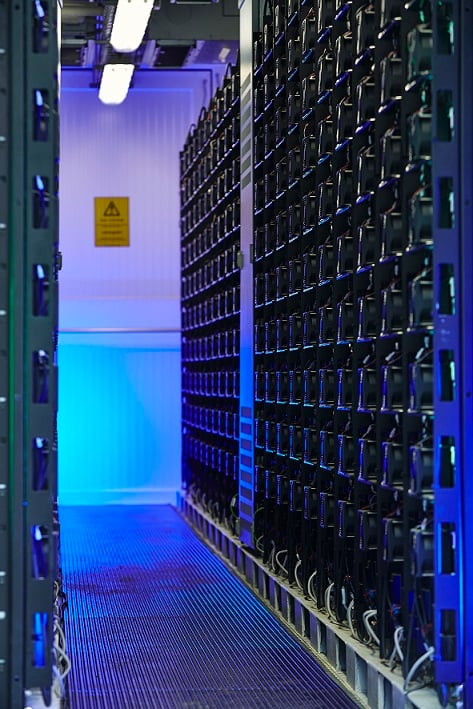
Multinational utility Engie and renewables developer Neoen are to invest €1.2 billion (US$1.46 billion) in a large-scale solar-plus-storage project in south eastern France, which includes a 1GW solar system and 40MW of battery energy storage.
The Horizeo project will include a 1GW capacity solar farm in Saucats, Nouvelle-Aquitaine, as well as 40MW of energy storage and a 10MW electrolyser for green hydrogen energy generation, as well as a data centre.
France’s National Commission for Public Debate announced last month it would hold a public debate to allow the local community in Saucats, where the Horizeo project is set to be constructed, to “participate in the development” of the system, which will be one of the largest in Europe on completion.
France’s installed PV capacity reached 9.43GW at the end of 2019, but the country still has four years to reach its goal of 18-21GW capacity. Beyond that, the government is calling for as much as 44.5GW by 2028. The Nouvelle-Acquitaine region has its own target of 8.5GW of installed PV capacity by 2030, compared with around 2GW today.
Try Premium for just $1
- Full premium access for the first month at only $1
- Converts to an annual rate after 30 days unless cancelled
- Cancel anytime during the trial period
Premium Benefits
- Expert industry analysis and interviews
- Digital access to PV Tech Power journal
- Exclusive event discounts
Or get the full Premium subscription right away
Or continue reading this article for free
Energy auctions have become a key tool for the government to ramp up its installed PV target before the deadline. The Minister for Ecological Transition awarded tariff support to 341MW of solar projects last October following completion of an oversubscribed auction that featured reduced prices compared to previous rounds.
Corporate contracts have also become crucial building blocks for energy producers and asset owners to become profitable without government support. Reports published within the past four months have shown record numbers of power purchase agreements (PPAs) being struck between asset owners and businesses in the US and Australia, while France was among the top 10 markets for PPAs in 2019.
However, the Horizeo project will generate revenue from over-the-counter contracts with businesses, as opposed to sourcing income through calls for tenders from the Energy Regulatory Commission (CRE) and therefore, without government subsidy, according to a statement from both Engie and Neoen.
By Edith Hancock.
This story first appeared on our sister site PV Tech.
Engie partners Total for France solar-plus-hydrogen project
Total and Engie have signed an agreement to develop and operate what they say will be France’s largest green hydrogen facility.
Located at a Total biorefinery in the southern region of Provence-Alpes-Côte d’Azur and powered by more than 100MW of solar projects, the 40MW electrolyser is expected to produce 5 tonnes of green hydrogen per day.
The project, dubbed Masshylia, has already applied for subsidies from both French and European authorities, as the partners aim to begin construction of the facility in 2022, following the completion of an advanced engineering study, with a view to starting production in 2024.
The companies said the installation will feature an “innovative management solution” for the production and storage of hydrogen to manage the intermittent production of solar and the biorefinery’s need for continuous hydrogen supply. This includes optimising the integration of several PV plants supplying the electrolyser to minimise energy losses and limit congestion. It will also feature large-scale hydrogen storage to balance intermittent electricity production and continuous hydrogen consumption.
Beyond the first phase, new renewable projects may be developed by the partners for the electrolyser, which has the capacity to produce up to 15 tonnes of green hydrogen per day.
Philippe Sauquet, president gas, renewables and power at Total, said the facility is an internationally reproducible project. “Innovation and sustainability are at the heart of this joint project. As demonstrated by our commitment to the European Clean Hydrogen Alliance, we believe in the future of renewable hydrogen, and we are working with our partner Engie to make it happen.”
As it aims to reach an electrolysis capacity of 6.5GW by 2030, France included a commitment to invest €7 billion in green hydrogen production by 2030 in its coronavirus recovery package. The three priorities of the country’s hydrogen strategy include decarbonisation of industry, support for research and innovation, and developing hydrogen-powered heavy transport.
To ensure the effective implementation of the strategy, France’s government earlier this week announced the formation of a National Hydrogen Council, which includes executives from both Total and Engie.
Recent analysis from IHS Markit revealed that green hydrogen production costs are down 40% since 2015 and are expected to fall by a further 40% by 2025. The research firm expects annual global investments in renewable hydrogen to exceed US$1 billion by 2023.
By Jules Scully.
This story first appeared on PV Tech.