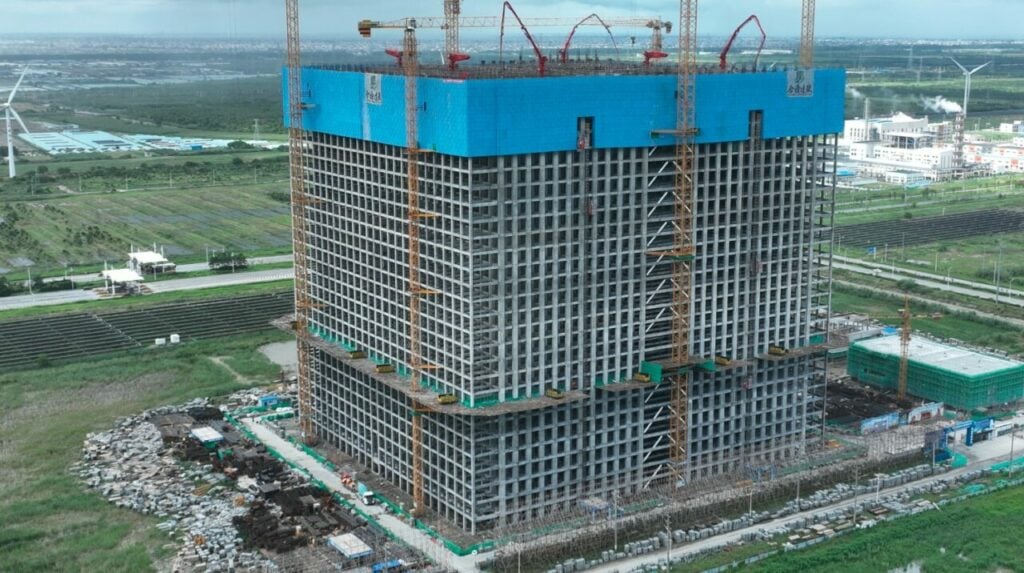
Energy Vault has started commissioning its first commercial EVx gravity energy storage project in Rudong, China, for Q4 commercial operation.
After mechanical completion of the 25MW/100MWh project, commissioning started in June and Energy Vault expects the project to be fully interconnected to the local state utility grid in the fourth quarter of this year.
The project is being developed by Atlas Renewable for customer China Tianying Group (CNTY), an environmental services company. Located near Shanghai, it will charge from a nearby wind farm and discharge to the grid during timeframes and at prices which have been pre-agreed with the utility.
But part of the appeal for CNTY is that the company could combine the construction of the composite blocks, which are lifted up and down to charge and discharge, with its waste remediation business where it is paid by the government to reuse waste materials like concrete debris and coal ash.
Try Premium for just $1
- Full premium access for the first month at only $1
- Converts to an annual rate after 30 days unless cancelled
- Cancel anytime during the trial period
Premium Benefits
- Expert industry analysis and interviews
- Digital access to PV Tech Power journal
- Exclusive event discounts
Or get the full Premium subscription right away
Or continue reading this article for free
Energy Vault CEO Rob Piconi discussed the project at length in a recent wide-ranging interview with Energy-Storage.news (Premium access), in which we put widely-held scepticism about its claimed performance to him. Piconi claimed that iterations to the gravity energy storage system coming later this year would deliver the “lowest cost of storage in the world”.
The company also claims the EVx system has a round-trip efficiency of over 80%, superior to the other most prominent forms of long-duration energy storage (LDES) like pumped hydro energy storage (PHES), compressed air energy storage (CAES) and flow batteries.
In the commissioning announcement, Piconi commented: “The team’s pace and quality of development since the start of construction in March 2022 has been extraordinary, especially when considering the backdrop of two COVID related work stoppages in the first year of construction alone.”
“While this represents a significant milestone, our work in China is just beginning given recent local announcements of multi-GW hours of gravity energy storage buildouts, including projects announced in 2022 supporting China’s ‘Zero-carbon parks‘ initiative with Energy Vault’s gravity energy storage technology.”
A subsidiary of CNTY has entered into an agreement with the government of Huailai County, Hebei Province, to build an additional 100MWh gravity energy storage project there, Energy Vault added.
Eric Fang, Chief Executive Officer, Atlas Renewable, added: “We remain focused on an efficient system commissioning process in order to begin storing and dispatching renewable energy to China’s national grid in full alignment with local and state grid authorities. This first deployment of Energy Vault’s EVx technology will serve as a model for global decarbonisation technology partnerships, and as we have previously announced, are already working on multi-GWh deployments of Energy Vault’s gravity technology in China to support and ideally accelerate China’s current 30-60 net carbon neutral plans.”
Alongside its gravity energy storage solution, Energy Vault is also deploying short-duration battery energy storage projects for numerous customers in the US as well as green hydrogen. Read all coverage of the company here.
The company is targeting US$325-425 million million in 2023 revenues, lower than initial guidance communicated in late 2022.