Egypt’s government has signed contracts with developer AMEA Power for two large-scale battery energy storage projects, the country’s first.
Dubai-headquartered AMEA Power announced yesterday (25 February) that it has signed government Capacity Purchase Agreements (CPAs) for the battery energy storage system (BESS) projects, which will have a combined capacity of 1,500MWh.
One will be a 500MWh system in Zafarana, a coastal village on the Gulf of Suez around 215km southeast of the Egyptian capital Cairo. The other will be a 1,000MWh project in Benban, around 700km due south of Cairo in the desert along the banks of the Nile River. The developer will also build transformers and grid network connection infrastructure.
Outputs of the projects in megawatt terms were not disclosed in announcements by AMEA Power or the Ministry of Electricity and Renewable Energy’s Egyptian Electricity Holding Company.
Try Premium for just $1
- Full premium access for the first month at only $1
- Converts to an annual rate after 30 days unless cancelled
- Cancel anytime during the trial period
Premium Benefits
- Expert industry analysis and interviews
- Digital access to PV Tech Power journal
- Exclusive event discounts
Or get the full Premium subscription right away
Or continue reading this article for free
However, AMEA Power said that Egypt’s first two standalone BESS projects will ‘enhance grid stability and enable greater integration of renewable energy sources in the country’s national energy mix’.
Egypt’s minister for electricity and renewables Dr Mahmoud Esmat said the ‘independent’ energy storage systems would maximise the benefits of renewable energy while enhancing the balance and stability of the grid during peak times.
Esmat also talked up the projects’ contribution to Egypt’s renewable energy goals and reduction of fossil fuel use and associated emissions. Last November, the African country reaffirmed its target to source 42% of its electricity generation from renewables by 2030. A cabinet report published in July put the current contribution from solar PV, wind and hydroelectric power to Egypt’s generation mix at 11.5%, according to Reuters.
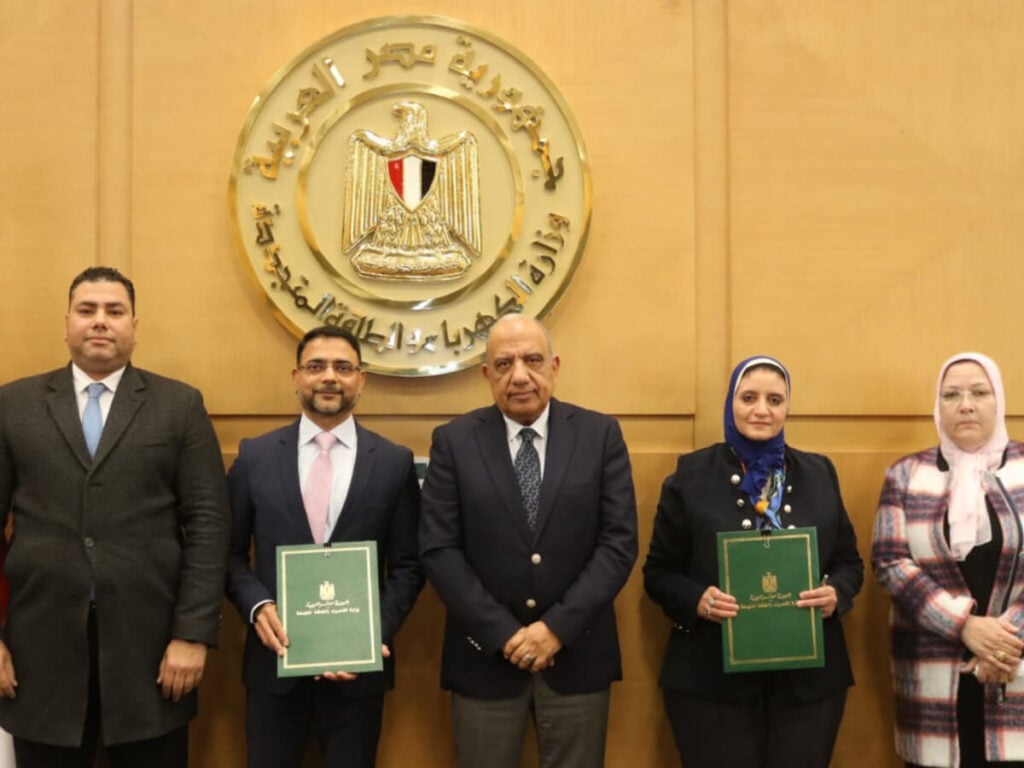
Contracts were signed by the chair of the Egyptian Electricity Transmission Company (EETC), Mona Rizk, and AMEA Power chief investment officer Aqueel Bohra. Also present were minister Esmat, EETC’s general manager for private sector renewable energy Hamida El-Sanea and AMEA Power business development manager Ahmed Hafez.
Terms and financial details of the Capacity Purchase Agreements were not disclosed.
A few days earlier, Egypt’s Ministry of Electricity and Renewable Energy said it had held talks with Saudi Arabian power and infrastructure developer ACWA Power and State Grid Corporation of China to discuss partnerships and cooperation in renewable energy, battery storage, and electricity network development.
The AMEA Power CPAs follow the September 2024 signing of 25-year power purchase agreements (PPAs) for two solar-plus-storage projects between the EETC, AMEA Power and another developer, Norway’s Scatec.
Those covered AMEA Power’s 1GW solar PV project with a 600MWh BESS, also in the Benban region and an expansion to the UAE developer’s 500MW Abydos solar PV power plant with the addition of 300MWh BESS capacity.
The deal announced yesterday brings AMEA Power’s government-contracted BESS capacity in Egypt to 2,400MWh, while the developer said its total capacity of solar and wind projects in the country now stands at 2,500MW. The company claimed its activities in Egypt represent US$3 billion investment.
Scatec, meanwhile, would build a 1GW solar plant co-located with 100MW/200MWh of BESS technology.