
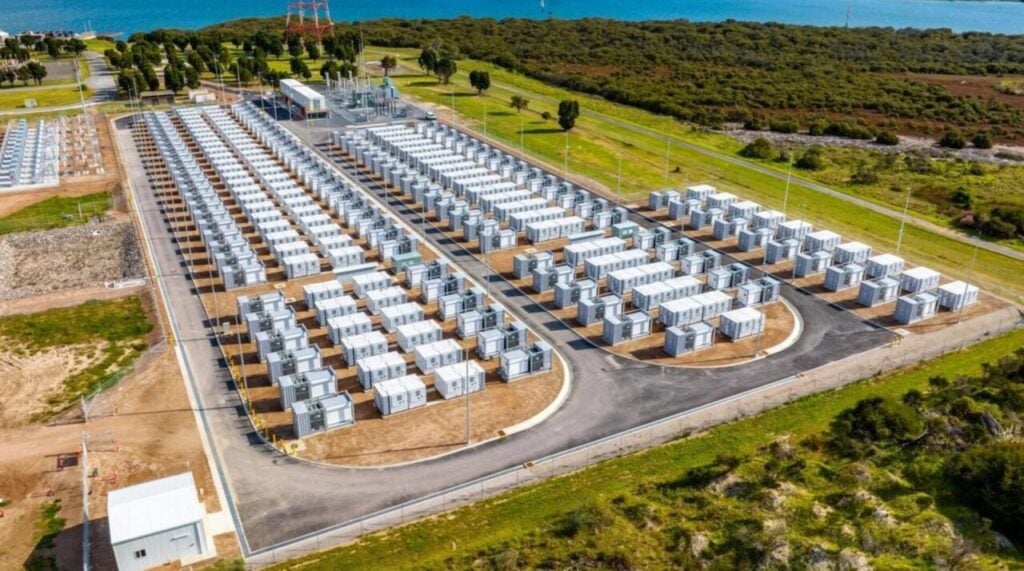
“Australia remains a multi-gigawatt proving ground for utility-scale energy storage systems,” says Kashish Shah, market development manager at Wärtsilä Energy Storage.
With battery energy storage systems (BESS) playing an increasingly central role in the nation’s renewable energy transition, Shah shares his insights into the trends, challenges, and opportunities shaping the sector.
And, echoing the thoughts of his former colleague, Andy Tang, in an interview with ESN Premium last year, Shah still believes the country is the proving ground for utility-scale BESS.
Reflecting on the development of energy storage in Australia, Shah notes the rapid progress since the commissioning of the country’s first utility-scale battery storage system in 2017, the 129MWh Hornsdale Power Reserve in South Australia.
Try Premium for just $1
- Full premium access for the first month at only $1
- Converts to an annual rate after 30 days unless cancelled
- Cancel anytime during the trial period
Premium Benefits
- Expert industry analysis and interviews
- Digital access to PV Tech Power journal
- Exclusive event discounts
Or get the full Premium subscription right away
Or continue reading this article for free
“It’s been, what, nine years now, and the market has now seen 10GW of battery capacity,” he says. This growth has been accompanied by a significant shift in the role batteries play within the grid.
“From the perspective of batteries’ position in the grid and the role they’re supposed to play, it’s quite mature,” Shah explains. He points to data from the Australian Energy Market Operator (AEMO) that highlights record-breaking dispatch of renewable energy and battery storage in 2025.
“Batteries are dispatching more and more energy, having more and more influence over prices during peak demand periods, so they’re doing what they’re supposed to do from an operational perspective,” he says.
One of the most striking changes in the market has been the transition in revenue streams for battery projects. Shah describes how the revenue model has evolved over the years.
“We’ve seen batteries’ revenue transition from Frequency Control Ancillary Services (FCAS)-dominated until 2021 to now being energy-dominated,” he says. He cites Q4 2025 statistics showing that 87% of total battery storage revenue comes from the energy market. This shift has not diminished the financial viability of battery projects.
“Despite more megawatts coming into the market and the opportunities between FCAS and energy changing, batteries are still making viable revenue,” Shah notes, adding that average revenues in 2025 are around AU$140,000 (US$98,625) to AU$150,000 per megawatt.
Looking ahead, Shah highlights the potential for additional revenue streams to emerge as the market continues to develop. He points to the growing importance of synthetic inertia and system-strength services, which are critical to maintaining grid stability.
“Batteries will be providing a dominating share of synthetic inertia,” he says. While these services are currently contracted rather than market-based, Shah suggests they could serve as another revenue stream for battery storage projects. He also discusses the role of battery storage systems in addressing minimum system load events, particularly in South Australia, where rooftop solar has created unique challenges.
“AEMO has started to use batteries to actually come in and help during those hours,” he says. However, he emphasises the need for compensation mechanisms to support these services, whether through contracts or new market structures.
How the Australian battery energy storage market is evolving
On the supply side, the battery storage development landscape is becoming increasingly fragmented. Shah describes how developers are adopting a more modular approach to project development, moving away from traditional system integrators.
“What they’re trying to do is a bit of pick and choose,” he explains. Developers are now securing grid connection approvals using specific inverter and power plant controller (PPC) models before finalising battery procurement. This strategy offers flexibility and bargaining power but also introduces risks.
“Certain projects will succeed with this strategy, while others may face challenges,” Shah says.
He adds that the value of full-scope integration is that a single provider delivers a comprehensive solution encompassing hardware, software, and operational support.
“A lot of projects are going to run into trouble, whether it’s from a development perspective or an operational perspective,” he warns. “Going to a provider which provides an integrated solution on hardware and software will be of immense value.”
The increasing scale and duration of battery storage systems are also reshaping the market. Shah notes that four-hour duration batteries are becoming the standard for new projects, driven by the need to time-shift renewable energy generation.
“The forward pipeline is becoming 4-hour duration,” he says. Additionally unique challenges are beginning to arise, such as as noise regulations, which can significantly impact project feasibility.
“Noise is a big challenge. It can make or break the project,” Shah says.
Hybridisation is another key trend, with battery storage becoming increasingly co-located with solar and wind projects. This topic has been discussed in depth on Energy-Storage.news.
Why market optimisation is critical as Australia’s battery storage fleet grows
Market optimisation is emerging as a critical area of focus as the battery fleet grows. Shah notes that the market is transitioning from being dominated by large-scale ‘gentailers’ to a more diverse mix of independent power producers (IPPs).
This shift is driving the need for asset-level optimisation, enabling apples-to-apples performance comparisons and unlocking additional value.
“Optimisation will be key as we reach an inflexion point with enough batteries in the market to benchmark individual asset performance,” he says.
Integration of hybrid assets also presents both opportunities and complexities, particularly in optimising their operations. Shah highlights: “As more batteries come into the market, each megawatt will be competing for those high-price periods.”
Effective optimisation will be crucial in balancing energy and FCAS revenues, managing contracts, and integrating hybrid assets with existing renewable energy contracts.
“We have a range of solutions that integrate problems, not just from a hardware perspective, but also from a software perspective,” Shah explains.
Australia remains a multi-gigawatt proving ground for utility-scale energy storage systems, a characterisation that Shah believes will hold true for at least the next decade.
He points to the draft Integrated System Plan (ISP) released in late 2025, which underscores the central role of battery energy storage in the energy transition.
“Batteries are essential for time-shifting renewables, providing system strength, and addressing minimum system load events,” he says. The ISP and other planning documents from AEMO highlight the need for long-term investment in flexible dispatch infrastructure, further solidifying the importance of battery energy storage in Australia’s energy landscape.
While long-duration storage technologies are often discussed as potential alternatives, Shah argues that lithium-ion batteries remain the most viable option.
“It’s a proven technology. It can be commissioned faster than any other and scaled as fast as any other,” he says.
Concluding the discussion, Shah emphasises the importance of full-scope integration in navigating the complexities of the Australian energy storage market.
“A lot of projects are going to run into trouble, whether it’s from a development or operational perspective,” he says.
“Going to a provider which provides an integrated solution on hardware and software will be of immense value.”
As Australia continues its transition to a renewable energy future, energy storage will play an increasingly vital role in stabilising the grid, optimising the use of renewable energy, and supporting the nation’s ambitious decarbonisation targets.
The Energy Storage Summit Australia 2026 will be returning to Sydney on 18-19 March. It features keynote speeches and panel discussions on topics such as the Capacity Investment Scheme, long-duration energy storage, and BESS revenue streams. ESN Premium subscribers receive an exclusive discount on ticket prices.
To secure your tickets and learn more about the event, please visit the official website.