
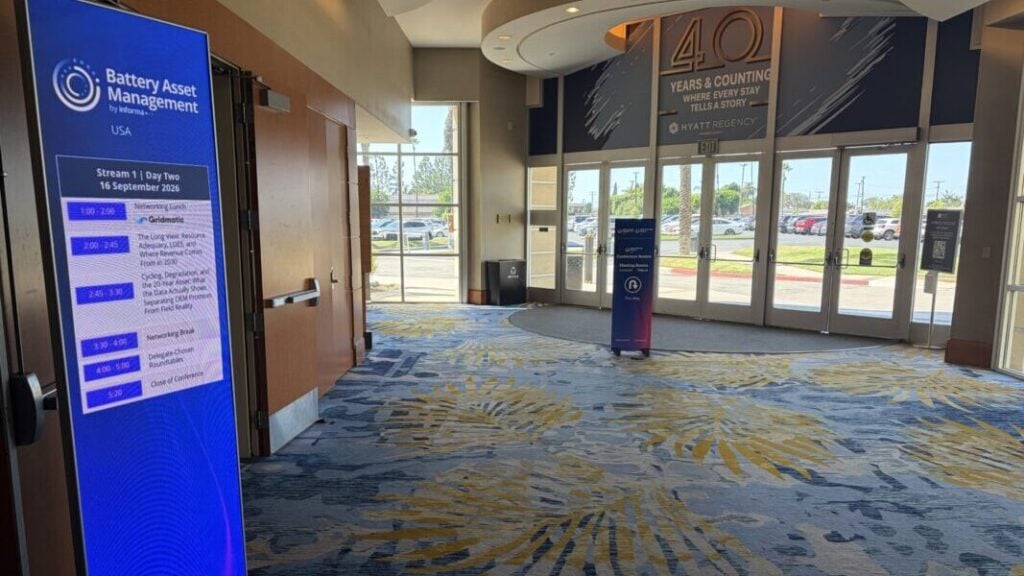
Energy-Storage.news Premium speaks with Randolph Mann, CEO at developer esVolta at the 2026 US Battery Asset Management Summit in Garden Grove, California.
Standalone battery energy storage system (BESS) developers in California are increasingly relying on tolling-type contracts to achieve bankable revenue streams as merchant revenues decline, according to esVolta CEO Randolph Mann.
Mann explains that tolling contracts—where utilities pay a fixed price over the contract duration—have become essential for securing project financing in the California Independent System Operator (CAISO) market.
“When we’re trying to put a project together, it’s trying to make sure that we’ve got predictable enough stream of revenue that we can support that required financing and return,” he says. “In California, that increasingly looks like tolling-type contracts where the utility is paying you a fixed price over the duration of the contract.”
Try Premium for just $1
- Full premium access for the first month at only $1
- Converts to an annual rate after 30 days unless cancelled
- Cancel anytime during the trial period
Premium Benefits
- Expert industry analysis and interviews
- Digital access to PV Tech Power journal
- Exclusive event discounts
Or get the full Premium subscription right away
Or continue reading this article for free
Resource adequacy alone insufficient for project returns
Whilst resource adequacy (RA) contracts provide some revenue stability, they are not sufficient on their own to support project economics, the executive explains.
“What we are typically looking at are 10-plus-year type of RA contracts, and those would be in the high single digits [dollars-per-kilowatt-month], but that’s not going to be sufficient to cover the full capital and revenue to give a project,” they note.
Mann emphasises that investors are looking for double-digit returns on BESS assets, with the level of contracted revenue directly impacting acceptable returns. “The more contracted revenue you have, the less risk you have on that asset, so we can accept a bit of a lower return. A fully tolled asset, you’re probably talking low to mid double-digit returns.”
In situations where full tolling contracts are unavailable, esVolta may pursue projects with shorter-term contracts or partially contracted revenue combined with merchant exposure. “We can take some degree of market risk and manage that, but getting a return of your capital through contracted revenue is pretty important.”
Interconnection delays increase development costs
California’s lengthy and unpredictable interconnection process is significantly impacting project economics by increasing both development timelines and capital at risk.
“If your interconnection process takes longer or your permitting process takes longer, that means you’ve got more capital outstanding for a longer period of time and more risk on that capital, and so you have to price accordingly to recover that capital at risk,” he explains.
Mann notes that whilst California’s RA market provides some revenue stability, the state presents unique development challenges. “California is a hard place to develop. It’s a hard place to site projects. It’s a hard place to permit projects. The interconnection queue is lengthy. It’s also expensive and risky.”
The executive suggests that shortening the interconnection queue and making the study process more predictable would significantly benefit developers.
Expanded credit facility supports growing pipeline
EsVolta closed an expanded credit facility in June 2026, led by investment bank Nomura Securities International, to support its growing development pipeline, which now exceeds 30GWh of projects across five markets.
“The cost of development and the duration of development is increasing. So you need more capital available to help you finance development across that portfolio,” he says.
The facility primarily supports interconnection deposits, power purchase agreement deposits, and long-lead equipment deposits. Mann attributes the need for increased development capital to growing demand across all markets where esVolta operates.
“Utility customers across all of the markets that we’re in are really grappling with demand and capacity needs, and seeing BESS as one of the solutions. So we’re developing more and larger projects, and that just requires larger development capital to go with it.”
Grid-connected assets
Mann has previous experience working with energy supplier NRG Energy, which provides microgrid and distributed energy resource (DER) solutions.
When asked about microgrid models as a potential solution to California’s storage financing challenges, Mann emphasises esVolta’s focus on grid-connected projects.
“The reason that we put our storage assets directly connected to the grid is because that’s where they can have the most benefit to the grid and to the consumers. If you put it behind the meter and you are using it solely for a specific customer, you’re losing some of the functionality of the asset.”
