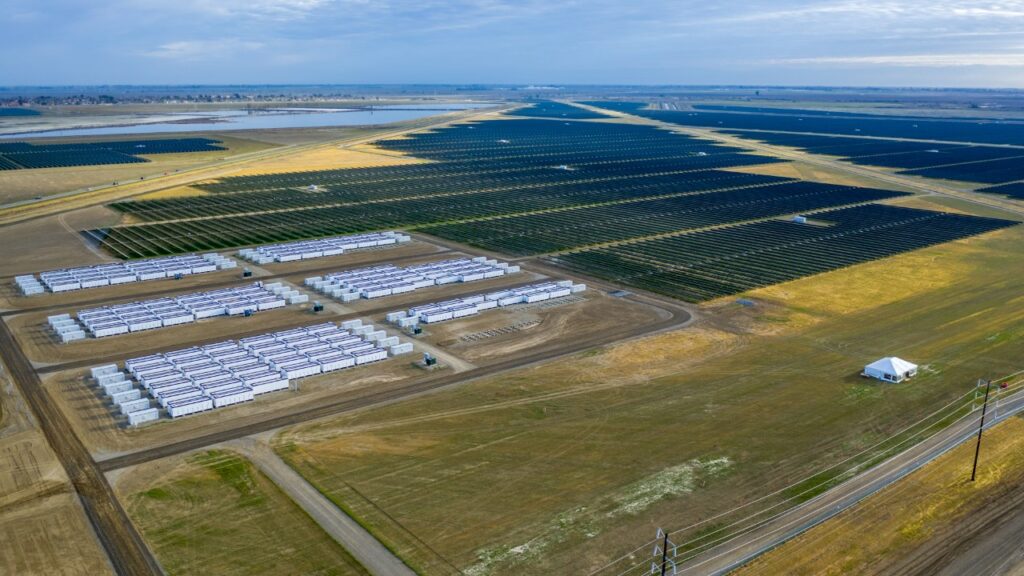
Battery storage will be a valuable asset for enhancing and upgrading the electric transmission and distribution (T&D) system of California.
The board of CAISO last week approved the California grid operator’s 10-Year Transmission Plan, which will upgrade the network and make it better able to accommodate renewable energy.
As reported by our sister site PV Tech, resource requirements for decarbonising California’s energy system by 2045 and enhancing reliability of the electricity network demand significant increases in the amount of battery storage and different renewable energy technologies.
Identifying 23 separate transmission projects representing about US$2.9 billion of investment in expansion, upgrade and reinforcement, the transmission plan has been put together with California’s energy needs in mind. The state needs to add about 4,000MW of new resources each year over the next decade — four times more than the 1,000MW of additions expected and modelled for in CAISO’s previous 2020-2021 transmission plan.
Try Premium for just $1
- Full premium access for the first month at only $1
- Converts to an annual rate after 30 days unless cancelled
- Cancel anytime during the trial period
Premium Benefits
- Expert industry analysis and interviews
- Digital access to PV Tech Power journal
- Exclusive event discounts
Or get the full Premium subscription right away
Or continue reading this article for free
California is known as the global regional leading market for battery storage, driven largely by procurements through the state’s three big investor-owned utilities (IOUs) for Resource Adequacy — capacity to guarantee customers their lights will stay on.
CAISO, the California Energy Commission and regulatory California Public Utilities Commission (CPUC) are all aware the state will need dramatically more energy storage, as well as renewables, to decarbonise while replacing capacity from retiring fossil fuel and nuclear.
The CPUC in February unanimously approved a US$49 billion plan to accommodate more than 25.5GW of new renewable energy and 14,751MW of battery storage by 2032.
CAISO’s 10-year plan meanwhile models the different forecasted and required capacities of battery storage in each of the regions around its network.
In specific instances, battery storage is recommended as an alternative to grid upgrade projects. For instance 50MW/200MWh of BESS should be procured at a 115kV substation in Mesa to address a maintenance window for the network instead of carrying out a full transmission 230kV line upgrade project.
The approved 10-year Transmission Plan can be found here on CAISO’s website.
CAISO’s 20-year Transmission Outlook, aimed at providing a framework for long-term planning, can be found here.
Interconnection: ‘the real challenge’ for California and CAISO
At present, getting interconnection agreements for battery storage projects in California is proving very difficult, Energy-Storage.news heard from Seth Hilton, a California-focused specialist renewable energy industry lawyer at legal firm Stoel Rives.
CAISO is dealing with far more interconnection requests than it can deal with and has extended the timelines developers have to work with.
“They can’t process the volume of interconnection requests along the timeline that’s provided for in their tariff. So that’s the real challenge. And California ISO has been looking at what some of the solutions are, but they have to give non-discriminatory access to the transmission system,” Hilton said.
A good indicator of just how much lead times for BESS projects are impacted by the interconnection agreement process is that state governor Gavin Newsom’s emergency proclamation over energy issues last summer ordered the California Energy Commission to expedite permitting for clean energy projects, including energy storage.
With permitting often cited as a reason for lengthening the project development process, it might be considered that this step would have been beneficial to the industry.
However, Seth Hilton said: “Not a single energy storage project took advantage of that expedited process that was set up by the Energy Commission — because of interconnection issues, which the Commission couldn’t deal with”.
“Even if you had expedited permitting at the Energy Commission, it didn’t solve the interconnection problem, which was really the the long lead time item and the issue which is the real challenge we’re dealing with in California.”