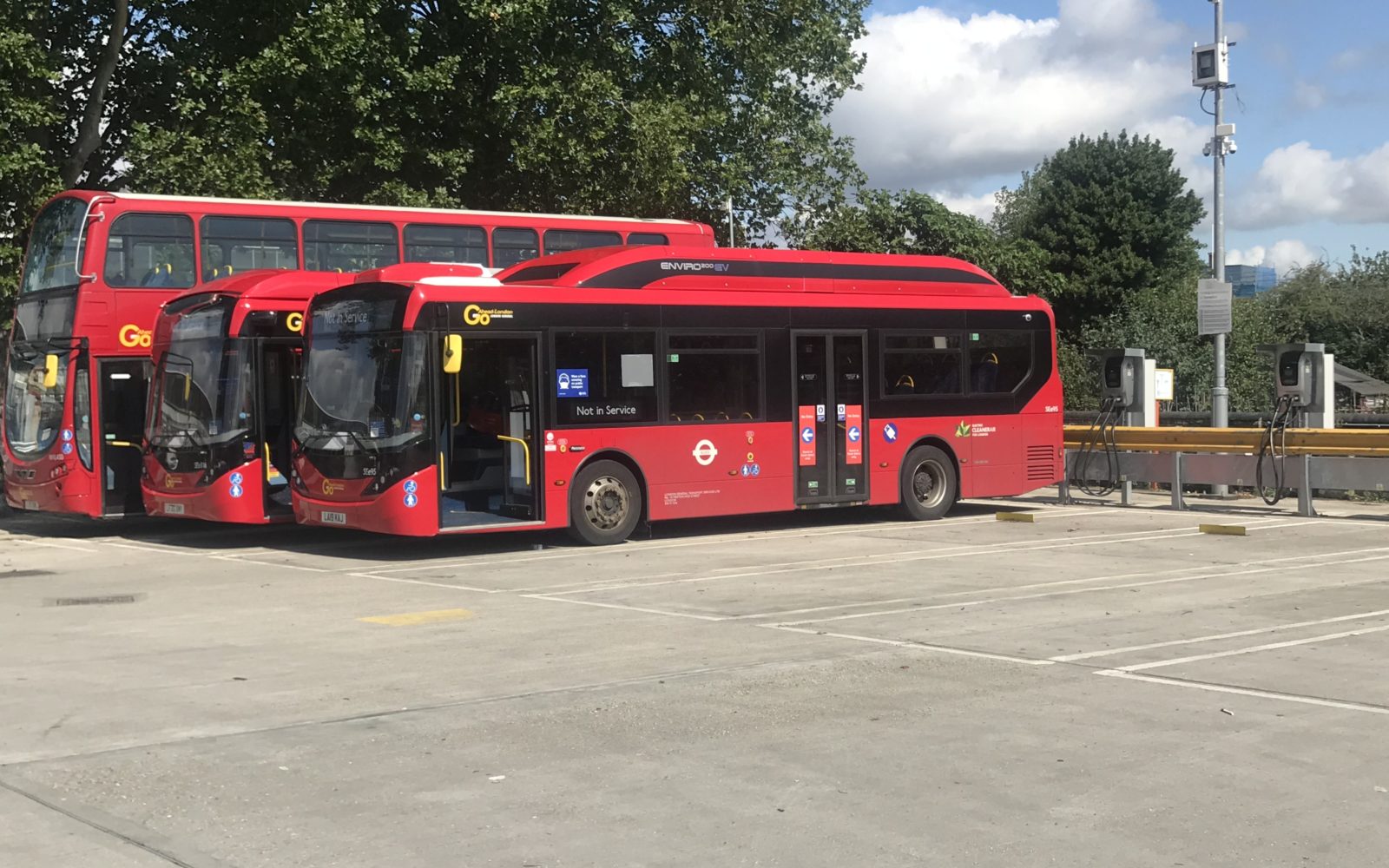
The world’s largest vehicle-to-grid (V2G) project has been launched at a north London bus garage.
Nearly 100 new zero-emission electric buses will be run from the Northumberland Park garage, which has been transformed with chargers that will be used for the Bus2Grid project.
Initially, it will use batteries from 28 of the state-of-the-art double decker buses to trial V2G systems, which are capable of returning 1.1MW energy to the grid to provide balancing services. The buses are adapted BYD ADL Enviro400EV, double deckers, each with a 382kWh BYD lithium iron phosphate batteries.
The buses are AC charged with 2 x 40kW on-board-chargers, which means that it’s a mobile discharge facility. From a technical standpoint, this therefore has implications for satisfying the UK’s G99 voltage control requirements – within which generators must have a voltage control system to inject or absorb reactive power into the grid so that it can control voltage – and is a specific project challenge. It should result in the first ever G99 certification for such a large scale mobile energy generation type, according to SSE.
Try Premium for just $1
- Full premium access for the first month at only $1
- Converts to an annual rate after 30 days unless cancelled
- Cancel anytime during the trial period
Premium Benefits
- Expert industry analysis and interviews
- Digital access to PV Tech Power journal
- Exclusive event discounts
Or get the full Premium subscription right away
Or continue reading this article for free
Most other V2G projects use DC (CHAdeMO) charging, therefore requiring only the ChargePoint and associated inverter – which does not move – to be certified rather than the vehicle.
To read the full version of this story, visit Current±.