The World Bank Group has approved plans to develop Botswana’s first utility-scale battery energy storage system (BESS) with 50MW output and 200MWh storage capacity.
The World Bank will support the 4-hour duration BESS via a loan of US$88 million. It will also receive a US$30 million loan and a US$4 million grant from the Green Climate Fund’s Sustainable Renewables Risk Mitigation Initiative Facility.
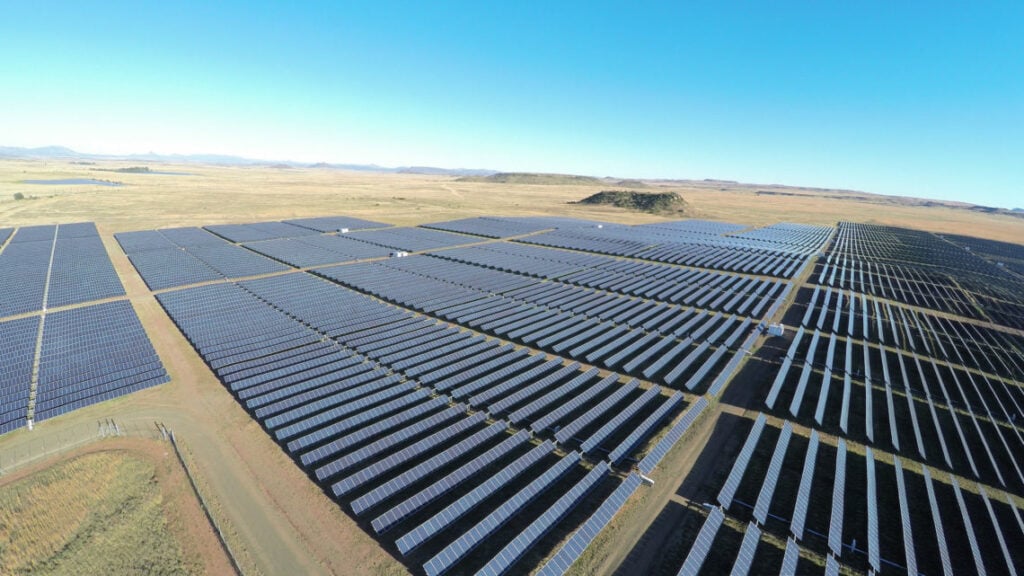
The BESS will be situated at Selebi Phikwe/Mmadinare and Jwaneng, where the Southern African country’s first large-scale solar PV plants, each with a capacity of 100MW, are planned. The targeted operational date for Selebi Phikwe/Mmadinare is 2025, and for Jwaneng, it is 2026.
According to documents accompanying the World Bank’s announcement, it is hoped the BESS will lay the foundation for further development of a pipeline of energy storage assets in the country to support its energy transition. Crucially, this will increase the number of BESS assets in the country, helping provide flexibility, which is currently absent.
Try Premium for just $1
- Full premium access for the first month at only $1
- Converts to an annual rate after 30 days unless cancelled
- Cancel anytime during the trial period
Premium Benefits
- Expert industry analysis and interviews
- Digital access to PV Tech Power journal
- Exclusive event discounts
Or get the full Premium subscription right away
Or continue reading this article for free
This must be scaled rapidly, with Botswana set to enable the first grid integration of 335MW of solar PV capacity by the end of 2026. With the government looking to install 1GW of wind and solar PV capacity by 2030, the World Bank claims that 140MW of BESS will be required to facilitate the integration of variable renewable energy (VRE).
A feasibility study for the project is currently underway. Once complete, it will provide further information on where to install the BESS.
Commenting on the financing, Satu Kahkonen, World Bank country director for Botswana, said: “In addition to financing, the World Bank will provide technical assistance to facilitate further renewable energy projects. This is an important part of our commitment to support more sustainable and inclusive growth in Botswana.”
The World Bank will provide financing to help develop the BESS and support the Botswana government in its ongoing efforts to improve energy access. This will include financing for expanding the grid to rural villages and enhancing electricity services in the Southern districts.
Lefoko Moagi, Botswana’s minister of minerals and energy, said the finance will “support us [Botswana] to harness our rich renewable energy resources for a reliable, affordable and sustainable energy future” and will be “an important driver of economic growth.”
Other projects supported by the multilateral development finance institution recently covered by Energy-Storage.news include Mozambique’s first-ever solar-plus-storage plant, developed by independent power producer (IPP) Globeleq and brought into commercial operation late last year, and 36MW of solar PV paired with 20MW/19MWh of battery storage across two ‘pre-assembled’ hybrid projects in Cameroon’s Grand North region, brought online last September by Norwegian developer Scatec.
In November, government-owned Kenya Electricity Generating Company (KenGen) was selected to deploy an energy storage pilot project in that country by the World Bank, while a few days ago Somalia’s Ministry of Energy and Water Resources (MoEWR) launched a World Bank-supported tender for 46 solar and storage off-grid power plants with storage capacity totalling 5MWh.