
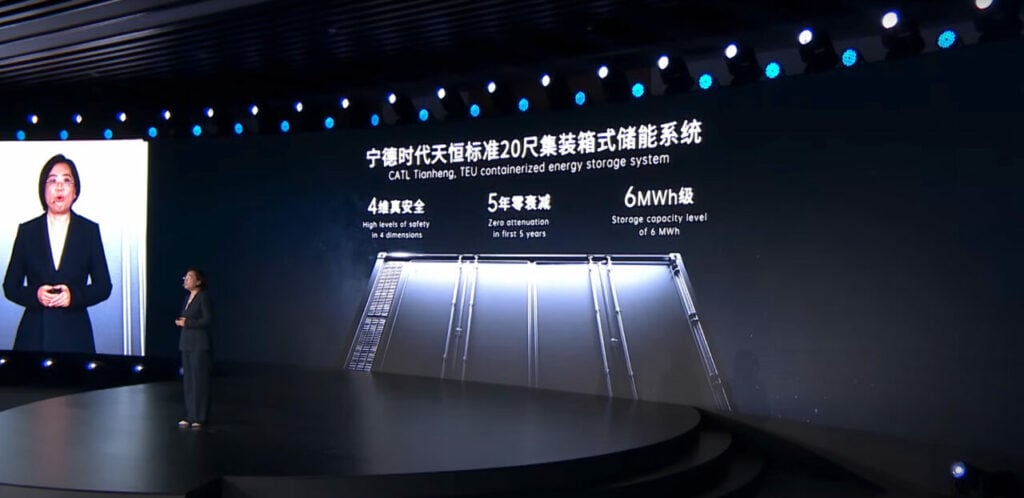
We analyse recent details that have emerged on battery OEM CATL’s zero-degradation BESS technology, which was first announced two years ago.
Back in 2024, CATL unveiled its TENER line of energy storage systems. The claim was that this was the first mass-producible energy storage system that shows zero degradation in its first five years. Now this was a big claim because technically every battery degrades in some form through both calendar and cycling use―something that has also been pointed out by battery experts and researchers on LinkedIn.
So, what’s going on behind zero degradation claims then? New information has recently been circulating in LinkedIn discussions, particularly from Accure Battery Intelligence’s Elizabeth Oliphant, about how these batteries don’t degrade. It has been revealed that it is due to the addition of sacrificial additives, which is a way of frontloading irreversible formation losses.
This delays the capacity fade rather than removing the capacity. It’s been revealed that CATL uses biomimetic solid electrolyte interphase (SEI) and self-assembled electrolyte technologies in its lithium iron phosphate (LFP) TENER batteries to achieve this ‘zero degradation’ effect, which is the delaying of capacity fade. It doesn’t remove the degradation curve of the battery, it just shifts it, and the aging curve remains flat for years. This has allowed CATL to get more cycles out of its batteries before the capacity loss starts to take effect.
Try Premium for just $1
- Full premium access for the first month at only $1
- Converts to an annual rate after 30 days unless cancelled
- Cancel anytime during the trial period
Premium Benefits
- Expert industry analysis and interviews
- Digital access to PV Tech Power journal
- Exclusive event discounts
Or get the full Premium subscription right away
Or continue reading this article for free
Croatian EV and BESS technology company Rimac also announced a ‘zero-degradation’ product later that year, promising a shorter two-year window with no capacity fade.
Sacrificial additives behind ‘zero degradation’
When sacrificial additives are added to the electrode, it means that there is more lithium to lose before the cells lose capacity beyond their rated capacity. This gives the illusion that no capacity has been lost, but instead, the additives have been depleted instead of the active lithium ions that move between the electrodes. A similar approach is used in BESS installations where the BESS container is overbuilt with more capacity than the rated capacity―so when the capacity does degrade, it does not drop below the rated capacity and gives the illusion of no degradation in the BESS unit for a long period of time.
The CATL approach, however, is different to overbuilding. The mechanisms are entirely different; it’s just a similar principle to adding more resources which stops the capacity fading over time. That’s where the similarities end.
The zero degredation mechanism starts with the first charge cycle and the formation of the SEI. When the battery first charges, lithium ions migrate to the surface of the anode and react with the electrolyte to form the SEI layer. This is a critical process in any battery because it is a protective layer that stops the electrolyte from continually reacting with the electrode (which would cause rapid degradation).
However, it does cause an initial capacity loss/capacity fade because the lithium used to form the SEI is irreversibly lost, something that is called active ion loss (AIL) or a loss of lithium inventory (LLI). The sacrificial lithium additive― Li₅FeO₄ (LFO)―is consumed during the SEI formation instead and this prevents the initial capacity loss that most batteries suffer from.
When the cell first charges, LFO is oxidised, and lithium ions are released into the cell. These lithium ions are then sacrificed for the SEI, and the lithium inventory stays intact so there is no LLI. During this process, the oxygen is released from the LFO lithium compound. This does generate extra internal gases within the cell; however, they are either removed through standard degassing processes or the cell design has been specifically chosen where the extra gas pressure build up can be maintained within the design limits of the cell.
LFO is an ideal sacrificial additive for LFP batteries because it is very lithium-rich due to its antifluorite structure. This structure allows LFO to store up to four times more lithium ions (per gram) than many other active lithium materials. So, a lot more lithium can be released for less additive, meaning that the electrode structure is not significantly altered. CATL has been adding it into it LFP TENER batteries as a cathode additive.
In a normal cell, once that initial capacity fades through the SEI layer formation, the cell slowly experiences a continued reduction in capacity over time. However, by blocking that initial capacity loss in the first cycle, it causes the aging curve to stay flat for years (five years according to CATL). This then allows more cycles to happen before capacity fade kicks in.
However, even though the addition of sacrificial additives is beneficial for prolonging battery life, it is a balancing act and adding too much sacrificial additive or releasing it too fast can have a negative effect on the battery.
A delayed/late lithium release can maintain cell balancing and reduce degradation, however, if the lithium is released too early, it accelerates aging and degradation because of intra-cell stoichiometric imbalances. Anode overhanging can be used to mitigate the effects of rapid additive release, but that comes at an energy density trade-off, and when CATL are continually pushing the boundaries of energy, this is not a favourable trade-off. So, CATL had to get the lithium release speed right to realise its zero-degradation battery.
On the additive quantity side, a low amount of sacrificial additive provides limited benefit as there is not enough extra lithium to combat the SEI consumption effects, meaning that the cell still experiences capacity loss on that first cycle, which then causes continued capacity fade. So, too little sacrificial additive does not solve the problem. However, on the other side of the coin, too much sacrificial additive in the cathode is also bad for the battery as it accelerates degradation. So, both the right levels of sacrificial additive and the right release speed needed to be optimised and carefully designed in the TENER cells to give it the zero degradation characteristics that CATL has been promoting.
BESS implications because of the technology
For BESS applications, a slower degradation and longer life is beneficial when these installations run for many years to decades. With more cycles than other battery technologies, and a longer time to replace cells and modules that are affecting the overall capacity of the installation, the CATL system could help asset owners to save money and perform upgrades less regularly. Additionally, because there is delayed degradation, it means that asset owners may not need to overbuild to ensure a high installation capacity, and it also might mean that augmentation is less likely to be needed―but both will depend on the intended lifespan of the BESS installation.
CATL has released different TENER systems with different capacities, namely 6.25 MWh and 9 MWh per container. In the 2025 release of the 9 MWh container, CATL did state that it can achieve 45% improvement in volume utilisation and increases land-use efficiency by 40%. The firm said that the design could help assets owners to either save space or build more capacity in the same space. An example given by CATL is that an 800 MWh installation will require almost one-third fewer containers than a standard 20 ft container.
Conclusion
The approach to zero degradation using sacrificial additives is still relatively new from a commercial standpoint. It’s something that has likely been in development for some time, but because the battery systems this approach is used in will be in operation for at least the next 15-20 years, we won’t truly know the long-term effect that this sacrificial additive will have on real-world BESS until they have been in the field for some time. There have been few projects announced using the technology, we reported on one in Bulgaria recently.
The science says that they should last for more cycles before the capacity fades (up to 1000 cycles before capacity fade kicks in were mentioned when the TENER was first released), which could significantly improve BESS lifetimes. However, the actual cyclic additions in real-world installations with different environmental factors, load demands, and the energy applications the BESS is involved with (frequency regulation, energy trading etc) could all lead to different results than expected. Time will tell, and the subject will no doubt be visited again in the future when more field testing is available and the long-term effects have been studied.
