
Solar Media Market Research analyst Charlotte Gisbourne looks at the changing revenue and margin dynamics in the BESS supplier landscape.
With margins in the PV market still compressed and slowed EV demand, battery storage revenues have remained a strong source of revenue across the market.
This comes amid increased government schemes that aid the adoption of this technology in emerging markets and the continued rise in global deployments as the importance of ESS (energy storage systems) becomes more prominent.
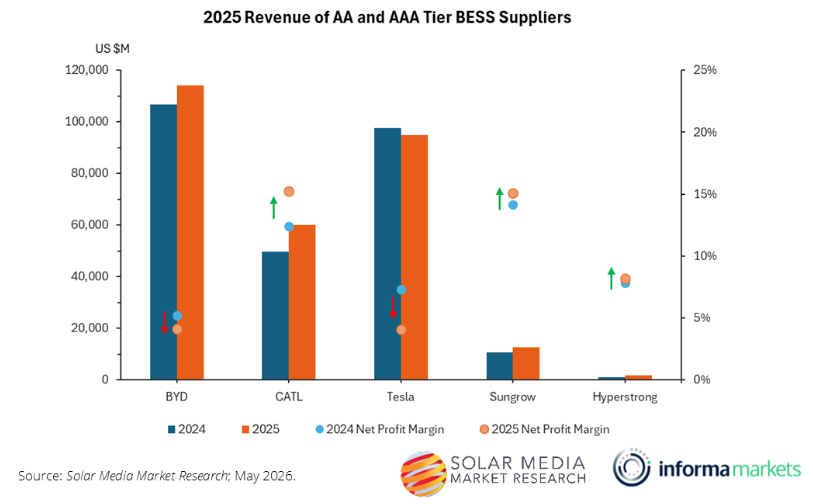
Fig 1. Hyperstrong, which has the highest proportion of energy storage as a share of total revenue, saw the largest revenue YoY growth at 45%, followed by CATL at 21% and Sungrow at 18%.
Try Premium for just $1
- Full premium access for the first month at only $1
- Converts to an annual rate after 30 days unless cancelled
- Cancel anytime during the trial period
Premium Benefits
- Expert industry analysis and interviews
- Digital access to PV Tech Power journal
- Exclusive event discounts
Or get the full Premium subscription right away
Or continue reading this article for free
New analysis from our Battery StorageTech Bankability Ratings Report shows that suppliers with higher exposure to energy storage revenue generally recorded stronger overall growth in 2025, as global ESS deployments accelerated and overseas markets expanded. The report evaluates the bankability based on a comparative analysis of two key components: financial and manufacturing, with industry leading figures required in order to reach the top tiers.
The majority of suppliers in the top two tiers of the bankability pyramid do not have energy storage as their main source of revenue, and while ESS share of total revenue has generally been increasing across all suppliers in the pyramid, CATL stands out as having this proportion fall slightly in 2025 to 15%. However, total ESS revenue did increase 9%.
Among the five top suppliers, Sungrow recorded the largest increase in ESS revenue last year, up around 49%, which accounted for nearly 42% of total revenue, while PV inverter sales increased only 6.9%. While the company has already cemented its place on the global stage for both PV and ESS with the delivery of multiple large-scale projects, 2025 saw this global approach pushed further. Revenue from mainland China declined 15%, while overseas revenue share jumped from 46% in 2024 to around 60%.
Notably, the company supplied some of the world’s largest battery storage projects outside China, three totalling 7.8 GWh in Saudi Arabia, that were put into commercial operation late 2025.
Despite strong full-year results, Sungrow’s Q4 earnings raised concerns, with YoY declines in both revenue (-18%) and net profit (-54%).
This could be due to the continued fall in BESS prices due to increased competition. It could also partially be because of a jump in lithium prices and cell prices rising accordingly; as an integrator, Sungrow could be more vulnerable to fluctuating raw material costs than suppliers with in-house cell manufacturing.
It may also have taken lower margins on some of the BESS projects it has signed, in the Middle East and elsewhere.
While BYD managed to increase total revenue in 2025, net profit fell 19%, mainly attributed to its EV business segment and intense domestic competition. Tesla, also an auto manufacturer, had its revenue dragged down by its EV business, which saw sales fall by 10% and overall revenue declined 3%. The company had another record-breaking year of storage deployments, however, up 29% and its energy generation and other reporting segment showed the strongest revenue growth for the company at 25%.
HyperStrong is the newest of these companies and is still in a stage of expansion, particularly internationally, where the company was able to break through to new markets in Greece and Sweden. As a result, overseas revenue saw an increase of 42%. With energy storage being the core focus of the company and 2025 ESS sales volume more than double that of the year prior, despite the average selling price falling, the company still managed a strong 40% rise in revenue and a 52% increase in net profits attributable to shareholders.
In 2025, these leading suppliers were also among the top in terms of shipment volume for fully integrated systems alongside CRRC, Envision, Huawei, and Sunwoda.
First quarter margins squeezed
The steady decline in price of lithium carbonate seen in the past few years has likely aided in the increased deployment of energy storage and has been a key factor influencing the financial state of energy storage suppliers. Towards the end of 2025, prices experienced a rebound with increased demand from both EV and ESS batteries with 2026 so far continuing this elevated level.
While manufacturers can pass on costs to downstream customers, the intensified competition could force some suppliers to keep prices low in order to gain market share. Some margin squeezing has already been seen; Sungrow experienced a net profit decline of 40% in Q1 and gross margins down 1.8 bps in addition to a YoY revenue fall of 18%. While the company does mention the rising cost of lithium carbonate affecting returns on larger projects, the geographic shift to lower margin markets is also referred to as an attributing factor.
Hyperstrong also experienced the effects of expanding end markets, but seemingly in the opposite direction, with both revenue and net profit margins rising as the company secures and delivers more overseas projects.
Many suppliers saw a lower operating margin in Q1 compared to that of FY 2025, among them being CALB (-2.3 bps), Sungrow (-1.2 bps), CATL (-0.5 bps), and Gotion which experienced an operating loss during the quarter along with a 79% fall in net profits.
While the first quarter of the year tends to have lower operating profits due to generally less shipments, it is crucial to keep an eye on how suppliers are managing costs as the year continues.
As profit margins in PV continue to be tight, especially in China, companies previously focused on the solar market are increasingly entering the ESS business, such as LONGi and Saatvik Green Energy. While there is a potential danger of oversupply, the majority of the newly established energy storage businesses, particularly those based outside of China, do not produce cells, meaning that it is system integrators rather than manufacturers who are likely to experience any margin pressure more acutely.
The rise in data centres in the US could potentially boost demand from suppliers and help mitigate some of the knock-on effects from any delayed order signings last year due to policy uncertainties. Wärtsilä was especially impacted by this in 2025, with energy storage order intake decreasing 52% in terms of MWh and net sales down 13%; so far 2026 the company’s energy storage has not been faring any better, with no new equipment orders for energy storage booked in Q1.
On the other hand, Fluence saw a record high contracted order backlog at the end of March with the company’s data centre pipeline up 30% from the end of 2025. In general, hyperscale data centres are a strong growth opportunity and suppliers are actively working on capitalising on this growing business with the development of AIDC geared solutions from Hithium, Sungrow and Sunwoda.
Looking forward, energy storage is likely to remain a strong source of revenue growth for Chinese cell manufacturers, especially with the new policies in China reducing EV incentives and moving from full exemption of purchase tax up to 5% in 2026. In the first quarter, EVE Energy shipped over 6GWh more energy storage batteries than power batteries and the company experienced a 61.6% overall revenue increase.
However, despite the currently thriving ESS industry and 2025 seeing companies with a higher share of ESS revenue seeing stronger total revenue growth, the market is particularly susceptible to government policies, with companies increasingly setting up production facilities overseas in a potential attempt to bypass country specific tariffs and comply with content requirements in different regions.
All data and analysis shown in this article come from our in-house market research. Full details on how to subscribe to our Battery StorageTech Bankability Ratings Report , featuring detailed financial benchmarking, shipment analysis, bankability scoring, and supplier risk assessments across the global ESS market, can be found here.
