Redwood Materials has announced the final closing of its Series E financing round, bringing the total raise to US$425 million.
In October 2025, the company announced it had closed the US$350 million Series E funding round to scale up its critical battery materials and energy storage businesses.
The round was led by venture capital (VC) firm Eclipse, with continued participation from existing investors Capricorn and Goldman Sachs Alternatives, and the addition of NVentures (NVIDIA’s venture capital arm) as a new strategic investor.
Redwood announced earlier this week (28 January) that it had raised additional funds at final close, with Google joining as a new investor.
Try Premium for just $1
- Full premium access for the first month at only $1
- Converts to an annual rate after 30 days unless cancelled
- Cancel anytime during the trial period
Premium Benefits
- Expert industry analysis and interviews
- Digital access to PV Tech Power journal
- Exclusive event discounts
Or get the full Premium subscription right away
Or continue reading this article for free
Redwood says the oversubscribed funding reflects growing confidence in the company’s approach to domestic battery recycling and large-scale battery energy storage systems (BESS).
The company, founded by CEO JB Straubel, former CTO at Tesla, operates two complementary business lines: critical materials production through battery recycling and grid-scale energy storage using repurposed electric vehicle (EV) batteries.
“As electricity demand surges—driven by AI, data centres, manufacturing and electrification—energy storage is no longer optional; it is essential infrastructure,” the company stated in announcing the funding.
The timing appears strategic, as data centres alone, according to a December 2024 report from the US Department of Energy (DOE), are projected to consume up to 12% of total U.S. electricity by 2028, forcing developers to seek alternatives to traditional grid connections.
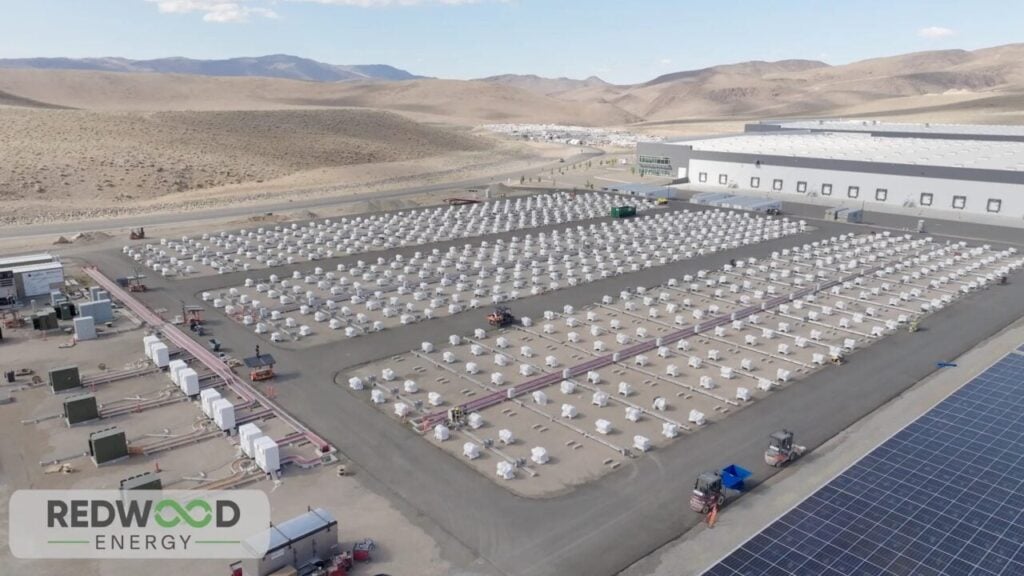
Redwood launched its storage division, Redwood Energy, in June 2025, building on its core recycling business that processes 20GWh of batteries annually. The company repurposes EV battery packs with remaining usable capacity for stationary storage applications, targeting hyperscalers, AI computing companies, and renewable developers who need massive power capacity deployed quickly.
Redwood highlighted that the availability of electric energy is a crucial strategic factor for the expansion of AI infrastructure.
Redwood highlights its proprietary Pack Manager technology—a DC-to-DC platform that integrates battery packs across different chemistries, capacities, and voltage classes. Unlike traditional battery energy storage systems that use new, imported batteries, Redwood’s approach works with batteries in their native form without requiring disassembly or remanufacturing.
“The Pack Manager acts as a universal translator to support a broad range of OEM battery pack architectures and simplifies pack replacement to improve system reliability and long-term serviceability,” a company representative explained to Energy-Storage.news.
This chemistry and form-factor-agnostic approach allows Redwood to adapt as the mix of end-of-life EV batteries evolves from primarily nickel manganese cobalt (NMC)-based to increasingly lithium iron phosphate (LFP)-based over time.
The company has deployed a 12MW/63MWh system for AI infrastructure firm Crusoe, and it reports GWh-level capacity in its current pipeline. Redwood’s systems use 100% domestic batteries and qualify for federal tax credits, offering cost and speed benefits compared to imported options.
The company’s business model combines materials and manufacturing expertise with power electronics and software to create what Redwood calls “a new generation of US-made energy storage systems—scalable, low-cost, and designed to power data centres, industry, and the grid.”
The recent funding arrives at a crucial time as global supply chain issues coincide with strong domestic demand for key materials and energy products. Redwood’s recycling activities generate cobalt, nickel, copper, lithium, and cathode active materials, decreasing dependence on imports and providing feedstock for its storage systems.
Redwood aims to use the new capital to speed up energy storage deployment, enhance refining and materials production, and grow engineering teams. The company views these efforts as steps toward creating “a resilient, dominant US energy future” and achieving “critical-minerals independence.”
Redwood’s decision might also have been influenced by difficulties in its main battery recycling and materials business. Declining prices for new batteries and their components from China have negatively impacted the value of recycled materials.
Another North American battery recycling company, Li-Cycle, filed for bankruptcy last year and was later acquired by mining giant Glencore. It is important to note that specific company factors contributed to its downfall.
The Energy Storage Summit USA will be held from 24-25 March 2026, in Dallas, TX. It features keynote speeches and panel discussions on topics like FEOC challenges, power demand forecasting, and managing the BESS supply chain. ESN Premium subscribers can get an exclusive discount. For complete information, visit the Energy Storage Summit USA website.