Project owner Vistra Energy expects the 300MW Phase I of Moss Landing Energy Storage Facility — the world’s biggest lithium battery project to date — to come back online during the first half of this year.
Phase I (300MW/1,200MWh) at the project in Monterey Bay, California, came online just before the end of 2020, followed by Phase II (100MW/400MWh) in August.
Then, after an incident on 4 September, where overheating was reportedly detected in battery modules, Phase I was taken offline and remains out of action. Phase II is still operational.
Earlier this month, Vistra published its principal investigation findings as well as corrective actions relating to the incident, which the company said caused “limited battery damage” to about 7% of Phase I’s battery modules. “Other facility systems” were also damaged in the incident.
Try Premium for just $1
- Full premium access for the first month at only $1
- Converts to an annual rate after 30 days unless cancelled
- Cancel anytime during the trial period
Premium Benefits
- Expert industry analysis and interviews
- Digital access to PV Tech Power journal
- Exclusive event discounts
Or get the full Premium subscription right away
Or continue reading this article for free
It appears that rather than battery modules overheating and causing the incident, it was actually a sprinkler system’s response to smoke coming from an air handling unit, in which a bearing had failed.
It appears the Very Early Smoke Detection Apparatus (VESDA) onsite triggered the spray of water at a threshold of smoke detection below what should have been required. This was likely due to a programming error in the VESDA, Vistra said.
Water improperly sprayed onto battery racks due to “a small number” of faulty couplings of hoses and pipes was what then damaged the batteries and cause overheating to occur.
That overheating led to more smoke being released, in turn causing more sprinklers to be activated by the project’s heat suppression system, damaging more battery modules. Investigation findings noted that battery modules were at normal operating temperature before the improper spraying of water was triggered.
As reported at the time, local first responders attended the scene, but their assistance was not needed to bring the situation under control. No workers were harmed and there was no negative safety impact for the local community.
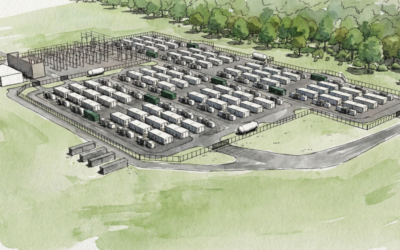
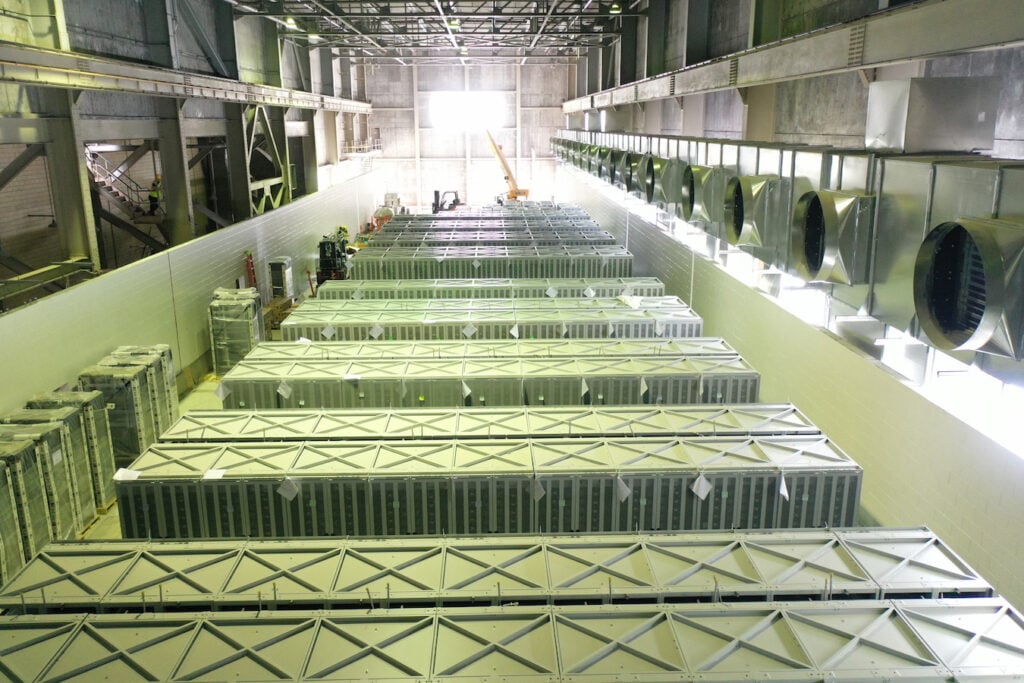
The 300MW Phase I facility is made up of three 100MW arrays housing a total of 99,858 LG Energy Solution battery modules.
Vistra said it hoped to bring the system back online in a staggered fashion, with 100MW expected back online during this quarter and the remainder to come back online during Q2 2022.
The company is now conducting repairs, commissioning facility systems as well as implementing enhancements to improve Phase I’s original design.
It will also take corrective actions: pressure testing the heat suppression system and identifying any leaks, installing an air supervision system to continuously monitor for heat suppression system leads, review the programming of the VESDA system and install smoke detectors in air handling units.
One other issue was that water sprayed onto modules on an upper level inside the facility fell through gaps onto battery modules on a level below. Vistra said gaps in the upper flow will now be sealed.
Vistra recently announced its plan to expand the Moss Landing Energy Storage Facility even further, adding another 350MW/1,600MWh, which would take its total size and capacity to 750MW/3,000MWh.
A 15-year Resource Adequacy agreement has already been signed with California investor-owned utility (IOU) Pacific Gas & Electric (PG&E) for the expansion project and is awaiting approval from the California Public Utilities Commission (CPUC).
While that expansion can be completed by June 2023, Vistra said Moss Landing, which has involved repurposing much of a natural gas plant site and utilising its grid interconnection and transmission and distribution (T&D) infrastructure, could host a total of 1,500MW/6,000MWh, should market conditions and contracts provide the opportunity.