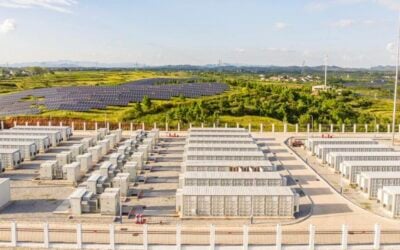
UK energy efficiency solutions provider Anesco has bolstered its portfolio of operational storage solutions, installing its second commercial battery at a solar farm.
A 250kWh commercial-scale battery has been installed at an as-yet-unnamed ground-mount solar farm in Berkshire eight months after the company installed its first battery at Slepe Farm in Dorset.
The battery has been supplied by Anesco’s storage partner, the Warren Buffet-backed and Tesla challenger BYD Company, and will serve as further progress towards the company’s aim of installing an additional 5MWh’s worth of storage solutions by the end of the year.
Anesco’s collaboration with BYD has been going for the last three years and Adrian Pike, chief executive at Anesco, said it has enabled the company to deliver for what has become a “fast-growing area”.
Try Premium for just $1
- Full premium access for the first month at only $1
- Converts to an annual rate after 30 days unless cancelled
- Cancel anytime during the trial period
Premium Benefits
- Expert industry analysis and interviews
- Digital access to PV Tech Power journal
- Exclusive event discounts
Or get the full Premium subscription right away
Or continue reading this article for free
“What we have been able to clearly demonstrate is how solar power can work as a key part of the generation mix, with battery storage providing a solution for matching supply with demand,” Pike said.
Further batteries are set to arrive from BYD’s China-based factory later this summer and Anesco has yet to roll out a 1MWh battery it was due to receive in April this year. BYD recently revealed that it has a strategy of building vast amounts of battery production capacity, thought to rival Tesla’s Gigafactory in size and scope, distributed across a number of sites internationally.
The latest installation is hoped to build on the success of the company’s first which, Anesco noted, secured three TRIAD payments over the course of last winter and enabled the solar farm to be registered as a non-intermittent generator, a first for the UK.
TRIAD charges are levied against electricity suppliers – who in turn recover them from customers – for their demand during peak half-hourly periods, typically between 4:30pm and 6:30pm on weekdays during winter months, and operators who reduce their demand during these times can reduce their TRIAD charges proportionally.
Speaking to PV Tech Storage, Pike said that TRIAD was one of a number of income streams Anesco was hoping to create for its battery storage solutions in order to “justify the expenditure”, something which he believes is a “key aspect” of battery storage.
“Obviously we would hope over time that some form of incentive will be provided to help drive battery storage in the UK and some form of tariff. I believe this would help drive pricing down and also lead to increased usage, which ultimately will mean that a large quantity of storage is installed – both commercially and residentially.
“Therefore it was our intention to build a control system to achieve TRIAD, which we’ve done, but more importantly it’s about demonstrating that we have full control of the storage unit, to charge, store and release energy, as and when the grid requires it,” he added.
Pike also said that the learnings gathered from its initial installations are shared with its customers and the UK Department of Energy and Climate Change (DECC) in order to “benefit all parties” in their understanding of the technology, and confirmed that the project had been funded by Anesco Asset Management.
UK energy regulator Ofgem ringfenced £500 million from the electricity distribution price control in order to establish the Low Carbon Networks Fund (LCNF), which supports projects sponsored by DNOs (Distribution Network Operators) to experiment new technology, operating and commercial projects in order to better understanding of emerging concepts which could provide greater energy security in the UK.
Battery storage has been a key concept under the LCNF with a number of storage projects receiving support from DNOs under both the first and second tiers of the fund.
This story has been amended from its original to inclue clarification of Anesco Asset Management’s funding of the project.