American Battery Solutions, a US company specialising in EV and commercial & industrial (C&I) battery energy storage solutions, has launched a new product for the grid-scale market.
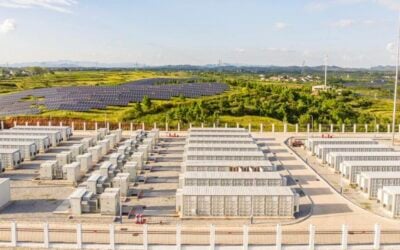
The company has released TeraStor, a new lithium-ion battery energy storage system (BESS) along with the StorView energy management system (EMS) suite of software and control hardware for optimising the system’s performance.
TeraStor offers ‘more than’ 7.2MWh of energy storage and 3.5MW of integrated inverter capacity, i.e. power. The company claims its pre-made configuration means it can be installed on-site in six hours versus weeks or months for a more conventional system.
According to a company datasheet, it has an an operating DC voltage range of 1150-1560 Vdc and an AC round-trip efficiency (RTE) of 88-91%, which refers to the system rather than the individual battery cells. Although not on the datasheet, the company’s website says it uses lithium iron phosphate (LFP) batteries, which typically have an RTE of around 95%.
Try Premium for just $1
- Full premium access for the first month at only $1
- Converts to an annual rate after 30 days unless cancelled
- Cancel anytime during the trial period
Premium Benefits
- Expert industry analysis and interviews
- Digital access to PV Tech Power journal
- Exclusive event discounts
Or get the full Premium subscription right away
Or continue reading this article for free
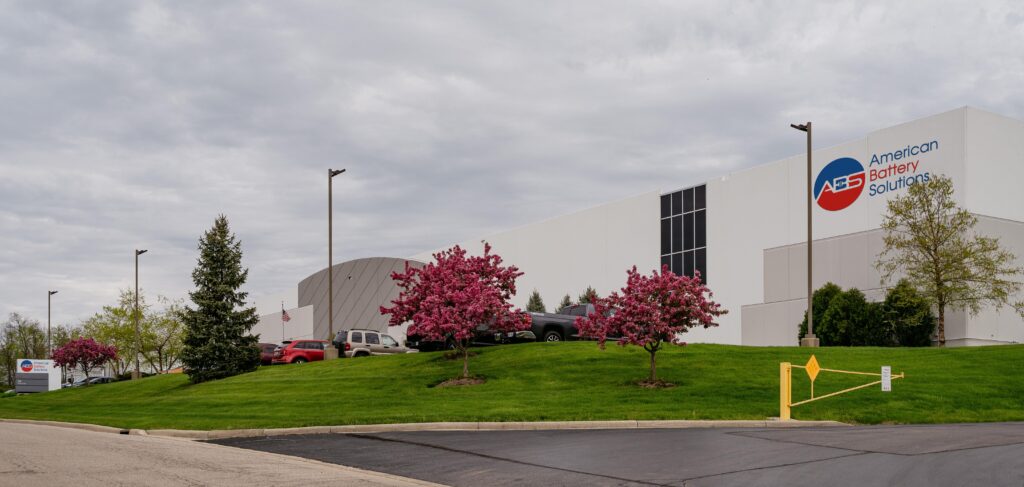
American Battery Solutions (ABS) announced its arrival into the market in 2018 with the acquisition of the manufacturing and testing assets for battery systems from Robert Bosch Battery Systems. That included a 16,000 square metre facility in Springboro, Ohio, where Robert Bosch had been assembling lithium-ion battery packs for the EV sector since 2009.
ABS re-launched the facility in April 2022 with added production capacity, mainly for its ALLIANCE Intelligent Battery Series for light commercial and heavy-duty EV markets. It also has an innovation centre in Michigan and employs 175 people.
US president Joe Biden last week signed the Inflation Reduction Act which increased incentives for both upstream and downstream parts of the country’s energy storage value chain.
This story was amended after publication to correct a sentence about the energy storage product’s round-trip efficiency.