
Existing assets can provide crucial benchmarks for the vital task of correctly sizing a battery storage system and other crucial design decisions, writes Ashutosh Vats, head of BESS business development at 3E.
Battery storage projects can start losing revenue as soon as they begin operating. The challenge is to learn from what happens in real-world operations and to use that information to improve the assumptions behind the next project.
This article looks at why battery sizing assumptions can have a bigger impact on project economics than many developers realise, and how using real operational data alongside financial models can lead to more realistic and reliable investment cases and ultimately change what it means for a battery project to be ‘bankable.’
Battery storage is now the fastest-growing power technology in the world. The International Energy Agency (IEA) reports 108GW of new capacity deployed in 2025, representing a 40% jump from 2024 and 11 times the installed base just four years earlier.
Try Premium for just $1
- Full premium access for the first month at only $1
- Converts to an annual rate after 30 days unless cancelled
- Cancel anytime during the trial period
Premium Benefits
- Expert industry analysis and interviews
- Digital access to PV Tech Power journal
- Exclusive event discounts
Or get the full Premium subscription right away
Or continue reading this article for free
Behind almost every BESS project sits a financial model which includes a sizing study that fixes power and duration, projects the revenue, and produces the internal rate of return (IRR) that unlocks the capital. Here comes the uncomfortable part for developers and IPP working on their first BESS projects: that financial model was built on assumptions and every one of them begins to drift the day the asset goes live.
Consider how a typical battery sizing study works. To identify the best configuration, the model simulates how the battery would operate over several years, using detailed forecasts of electricity prices and renewable generation. It effectively assumes that the future is known perfectly.
This is not a weakness of the approach. The aim is to establish a theoretical benchmark: the maximum revenue a battery could generate if it had perfect information and could always make the right decision.
A financial model that assumes, say, 2% annual capacity fade but meets 4% in the field will overstate revenue every single year, compounding across the debt term. The gap can be the difference between a project that services its debt and one that does not.
Yet most models still rely on manufacturer curves, and most operational platforms simply pass through the state of health (SoH) reported by the on-site battery management system (BMS), which is often supplied by the same OEM that issued the warranty in the first place.
Therefore, the assumptions that determine whether a BESS project is financeable are often the ones that are hardest to assess from a datasheet. The most reliable evidence comes from batteries that are already operating in the market. This is where the feedback loop becomes important. It needs to be based on independent, physics-based measurements rather than on information provided by equipment suppliers.
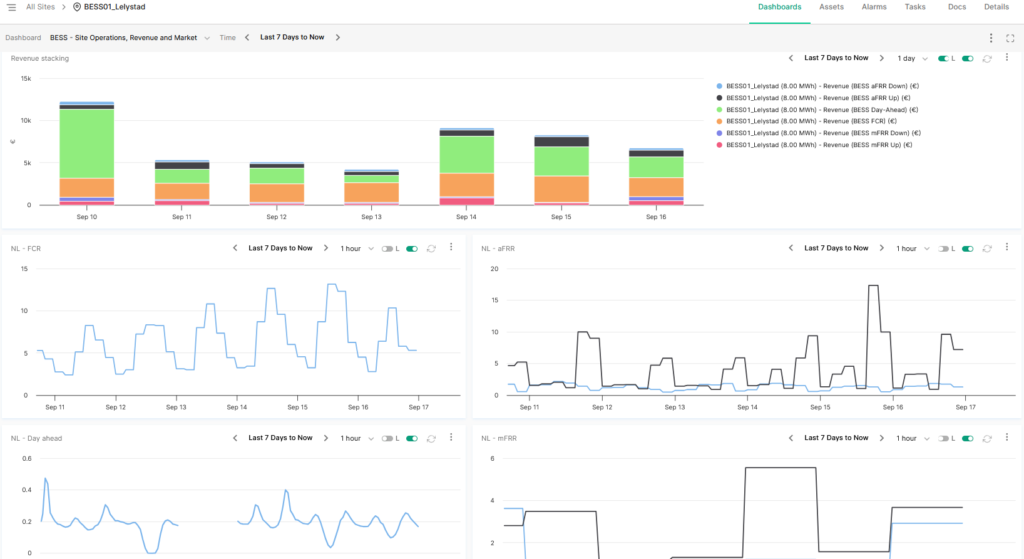
An independent digital twin can track how connected batteries actually perform over time. Instead of relying only on specifications, it can show how a battery is really behaving in the market: how its state of health changes, how different degradation mechanisms affect performance, how much revenue it captures, and how available it is during the periods when electricity prices are highest.
This is the principle behind SynaptiQ, 3E’s asset performance platform: independently measure how batteries actually perform across an operating fleet and use that evidence to improve the models used for future projects.
The same operational data can then feed back into 3E’s BESS sizing tool. This means that degradation assumptions are no longer based solely on manufacturer specifications. They can be informed by how batteries using the same chemistry have actually aged under comparable operating conditions, duty cycles and climates.
Every new BESS project can ‘learn’ from what came before it
At the development stage, investors can use the sizing tool to test different battery sizes and market strategies and assess how they would perform under different scenarios. The built-in optimisation process can then identify configurations that offer the best balance between technical performance and financial returns.
In Spain, for example, where co-location development of PV plants and/or wind farms with battery storage is thriving, understanding how the different technologies will generate electricity in order to optimise revenue stacking through the right BESS size requires an optimisation tool capable of integrating numerous variables, go-to-market strategies and real simulation of how the different assets will operate through time. Over the last 2 years, simulations have increasingly shown a need for 4-hour batteries instead of 2-hour batteries to obtain optimal profitability and NPV.
For investors and lenders, this changes the way we should think about bankability. A project will always depend on assumptions about future prices, degradation, availability and revenues. But those assumptions become more robust when they are continuously tested against the performance of real operating assets.
The value of closing this loop is simple: every new BESS project can learn from the batteries that came before it. Operational data improves the models, better models lead to better sizing decisions, and those decisions provide investors and lenders with a more realistic view of the project’s potential performance.
The BESS market is expanding rapidly, and large amounts of capital are being committed to new projects. As the market matures, the quality of the models used to make those investment decisions will become increasingly important. The projects that are grounded in real operational evidence will have a stronger basis for assessing risk and returns than those relying primarily on theoretical forecasts.
About the Author
Ashutosh Vats pairs a computer science engineering foundation with business to lead product and go-to-market strategy across the renewable energy, high-tech, and AI industries. As head of BESS business development at 3E in Belgium, he drives product launches and global market expansion. Across more than a decade, he has built and led teams that turn emerging technology into measurable market growth.
