Australian battery storage developer Akaysha Energy has secured an AU$300 million (US$196 million) corporate debt facility to accelerate its growing portfolio of utility-scale battery energy storage system (BESS) projects across Australia and global markets.
Akaysha Energy, owned by global investment manager BlackRock, announced today (4 September) that the three-year debt package will be funded by a consortium of five banks: BNP Paribas, Deutsche Bank, ING Bank, Sumitomo Mitsui Banking Corporation and Westpac Banking Corporation.
The multi-currency facility, available in Australian dollars, euros, and US dollars, comprises a revolving loan and letter of credit facility designed to support Akaysha’s expansion plans in the rapidly evolving energy storage sector.
Specifically, the debt facility will fund development and construction of Akaysha’s BESS project pipeline in Australia, the US, Japan and Germany.
Try Premium for just $1
- Full premium access for the first month at only $1
- Converts to an annual rate after 30 days unless cancelled
- Cancel anytime during the trial period
Premium Benefits
- Expert industry analysis and interviews
- Digital access to PV Tech Power journal
- Exclusive event discounts
Or get the full Premium subscription right away
Or continue reading this article for free
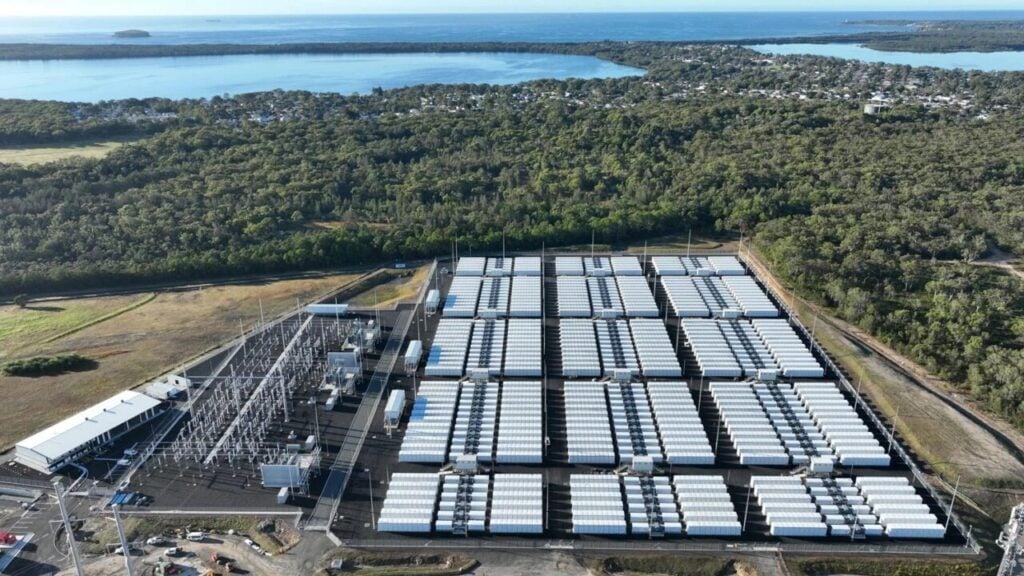
This financing represents a significant milestone for Akaysha, which has already established itself as a major player in Australia’s energy transition landscape. It recently energised the first stage of the 850MW/1,680MWh Waratah Super Battery in New South Wales.
In an exclusive interview with ESN Premium last month, Nick Carter, managing director and CEO of Akaysha Energy, discussed the development process of the utility-scale BESS.
Commenting on the corporate debt facility, Andrew Wegman, chief financial and investment officer of Akaysha Energy, said the financial package was a “landmark” facility for both the developer and the Australian renewables sector.
“As the first borrowing base loan of its kind in the market, it provides the scale and flexibility to accelerate our development pipeline and capitalise on the extensive set of near-term opportunities that we see in Australian and global energy markets,” Wegman added.
Alongside Waratah Super Battery, which is described as the “world’s most powerful battery” in megawatt terms, the organisation has several other large-scale BESS in its portfolio in Australia.
This includes several projects that are currently under construction, such as the Ulinda Park BESS (150MW/300MWh), which is expected to be operational in Q3 2025, and the Brendale BESS (205MW/410MWh) in Queensland, which recently secured a long-term offtake agreement, confirmed to be a battery revenue swap arrangement, with commodities trading company Guvnor Group.
The company is also developing the 415MW/1,660MWh Orana BESS project in Wellington, New South Wales. In December 2023, it secured a landmark AU$650 million project financing deal, which was reported at the time as the largest standalone battery storage financing globally.
The Orana BESS project, located in the Central-West Orana Renewable Energy Zone, also secured a 12-year virtual toll offtake agreement with EnergyAustralia and is expected to be operational by 2026.
Our publisher, Solar Media, will host the Energy Storage Summit Asia 2025 on 7-8 October 2025 in Manila, the Philippines. The official website has more information about the event, including how to book your ticket.