As the share of renewables continues to increase at pace, the need for energy storage – and particularly long-duration storage – is growing.
The nascent sector has received a lot of attention recently, including the Department of Business, Energy and Industrial Strategy (BEIS) unveiling nearly £7 million in funding to help “turbocharge” the sector.
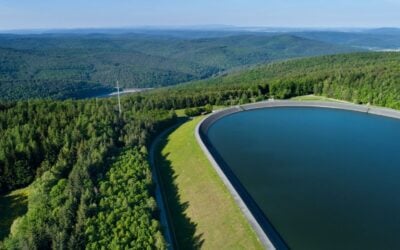
One of the winning companies was innovative pumped hydro developer RheEnergise, which has developed a solution that can operate on low hills rather than just mountains, creating an opportunity an order of magnitude greater than traditional pumped hydro.
Key to the solution is the use of the company’s High-Density Fluid R-19, which is 2.5x denser than water.
Try Premium for just $1
- Full premium access for the first month at only $1
- Converts to an annual rate after 30 days unless cancelled
- Cancel anytime during the trial period
Premium Benefits
- Expert industry analysis and interviews
- Digital access to PV Tech Power journal
- Exclusive event discounts
Or get the full Premium subscription right away
Or continue reading this article for free
“It’s got a high solid content that’s milled to a powder, and then we add chemistry to that too, so that the particles in the water repel each other, which is how even though it’s actually a solid in water, it behaves very much like a liquid does,” RheEnergise CEO Stephen Crosher told Current±.
“The mineral that we’re using is environmentally benign, it’s inert, it doesn’t react, it doesn’t corrode things. It’s even used in a very pure form in oral medical applications. So it’s definitely benign.”
Because of the high density of the fluid, projects can not only be constructed in areas with less elevation, but they can also be up to 2.5x smaller than traditional pumped hydro projects for the same energy.
“So if everything else was equal, our projects would be 60% smaller volumetrically than a project with water for the same power and energy,” said Crosher.
“And when you look at construction costs in hydro projects, 65 to 70% of the cost of those projects are in the civil engineering costs. So if volumetrically, you’re reducing those by 60%, you have a huge opportunity for cost saving.”
While there is an additional cost associated with using High-Density Fluid R-19 as opposed to water, because the system is a closed loop it does not need to be regularly replaced.
Additionally, the closed loop means you don’t need water abstraction in the same way as traditional pumped hydro. As such, it can be used in areas with low levels of rainfall, further opening up potential new geographies, even cities on the edge of deserts.
One of the big advantages to RheEnergise’s solution is the lack of supply chain challenges. This allows the high-density hydro installations to be rolled out quickly, as well as avoiding the use of rare minerals or metals which could be subject to additional challenges.
Because of this, along with other factors, the cost of the company’s technology is expected to be >40% below that of a lithium-ion battery project, and >15% below gas peaking plants.
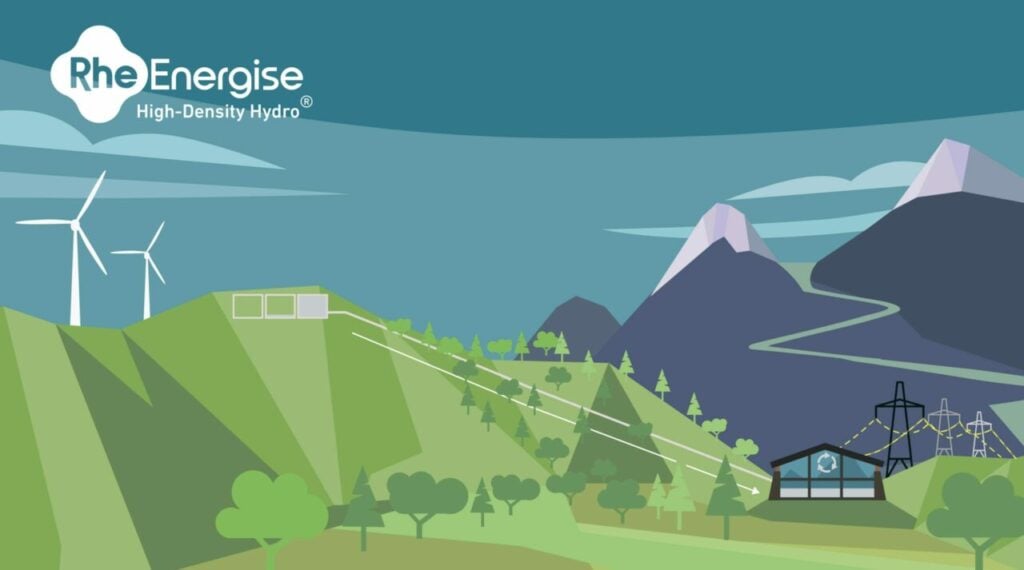
While the system works much like traditional pumped hydro – with the fluid raised when green electricity is abundant, and then released through turbines generating electricity to supply power to the grid when needed – because it can be used on a wider range of elevations, it requires less bespoke solutions, creating further cost-efficiencies.
“When you look at traditional pumped hydro, every project is a one off project. They look for a site and then they design the project around it,” expanded Cosher. “Every valve is bespoke, every turbine is bespoke, pipework’s often bespoke, while for us, we’re looking to commoditise this system.
“If we’ve built a project for, say, a 200m head, then we would resell that project. So we would go and look for other good sites with a 200m head and resell it, and therefore commoditise all of those various bits of machinery and equipment, and also have a much more predictable idea of cost.”
RheEnergise’s solution can offer between 10MW to 50MW of power, which can either be co-located with renewables like wind and solar or directly connected to the grid. The scale of the solution makes it well suited to balance solar power in particular, which works on a daily cycle.
The energy storage market is predicted to be worth $620 billion by 2040 according to BloombergNEF, and technologies that can provide mid-range storage – between four and six hours – will be needed to fill a crucial gap within this market.
RheEnergise expects it will take just 10 months to construct a typical 10MW, four hour system. While a 50MW project with eight hours would be closer to a two and a half year construction period. But, as with many renewable energy projects, the key unknown within the development of the sites is gaining planning permission and a grid connection.
The company is now planning to build a demonstration project, utilising the £150,000 from BEIS to conduct a feasibility study, for the development of a 1MW/4MWh site. Construction is expected to take place in 2023, allowing it to be commissioned at the end of next year.
As well as the funding from BEIS as part of its long-duration energy storage competition, RheEnergise opened a fundraising round on Crowdcube on March 28th. At the time of writing, the company had raised more than double its target, hitting £775,430.