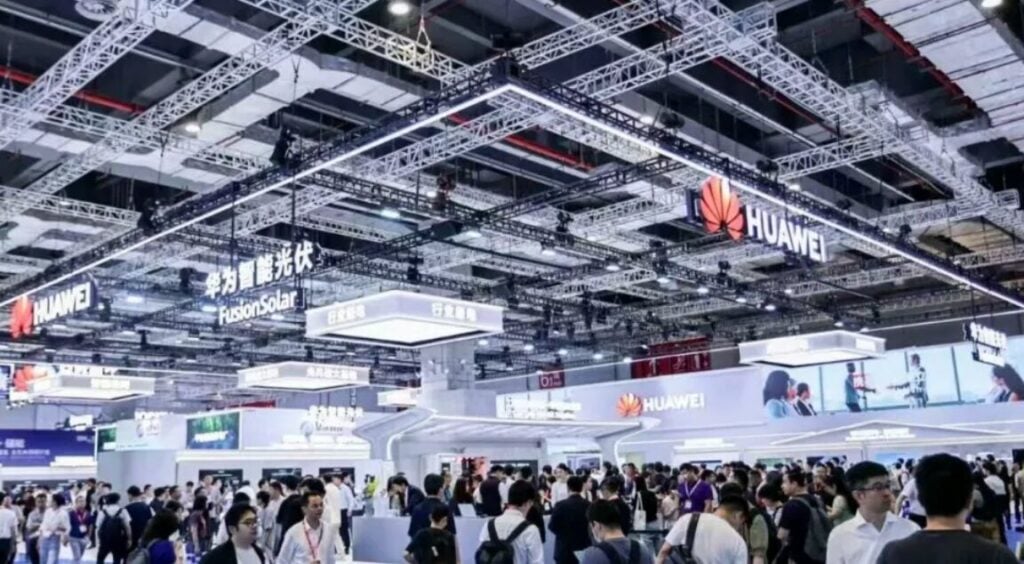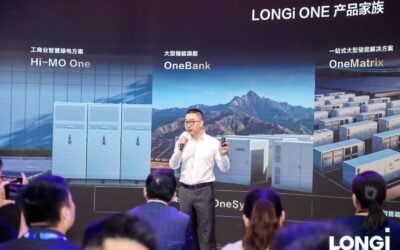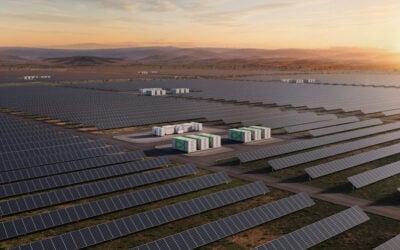
Carrie Xiao reports back from this year’s edition of SNEC in Shanghai, China, the world’s biggest solar and energy storage expo.
The 19th SNEC International PV Power Generation and Smart Energy Conference & Exhibition concluded on June 5, 2026. This year’s expo saw a notable shift in hall zoning, with energy storage standing out as a core crowd favourite, alongside PV.
Storage took up six full halls, outnumbering the four halls dedicated to PV modules for the first time. Gone were the rows of large PV module billboards of previous years; in their place were displays of all-domain energy solutions, liquid-cooled battery energy storage systems (BESS), and real-time zero-carbon park simulations.
Over 120 leading firms showcased their offerings at the event, including Sungrow, CATL, Chint Power, Hithium, Huawei, Sigenergy, AISWEI Tech, Ginlong Solis, Linyang Energy, Canadian Solar, Kehua Shuneng Tech, Xieneng Tech, Nanrui Electric, BYD, REPT BATTERO and Sunwoda.
Try Premium for just $1
- Full premium access for the first month at only $1
- Converts to an annual rate after 30 days unless cancelled
- Cancel anytime during the trial period
Premium Benefits
- Expert industry analysis and interviews
- Digital access to PV Tech Power journal
- Exclusive event discounts
Or get the full Premium subscription right away
Or continue reading this article for free
Their displays covered power conversion systems (PCS), cells, residential storage units, C&I storage systems, zero-carbon park solutions, and power solutions for AI data centres (AIDC).
This follows our first roundup of SNEC 2026 product launch and showcase highlights, which ran earlier this week.
Differentiated product features, smart technologies and comprehensive ESS, cell upgrades
Sungrow launched its PowerMatrix inverter, an all-in-one device that integrates PV inversion, storage conversion, intelligent energy routing, and grid-forming control. Boasting multi-source compatibility, multi-loop interconnection, and multi-device coordinated operation, the product enables seamless collaboration across power generation, power grids, power loads, and storage assets. Sungrow claimed that it greatly simplifies the overall structure of PV-storage hybrid systems and eliminates device compatibility challenges.
CATL debuted its sodium-ion cell at the exhibition. Featuring the same packaging design as lithium-ion cell, it can be directly retrofitted into existing lithium cell modules with outstanding compatibility. The cell is now in mass production and delivery and has been deployed in a megawatt-scale storage project in Tibet. CATL notes that sodium-ion cells benefit from abundant sodium resources and low cost, making them especially well-suited for long-duration storage applications that do not require high energy density.
Huawei Digital Power premiered a new string-type grid-forming PCS solution, a 1000V AC PCS with a unit power rating of 430kW. The system’s round-trip efficiency has been increased to 97.8%, and it features the industry’s widest DC voltage operating range of 550V to 1500V, supporting different cell types such as lithium-ion and sodium-ion.
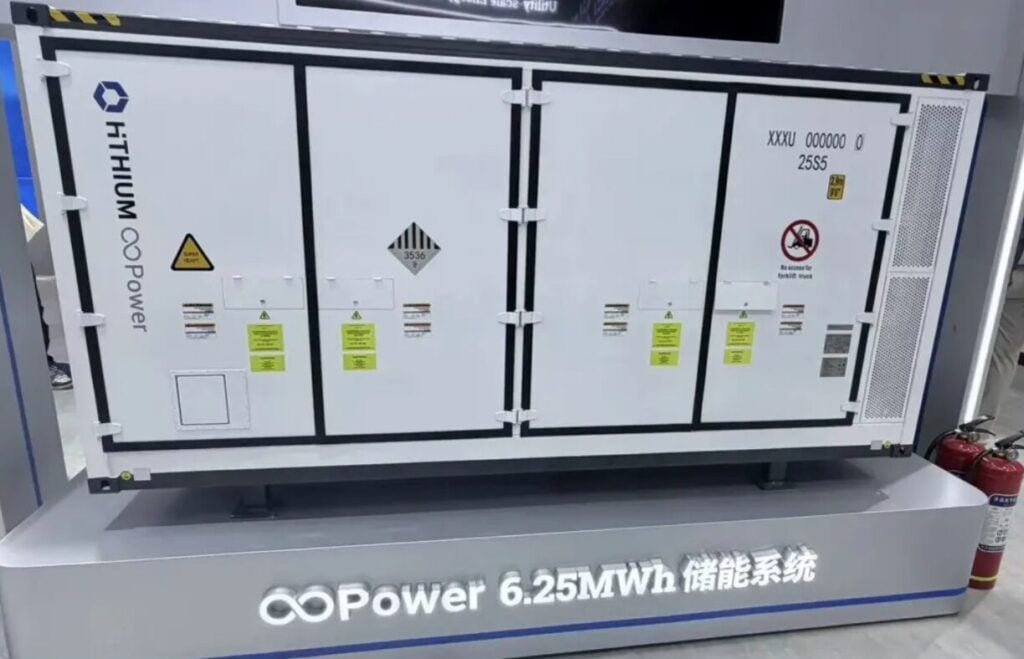
Centred on the theme of ‘Driving Long Duration, Sustaining Green Power,’ Hithium unveiled what the company claimed is the world’s first “native” 8-hour long-duration storage solution designed specifically for long-duration energy storage (LDES) applications, the ∞Power 6.9MWh system, alongside its new ∞Cell 650Ah large-format cell and the ∞Power 10+MWh product offering.
With a single-unit capacity of 6.9MWh, the system can efficiently store excess daytime solar power for nighttime use.
“As the ‘duck curve’ challenge becomes more pronounced, long-duration storage is emerging as a new infrastructure to ensure the safe operation of power systems,” said Ye Zi, product director at Hithium Storage.
Trina Storage presented its end-to-end storage ecosystem covering cells, DC systems, AC systems, and system validation services. Its core exhibits included the 587Ah high-capacity cell, the Elementa 3 storage platform, and the Electra, a 13.8MW AC-side storage solution. The company also highlighted its grid-forming storage technology and customised solutions for AI data centre (AIDC) applications.
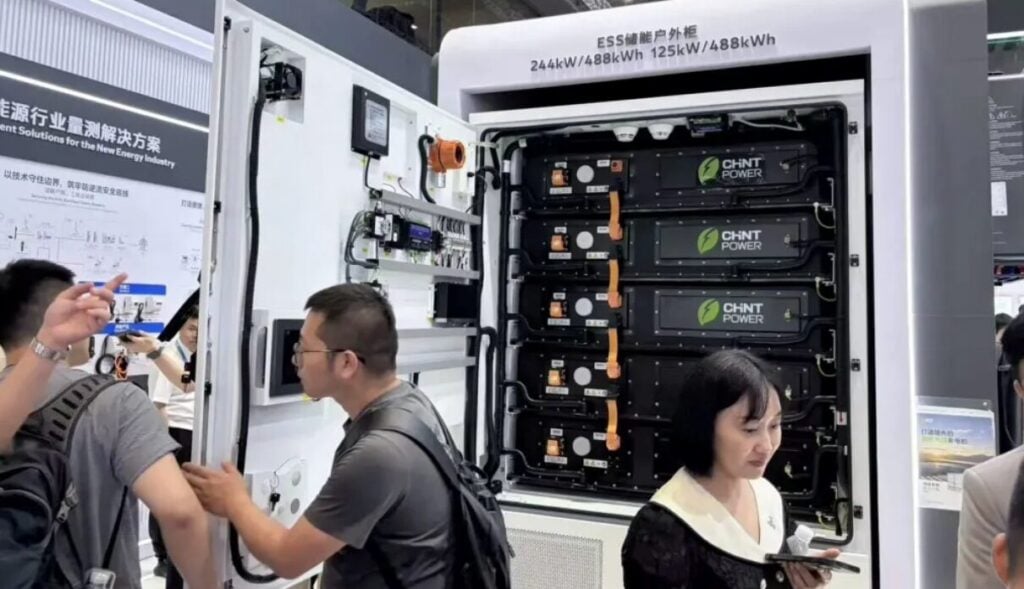
Chint Power unveiled three ground-mounted PV-storage generators, delivering tiered power ratings to accurately address large, medium, and small-scale PV-storage projects. They are applicable to both greenfield installations and technical retrofits of existing PV plants. The company also exhibited its C&I PV-storage portfolio, featuring 125kW/261kWh outdoor storage cabinet, decentralised inverter, and anti-reverse power box.
Sunwoda unveiled a full range of self-developed storage cells at the exhibition — 72Ah, 85Ah, 102Ah, 280Ah, 314Ah, 588Ah, and 684Ah — addressing applications from residential and AIDC to C&I and utility-scale storage. The company also introduced its new-generation NoahX 6.26MWh liquid-cooled storage system, featuring the 588Ah cell, for the first time.
JinkoSolar has designated 2026 as its “breakout year” for energy storage, launching its Blue Whale SunTera G5 system at this year’s exhibition.
“As the cost-effectiveness of PV-storage improves, we are seeing a growing number of customers, especially C&I distributors. Our company currently holds 5GWh of confirmed storage orders, 5.3GWh of high-potential orders, and over 20GWh in the pipeline. Storage shipments are expected to double year-on-year in 2026,” JinkoSolar vice president Qian Jing said.
Embrace of AI economy
At the exhibition, the majority of players — including top-tier system integrators, PCS suppliers and leading cell manufacturers — demonstrated their AI-related strengths. A few went so far as to declare, ‘The energy sector is ready to embrace the token economy.’
Huawei Digital Power, with its ‘grid-forming + AI’ strategy as the main theme, highlighted a range of solutions, including grid-forming (GFM) storage and FusionSolar Agent. As AI rapidly integrates into renewable power plants, Huawei is further expanding its grid-forming technology beyond storage to diverse scenarios such as PV, load management and AIDC.
Linyang Energy unveiled two AI-powered digital platforms — the ‘O&M Agent’ and ‘Virtual Trader 2.0’. Powered by dual-engine technology, the platform aims to revolutionise the operation and trading of renewable energy assets. This marks a shift from conventional manual maintenance and passive trading to a new phase of AI-driven autonomous operation and intelligent decision-making.
Inverter manufacturer GoodWe unveiled the WE-AI energy operating system, built on a dual-branch large model for time series and decision-making, an AI agent cluster, and cloud-edge-end collaboration. The system forecasts electricity prices, loads, and equipment conditions, and generates operational strategies — ushering residential PV-storage into the ‘autopilot’ era.
Over 92GWh of energy storage deals signed on SNEC 2026 show floor
The exhibition saw a flurry of contract signings among storage companies, with total volume of publicly announced deals and agreements surpassing 92.7GWh.
CORNEX bagged a total of 12GWh in orders, including an 8GWh framework agreement with Dongfang Electric covering 314Ah and 588Ah large-format cells, along with 2GWh strategic partnerships, each with CHINT Electric and Alpha ESS for its 588Ah large-format cell.
Ganfeng Lithium secured over 30GWh in cooperation intentions with partners including Clou, Deye, and GoodWe, spanning utility-scale, C&I and residential storage applications.
EVE Energy secured over 67GWh of bulk storage orders through agreements with prominent partners such as Shanghai Electric Power Electronics, Jiangsu WETOWN Energy, and Brazil’s Genesis.
SVOLT Energy secured 8GWh of storage orders with SOFAR Solar, Dahai Group, and Brazil’s BlueSun. Meanwhile, Sanj-Electric inked a 1GWh PV-storage strategic deal with Australian distributor OSW, and Sav-digitalpower formed a 10GWh strategic partnership with Hubei EVE Power, a subsidiary of EVE Energy.
The explosion in orders shows that storage demand in the market has moved beyond policy incentives and is now fuelled by economic fundamentals.