Two non-lithium battery energy storage system (BESS) companies, Eos Energy Enterprises and ESS Tech Inc, are betting big on the US adoption of long-duration energy storage (LDES) in Q1 2026 financial reports.
Eos Q1 2026 financial results
Zinc hybrid cathode battery and storage system maker Eos Energy was not profitable in Q1 2026 but remains committed to the future of LDES.
The company released its Q1 2026 financial results on 13 May, highlighting a 445% year-over-year revenue increase to US$57 million.
Eos reported Q1 2026 revenue of US$56.9 million and a gross profit loss of US$44.4 million. In Q1 2025, the company reported a US$10.4 million revenue and gross profit loss of US$24.5 million.
Try Premium for just $1
- Full premium access for the first month at only $1
- Converts to an annual rate after 30 days unless cancelled
- Cancel anytime during the trial period
Premium Benefits
- Expert industry analysis and interviews
- Digital access to PV Tech Power journal
- Exclusive event discounts
Or get the full Premium subscription right away
Or continue reading this article for free
The adjusted EBITDA loss reached US$68 million, up from US$43.2 million in the same quarter last year.
Eos reaffirmed its 2026 revenue guidance of US$300 million to US$400 million, emphasising its recent formation of Frontier Power USA, with Cerberus Capital Management.
Eos also revealed on 13 May that it and Cerberus intend to capitalise Frontier Power, a purpose-built company tasked with developing and operating a portfolio of LDES projects featuring Eos’ zinc bromide Z3 technology. The entity aims to function as an independent power producer (IPP), marking a shift from equipment supplier to project owner-operator.
A 2GWh firm capacity reservation agreement between Eos and Frontier Power has expanded Eos’ order backlog from its 31 March 2026 baseline. The reserved capacity is earmarked for deployment across three segments—utility-scale installations, AI data centres, and commercial and industrial (C&I) sites—all drawn from Frontier Power’s active multi-gigawatt-hour project pipeline. Private equity firm Cerberus Capital Management is an existing investor in Eos, agreeing on a US$315 million financing package with the battery startup in mid-2024.
In Eos’ Q4 and full-year 2025 financial results, the company’s CEO Joe Mastrangelo expressed disappointment in not meeting revenue expectations and said that 2025 was a “structural turning point” for the company.
In November 2025, Eos reported Q3 results showing continued losses, with leadership emphasising that profitability would depend on LDES market adoption and scaled automated production.
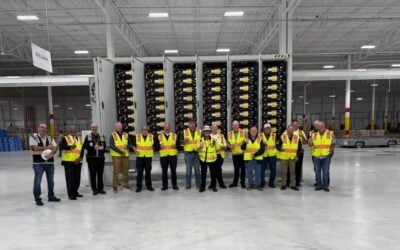
The company announced an expansion in Marshall Township, Pennsylvania, establishing manufacturing lines with up to 8GWh annual capacity and developing a software hub in Pittsburgh. Eos planned a US$352.9 million investment in new production lines and headquarters relocation, supported by approximately US$22 million in Pennsylvania state funding.
While the company had previously expressed doubt about its ability to continue operating, its Q4 2025 financials stated: “Given the Company’s current cash position and ongoing margin improvements, management has concluded that substantial doubt regarding the Company’s ability to continue as a going concern no longer exists.”
In its latest financial results, Mastrangelo said, “The market is telling us what it needs: long-duration storage that is safe, American-made, and financeable at scale. We have the technology, the manufacturing, the controls, and now, with Frontier Power USA, the planned capital to accelerate project deployment.”
He continued, “Q1 showed the business scaling: record output, improved margins, and more than 6GWh discharged energy on Eos technology. The work ahead is conversion: turning a US$24 billion pipeline into installations discharging energy.”
ESS Tech Inc Q1 2026 financials
Iron flow battery company ESS Tech Inc announced its Q1 2026 on 7 May, remaining unprofitable, but focused on recent partnerships.
ESS reported Q1 2026 revenue of US$128,000 and a net loss of US$15.9 million. In Q1 2025, the company reported US$571,000 in revenue and a net loss of US$18.02 million.
The adjusted EBITDA loss reached US$10.26 million, improved from US$14.95 million in the same quarter last year.
ESS highlighted its Project New Horizon collaboration with utility Salt River Project (SRP) and tech giant Google, a 5MW/50MWh system using ESS’ iron flow Energy Base technology.
Project New Horizon was selected via a competitive process for LDES technologies from SRP. Manufacturing is planned for this year and delivery is aimed for December 2027.
The company also pointed to its US$9.9 million contract with the US Air Force Research Laboratory, to deploy up to 27MWh of its energy storage solutions, supporting the Clear Space Force Station in Alaska, as an achievement.
ESS Inc also noted its recent partnership with sodium-ion (Na-ion) battery startup Alsym Energy, which will see ESS add 8.5GWh of Alsym’s Na-ion cells and modules to its portfolio.
ESS Inc went public on the New York Stock Exchange (NYSE) in 2021 via a special purpose acquisition company (SPAC) merger during the boom of 2020-2023, when others, including Eos, Energy Vault and Stem, did the same. Since then, ESS Inc’s shares have plummeted from an all-time high of US$281.25 in 2021, though leadership cautioned early on that profitability would take time.
This month, the stock price has dropped as low as US$0.77 per share.
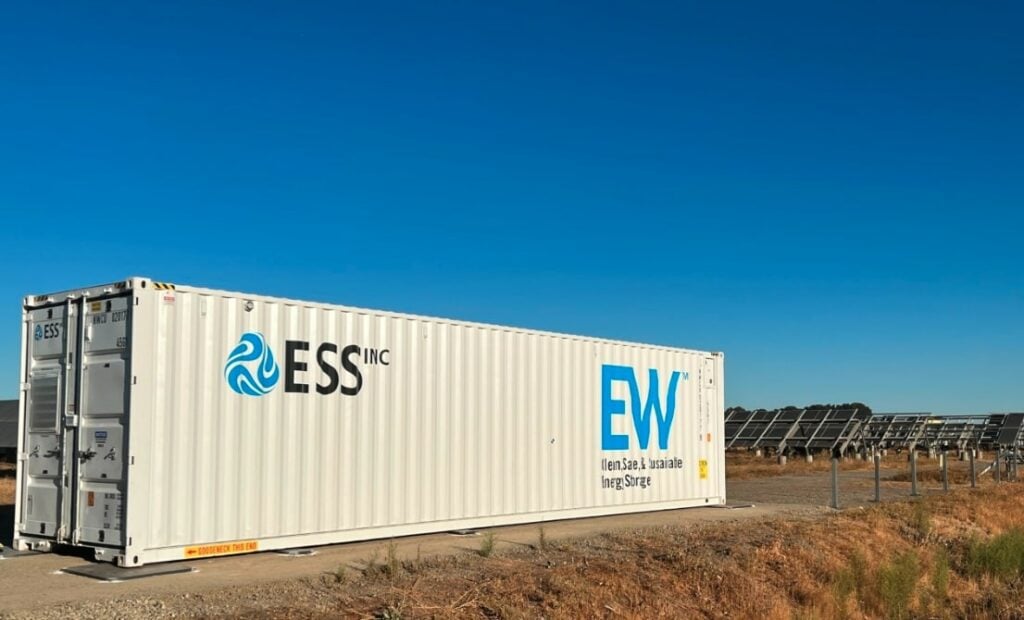
In Q1 2025, the company announced a strategic pivot, discontinuing its smaller Energy Warehouse and Energy Centre products to focus exclusively on Energy Base, a 12- to 14-hour LDES system targeting data centres and large-scale renewable energy operators.
Kate Suhadolnik, chief financial officer of ESS, commented on the company’s most recent financial results, “We remain focused on expense control, liquidity, and maintaining financial flexibility as we support the business through its transition and commercialisation efforts.”
Suhadolnik continued, “Total operating expenses declined 33% year-over-year and we also benefited from the capital raised through our registered direct offering during the quarter. We ended the quarter with US$15.5 million in unrestricted cash and cash equivalents and US$6.0 million in short-term investments, representing total liquidity of US$21.5 million. We remain focused on the strategic allocation of capital as we advance our operational and commercialisation priorities.”