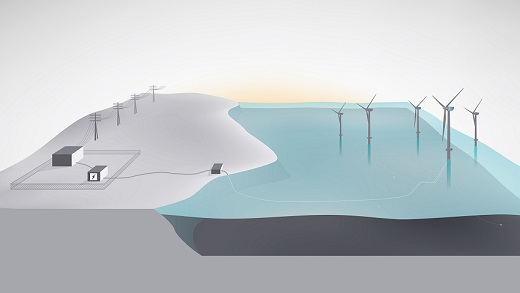
Norwegian oil and gas company Statoil’s Batwind project in Scotland, combining wind turbines with energy storage, will have a battery system installed by system integrator Younicos.
Batwind is under development through a partnership between Statoil and Masdar, the renewables and energy efficiency company owned by a government investment group in the United Arab Emirates’ Abu Dhabi. A Memorandum of Understanding (MoU) was signed by parties including Statoil and the Scottish government to develop the project in March 2016.
The project also hosts the world’s first floating wind turbines, based on Statoil’s proprietary Hywind platform, with the wind farm portion of the project dubbed Hywind Scotland. The floating turbines generate 30MW of electricity and began production in mid-October, when the facility was officially opened by Scotland’s First Minister Nichola Sturgeon.
The offshore power plant, some 25km off the coast of Aberdeenshire to the east of the Scottish coast, is 75% owned by Statoil and 25% by Masdar. Statoil announced yesterday that it has awarded Younicos the contract to deliver a battery energy storage system of 1MW / 1.3MWh to connect to Hywind Scotland.
Try Premium for just $1
- Full premium access for the first month at only $1
- Converts to an annual rate after 30 days unless cancelled
- Cancel anytime during the trial period
Premium Benefits
- Expert industry analysis and interviews
- Digital access to PV Tech Power journal
- Exclusive event discounts
Or get the full Premium subscription right away
Or continue reading this article for free
The battery is intended to maximise the output of the wind farm usable by the grid, which in times of overproduction could mean storing the energy generated for injection into the grid later, could smooth out the variable generation of the six 5MW Siemens Gamesa-supplied turbines and otherwise mitigate peaks and troughs in energy production. Younicos has in the past sourced batteries from Samsung SDI and others, acting as integrator for grid-scale and commercial energy storage projects, using its own energy and battery management software and control platforms.
“As part of Statoil’s strategy of gradually supplementing our oil and gas portfolio with profitable renewable energy, getting to understand energy storage is important. With more renewables coming into production it will be crucial to handle storage to ensure predictable energy supply in periods without wind or sun,” Statoil director of development for Hywind projects, Sebastian Bringsværd said.
“Batwind has the potential to add value by mitigating periods without wind – and by that making wind a more reliable energy producer year around. This could expand the use and market for wind and renewables in the future.”
The battery energy storage system will be housed in two 10ft containers, scheduled for completion by the second quarter of 2018. When the project – considered to be a pilot of the technologies involved – was first announced, Statoil said the decision to build a floating wind farm would trigger investment of around NOK2 billion (US$240 million) and creating a cost reduction of up to 70% from the first Hywind demonstration project Statoil deployed in Norway.
Growing case for wind-plus-storage
While solar-plus-storage has garnered headlines and acclaim across the clean energy industries over the past couple of years, announcements of batteries and other energy storage integrated or co-located with wind power have also become more frequent.
To name but three, Toshiba and NRG Energy recently powered up a wind-plus-storage solution in Texas, the world’s planned ‘tallest wind turbine’ installation in Germany looks likely to get a co-located pumped hydro storage and our reporter David Pratt recently went to see Vattenfall’s 22MW battery system at a wind farm in Wales, in the UK, last month.