
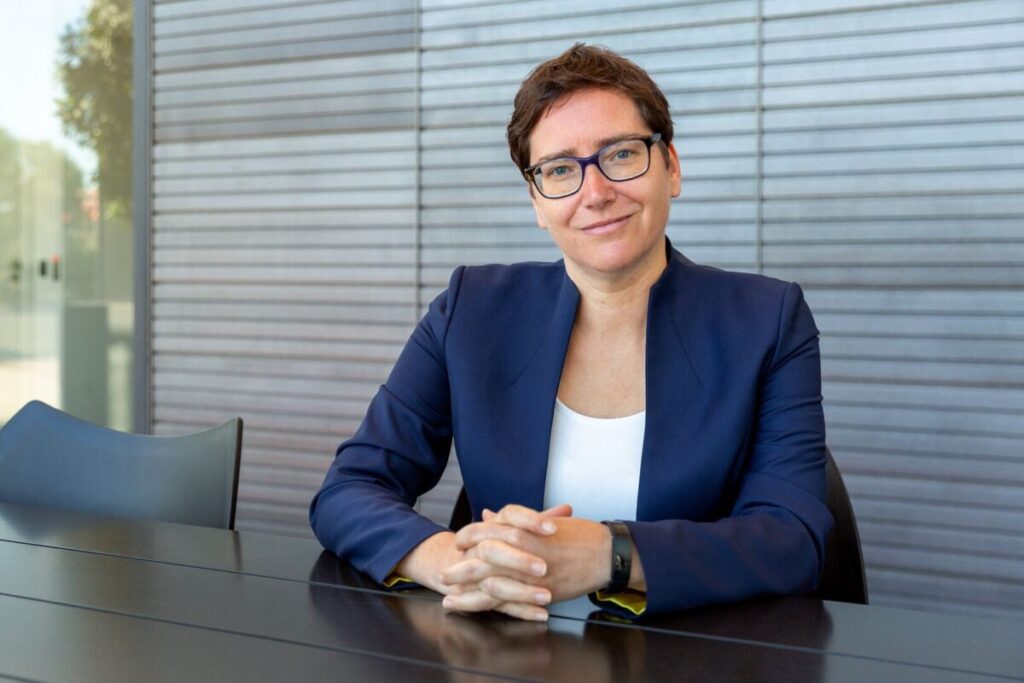
We catch up with Tamara de Gruyter, president of Wärtsilä Energy Storage, to discuss the system integrator’s strategy under new leadership.
Wärtsilä has been one of the leading battery energy storage system (BESS) integrators from the outset of the industry. De Gruyter now leads its activity in the space since it parted ways with industry veteran Andy Tang, who had led its energy storage activities for six years as head of its Energy Storage & Optimisation (ES&O) segment, in early 2025. (Tang is now head of overseas business for Chinese OEM Rept Battero.)
It’s worth noting the context here. Wärtsilä’s board launched a strategic review of the ES&O segment in 2023, saying it had grown to a size where it had to be re-assessed with options including strategic divestment. An analyst told us at the time that this was likely because storage’s lower margins and faster growth than Wärtsilä’s other divisions would have a negative effect on group margins.
However, in early 2025 it closed its strategic review of the segment and said it was ‘committed’ to the sector. It made energy storage a distinct vertical (Energy Storage, 10% of full-year revenues) for the first time, sitting alongside rather than under its ‘Energy’ vertical, and therefore directly under its Board of Management.
Try Premium for just $1
- Full premium access for the first month at only $1
- Converts to an annual rate after 30 days unless cancelled
- Cancel anytime during the trial period
Premium Benefits
- Expert industry analysis and interviews
- Digital access to PV Tech Power journal
- Exclusive event discounts
Or get the full Premium subscription right away
Or continue reading this article for free
Its long-term Energy Storage financial targets are low double-digits organic growth and a 3-5% operating margin, while for Marine and Energy (80% of the business), it is 5% organic growth but a 14% operating margin.
Change in leadership and decision not to divest
“That change (in structure) also required a different need, now being under the Board of Management, which I was part of, so I was asked to take on this new challenge,” says de Gruyter, who has been at the company for nearly 30 years.
We then ask why the company decided not to divest the energy storage segment: “In the end, we are a stock-listed company and so we have to look at what is best for the shareholders. And from all the options available, this was the best way forward for them.”
Change in strategy and adapting to US policy environment
De Gruyter says that there wasn’t a change in strategy related to her taking the helm, but that the strategy had to change when Trump hiked up tariffs globally, increasing the effective tariff on BESS from China into the US to 82%. That happened on her second day in the job, on 2 April.
“For any business leader it meant really thinking how to navigate this complexity. And you could say the first crisis I had to deal with was for one of our customers. We had all the equipment ready in China, ready to get shipped to the US, and all of a sudden we were faced with higher tariffs and our customers said they couldn’t afford it. And we as Wärtsilä also couldn’t afford it,” De Gruyter explains.
“It changed the dynamics in the US market, and it also, of course, has an impact in the other markets. The US market depressed and competition in other parts of the world increased because everyone started looking for other markets. This is something all companies had to deal with.”
“But the US market was a big one for us, and that’s also meant pivoting a little bit to ask how we can still get a share of the US market but, but also doubling down on Europe and Australia which are important markets too. So there’s been not necessarily a change in strategy because of me, but I think it’s more a change because of what happened in the world.”
Year-on-year, 2025 saw the Energy Storage division’s net sales subsequently fall 11% and its operating margin fall from just over 4% to 3.3%, compared with 2024 figures.
Key to retaining a foothold in the US market could be diversifying to a broader Southeast Asia supply chain rather than China, which has typically been where Wärtsilä has manufactured its BESS, de Gruyter says.
She says the firm is exploring opportunities in Southeast Asia as well as in the US itself, but the premium that buyers are willing to pay for locally-produced product is not yet clear, and will not pencil out for all.
That local manufacturing question is much less prominent in Australia, while in Europe it is growing, although the concrete ramifications of a recent European Union proposal to support and favour increased domestic supply chain involvement are not clear yet.
Focus on ‘complex’ projects and markets and ‘not being an EPC’
Geographically the focus has been and will continue to be Australia and Europe alongside the US. But the company will also prioritise the more complex, demanding projects too, Gruyter says. Note that these kinds of projects are presumably higher-margin as well.
“And we also are looking at those countries where there is a level of complexity, where there is a particular requirement for fire safety and cyber security, because I think we also have to be realistic. We’re probably never going to be able to be the cheapest and compete, for instance, against pure Chinese battery players,” De Gruyter says.
“So we’re looking at those part of the market where there’s a lot of firsts, where there is complexity, and this is also something that we can see we can help our customers with.”
“Last year, we got a software-only order where a customer was sitting with a stranded asset, which they had bought rather cheap. But then, basically they couldn’t get the grid connection and the modeling, and then basically, with our competencies, we stepped in and we were able to unlock the asset, which, of course, is extremely important for customers.”
You can see this reflected in recent project history (browse all our coverage of the firm here), including numerous ‘firsts’ including grid-forming projects in the UK.
De Gruyter also says the firm is somewhat “drawing back from” doing engineering, procurement and construction (EPC) services to focus on being an equipment, software and lifecycle solutions provider. There is a lot of variety in the extent to which system integrators position themselves as technology providers of full project solutions companies. Tesla and Fluence provide full EPC wraps, for example.
Key strategic priorities
So now that the dust has somewhat settled around US tariffs and tax credits for energy storage (at least for now), what are de Gruyter’s key priorities for the next year or two?
“It’s really finding a segment in the market that caters to our strength, which we’re already doing. It’s project execution, it’s software, it’s the complex matters, because that’s really where out strengths are. Our customers really value a lifecycle solution,” she says.
“Whatever market you are in, there will always be someone that says ‘I don’t really care about all that, I just want a low price: that is not our market.'”
“And in this rather young market of energy storage, we have opportunities because of customers buy cheap and have problems later they will come back to us and start appreciating what we have to offer.”
Energy Storage’s long-term place within Wärtsilä
Thinking more long-term, what if energy storage continues to grow and become an ever-larger chunk of Wärtsilä’s business, and therefore has an even greater negative effect on group margins. Is there a point down the line where it becomes too big for the company in this respect?
De Gruyter: “That’s a good question. Your guess is as good as mine, but I would say, let’s get there first!”
