Agreements to progress renewable energy projects in Uzbekistan that include energy storage were signed by Voltalia during French president Emmanuel Macron’s visit to the Central Asian country.
Renewable energy developer Voltalia signed the two agreements last week, on 2 November, with relevant agencies in the country, both of which consolidate agreements for already-announced projects.
One is Shurkul, a large-scale hybrid renewable energy park, including solar PV, wind energy and battery energy storage system (BESS) technology and set to be built in the vicinity of the city of Navoi. The cooperation agreement just signed covers an implementation protocol for the project, Voltalia said.
The other is Sarimay, a 123MW solar PV project which was awarded to the developer in a government tender coordinated by the International Finance Corporation (IFC) in late 2022.
Try Premium for just $1
- Full premium access for the first month at only $1
- Converts to an annual rate after 30 days unless cancelled
- Cancel anytime during the trial period
Premium Benefits
- Expert industry analysis and interviews
- Digital access to PV Tech Power journal
- Exclusive event discounts
Or get the full Premium subscription right away
Or continue reading this article for free
During Macron’s visit with Uzbekistan’s president Shavkat Mirziyoyev, Voltalia signed an extension protocol agreement to add 100MW of wind energy to the Sarimay project, as well as battery storage of undisclosed – or not yet determined – sizing.
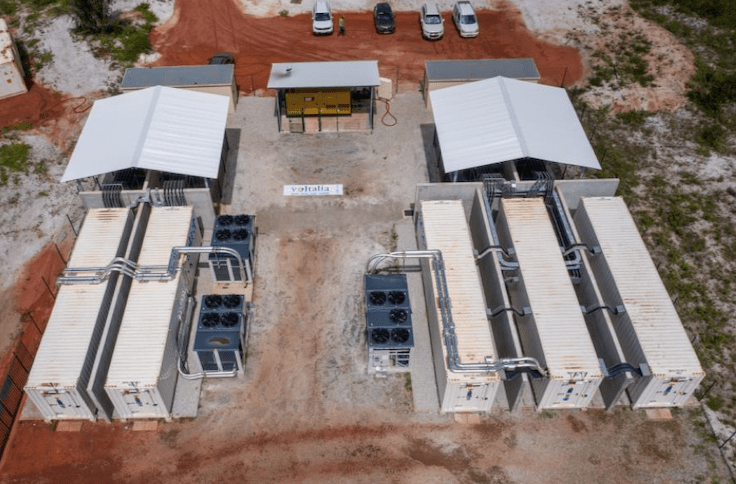
Proposed battery storage output and capacity for the Shurkul hybrid plant was revealed however in November 2022, when Voltalia first signed a co-development agreement with Uzbekistan’s Ministry of Energy and Ministry of Investment. The BESS portion would be 60MW/240MWh, and co-located with 200MW of solar PV, and 200MW of wind generation.
At that time, the project site hadn’t yet been selected, with the two development partners since doing so, while Shurkul is expected to be commissioned in 2026 or later. The “electricity cluster,” as Voltalia described it, would be the first of its kind in Central Asia.
Voltalia said last year that its market entry into Uzbekistan was prompted by the European Bank for Reconstruction and Development (EBRD), which is one of the developer’s shareholders, and the EBRD was present once again last week as the further agreements were signed.
The Sarimay project was one of three winning bids in the government tender, as reported by our colleagues at PV Tech, and Voltalia’s bid, at US$0,028/kWh was the lowest-priced of the three winners. One of the other two was UAE state-owned renewables company Masdar, which won with a bid to build a 250MW PV plant, with a 62MW BESS – expected to be the country’s first implementation of grid-scale batteries.
Incidentally, Masdar built on its relationship with the Uzbekistan government following the tender win, signing a joint development agreement (JDA) for more than 2GW of solar and wind, as well as 500MWh of battery storage. Fellow Middle East-headquartered developer ACWA Power, from Saudi Arabia, signed investment agreements for solar PV and battery storage with the Ministry of Investment, Industry and Trade earlier this year.
Uzbekistan is targeting 8GW of renewable energy capacity by 2026, and 12GW by 2030, with much of the motivation being to gain energy independence. The country is one of the world’s major natural gas producers and exporters. The fuel also comprises about 54% of its domestic electricity generation, and solar and wind deployment levels are “negligible” according to the International Energy Agency (IEA).
Meanwhile, Voltalia has built various types of renewable energy projects to date, company CEO said its experience with developing mixed technology renewables projects such as a hybrid wind and solar park in Brazil and solar-plus-storage in French Guiana was central to its selection by the Uzbek government. The company recently published its Q3 2023 financial results, which included a turnover of €126.2 million (US$133.3 million) for the three-month period.