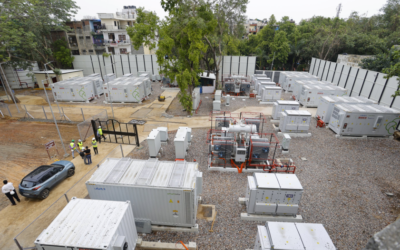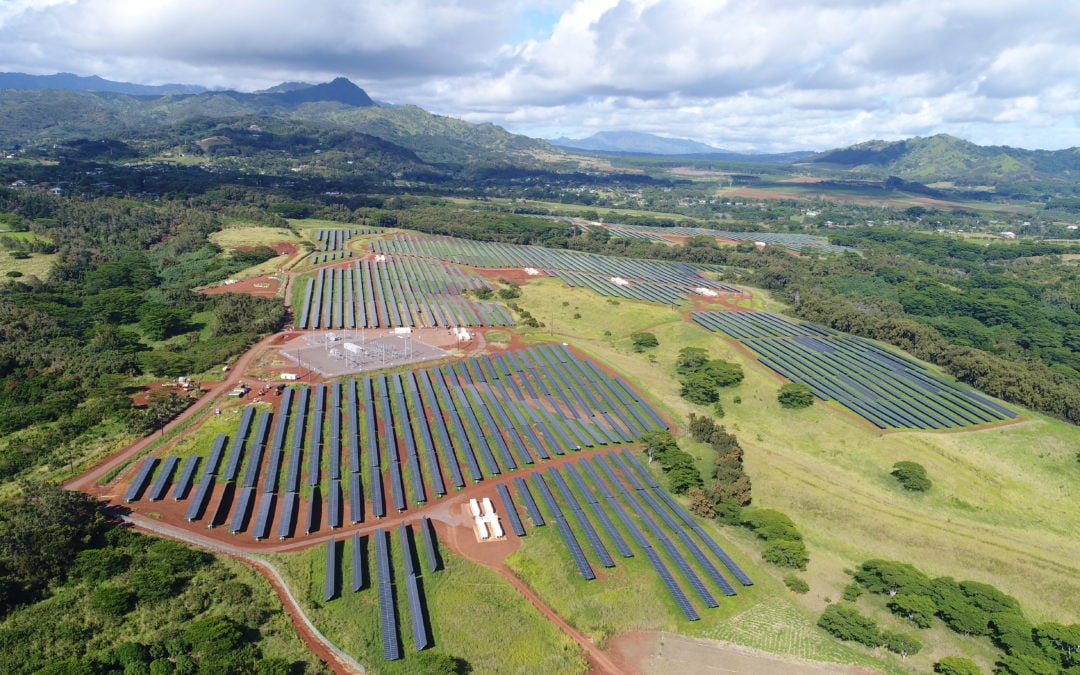
Plans to build five large-scale battery energy storage systems (BESS) across the islands of Hawaii will come up for public input via web links and community TV channels, as utility Hawaiian Electric (HECO) takes the process into the ‘virtual’ space.
A clear leader among US states for solar PV installations per capita, Hawaii has also been installing increasing amounts of energy storage in the form of batteries (and some other technologies including flywheels) in order to integrate that renewable capacity. This includes multiple megawatt-scale dispatchable solar plants, built to provide energy at much lower cost than from the imported fossil fuels on which the island state has long relied.
This time last year, six large-scale projects were approved by state regulator Hawaii Public Utilities Commission comprising 240MW of solar and 988MWh of four-hour duration battery storage that HECO said would will help to protect customers from the “volatile prices of fossil fuels”. The state also has the goal of reaching 100% renewables by 2045 as well as a 2030 interim target of 40%.
Subsequently, in August 2019, Energy-Storage.news reported main utility Hawaiian Electric’s plan to tender for 900MW of solar PV, along with grid services. The plan announced then was to select winning projects by May of this year, for them to be completed and online between 2022 and 2025. Under the request for proposal (RFP) issued by HECO, PV plants can range from 4MW to 119MW capacity.
Try Premium for just $1
- Full premium access for the first month at only $1
- Converts to an annual rate after 30 days unless cancelled
- Cancel anytime during the trial period
Premium Benefits
- Expert industry analysis and interviews
- Digital access to PV Tech Power journal
- Exclusive event discounts
Or get the full Premium subscription right away
Or continue reading this article for free
Hawaiian Electric proposed to “self-build” five energy storage projects that go along with that renewables procurement and has decided to push ahead with the necessary community meetings to seek public input on those proposals. The islands of Maui and Hawaii will see their community meetings hosted on a local tv channel, with HECO accepting emailed public input. Plans for Oahu will be hosted via Webex.
Utility representative Jack Shriver, who is HECO’s director of generation development, said that the potential projects “are under a compressed schedule for permitting and construction. We want to give our communities an early opportunity to provide their feedback on our self-build proposals”.
“We know the community is dealing with a lot right now because of the pandemic, and there is uncertainty on how long this will last. If we could postpone these meetings we would,” Shriver said.
Shriver also emphasised that the utility must abide by the terms of the RFP in the same way that any other competing developer would and that the HECO teams have no insider knowledge of what those other developers might be proposing.
HECO’s proposed ‘self-build’ battery storage projects
| Island | Output / Capacity | Location or nearest town |
|---|---|---|
| Maui | 40MW / 160MWh | Waena |
| Oahu | 135MW / 810MWh | Kahe Power Plant |
| Oahu | 65MW / 390MWh | Kalaeloa |
| Hawaii Island | 6MW / 6MWh | Puna |
| Hawaii Island | 12MW / 12MWh | Keahole Power Plant |
Public input will be sought until various dates during May. HECO has explained the benefits of BESS for Hawaii as including load-shifting load shifting, to store energy generated during low customer demand periods, into the islands’ grids during peak times and for use at night and early morning hours. The utility also highlights the suitability of batteries to provide contingency, i.e. balancing the grid through frequency response and other ancillary services, by matching supply to demand very quickly. The utility is allowed to build its own projects, defined to encompass design, construction and ownership, under state regulator Hawaii Public Utilities Commission-approved Competitive Bidding Framework rules.